Background:
We developed a Motivational Interviewing (MI) skills training program for lay counsellors (The Thusa Thuso program) to improve the quality of patient-centred HIV retention counselling in South Africa (SA). We report the effect of the Thusa Thuso intervention on HIV patient outcomes at 12 months after HIV diagnosis.
Methods:
We randomized eight primary healthcare clinics (PHC) in Johannesburg (SA) to either the intervention condition (n= 4 clinics) where all lay counsellors were supported for 12 months before the patient enrolment or the standard of care support (n=4 clinics). Recorded Motivational Interviewing Treatment Tntegrity (MITI) coding of training was used to determine counsellor MI technical skills level (Cultivating Change Talk (CCT), Softening Sustain Talk (SST), Empathy and Partnership towards clients. A total of 554 adult ( 18 years) patients were recruited immediately after HIV diagnosis from March 2020 to August 2021 (n=293 intervention, n=261 control). We conducted cluster-adjusted Poisson regression to assess the intervention effect on retention in care (being within 90 days after a scheduled appointment) and viral suppression (<50 copies/ml) at 12 months after HIV diagnosis, reporting risk ratios (RR) with 95% confidence intervals (CIs).
Results:
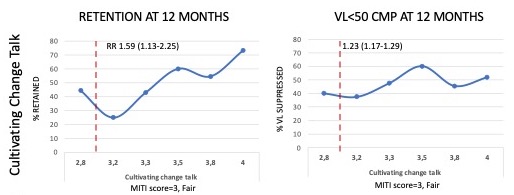
We observed modest retention rate improvement in patients supported by intervention clinic counsellors compared to control patients (RR 1.3, 95% CI: 0.9-2.0) and a marked increase in retention rates proportional to increasing MI skill levels (Fig 1.) (CCT, RR 1.6, 95%CI: 1.1-2.5; SST, RR 1.5, 95%CI: 0.8-2.9; Empathy, RR 1.4, 95%CI: 1.0-1.8); Partnership RR 1.5, 95%CI: 1.2-1.9). Viral suppression at 12 months also increased in the intervention group (RR 1.4, 95%CI: 1.1-1.8. Similarly, to the retention outcome, increasing counsellor MI skills resulted in higher patient VL suppression at 12 months (CCT, RR 1.2, 95%CI: 1.2-1.3; SST, RR 1.3, 95%CI: 0.8-2.2; Empathy, RR 1.1, 95%CI: 0.9-1.4; Partnership, RR 1.2, 95%CI: 1.1-1.3).
Conclusions:
Appropriately tailored MI training for lay counsellors, resulting in documented improvement in counsellor skills, can improve retention and VL suppression outcomes. While these preliminary data indicate potentially significant effects, statistical significance is limited by the pilot’s small cluster sample size and statistical power.