Background:
Antiretroviral regimens have differential effects on adverse birth outcomes. Nevirapine (NVP) has been associated with particularly high risk of adverse birth outcomes compared with newer ART like dolutegravir (DTG). We emulated a target trial of pre-conception switch from NVP to DTG to evaluate whether switch from high-risk to low-risk regimens prior to pregnancy can favorably impact outcomes.
Methods:
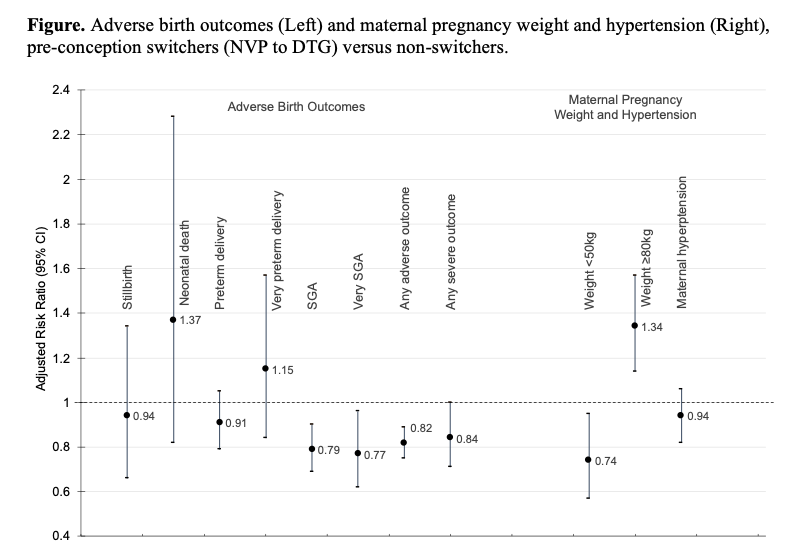
The Tsepamo Study has performed birth outcomes surveillance at government delivery sites in Botswana since 2014. Among individuals who initiated NVP from 2002-2014 and remained on NVP in 2016, we compared those who switched to DTG (usually for programmatic reasons, after DTG became first-line ART) with those who did not switch from NVP prior to pregnancy. We estimated adjusted risk ratios (RRs) and 95% CIs for stillbirth, in hospital neonatal death (<28 days), preterm delivery (<37 weeks), very preterm delivery (<32 weeks), small-for-gestational-age (SGA) (<10%tile), very SGA (<3%tile), and combined endpoints of any adverse or severe adverse outcome. We also evaluated low (<50kg) and high (≥80kg) early pregnancy weight (before 24 weeks) and hypertension in pregnancy (SBP≥140 or DBP≥90 mm/Hg).
Results:
Of 4,265 eligible individuals (median [IQR] age in pregnancy: 36 [32, 39] years), 1,102 (26%) switched from NVP to DTG and 3,163 (74%) did not switch from NVP prior to pregnancy. The most common backbones during pregnancy were TDF/3TC (90%) and TDF/FTC (8%) for switchers and ZDV/3TC (60%) and TDF/FTC (39%) for non-switchers. Comparing switchers with non-switchers, RRs (95% CIs) were 0.82 (0.75, 0.89) for any adverse and 0.84 (0.71, 1.00) for any severe adverse outcome. These differences were driven by SGA and very SGA (Figure, Left Panel). Switchers were less likely to have low and more likely to have high early pregnancy weight (Figure, Right Panel); the adjusted mean difference (95% CI) in early pregnancy weight was 2.9 (1.8, 4.1) kg. While switchers became pregnant in later years, sensitivity analyses indicated little evidence for time-trends in birth outcomes over the study period. Results were similar when excluding ZDV backbones.
Conclusions:
Switching from legacy NVP-based regimens to DTG/TDF/XTC prior to pregnancy may reduce the risk of low maternal weight in early pregnancy and fetal growth restriction. This study provides further evidence that specific regimens impact birth outcomes, and that switching from legacy regimens prior to conception can improve birth outcomes.