Background:
There is dearth of data on antibody responses to AIDS-associated talaromycosis and how they impact disease phenotype and patient outcomes. Data from our talaromycosis Itraconazole versus Amphotericin B for Penicilliosis (IVAP) trial (N=440) showed that patients presenting with an acute pulmonary syndrome had higher mortality. Here, we tested the hypothesis that acute pulmonary syndrome is associated with a serological pattern of acute infection, and an acute serological pattern is associated with severe disease and mortality.
Methods:
Longitudinal IgG antibody responses to talaromycosis were measured in available plasma samples of IVAP patients using a direct anti-Mp1p IgG enzyme immunoassay. Patients were classified into three IgG response types: Negative IgG, Increasing IgG, and Positive Unchanged IgG through analysis of the IgG trend over 24-weeks. Univariate and multivariate logistic regression were used to assess association of IgG type and disease severity (defined as a respiratory rate >22, dyspnea requiring oxygen, and/or respiratory failure diagnosis at presentation) and 24-week mortality.
Results:
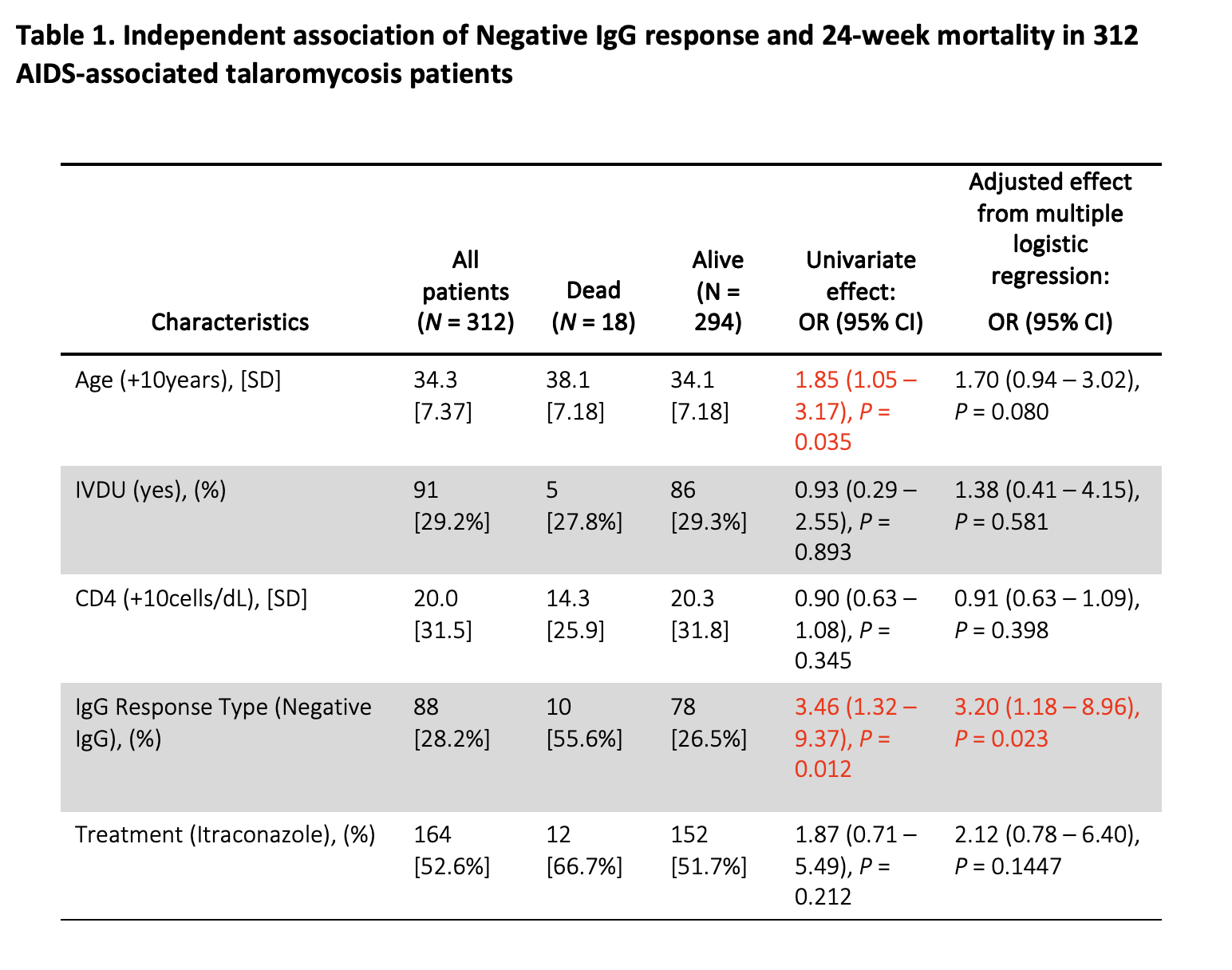
Plasma samples and complete data were available for 409 of 440 IVAP patients. Mean age was 34.7 years (SD:7.4). Mean CD4 count was 23.3cell/mm3 (SD:49.1). Serial samples for classification of IgG response into 3 types were available for 312 patients: 88 (28.2%) Negative IgG, 114 (36.5%) Increasing IgG, 110 (35.3%) Positive Unchanged IgG. In the multivariate models of the 312 sub-population (N=312) adjusting for age, history of injection drug use, CD4 count, and antifungal treatment arm, Negative IgG was associated with higher risk of death (OR=3.20,95% CI:1.18-8.96,P=0.023) while Increasing IgG was protective of death (OR=0.14,95% CI:0.02-0.56,P=0.013). In the multivariate models of the full population (N=409) where IgG type could only be classified as Negative or Positive at baseline, Negative IgG was associated with disease severity (OR=1.62,95% CI:1.02-2.55,P=0.039) and had a non-statistically significant association with mortality. Disease severity was an independent predictor of death (OR=2.44,95% CI:1.38 – 4.34,P=0.002).
Conclusions:
Although these results were unexpected, the findings that 28% of talaromycosis patients do not mount an IgG response, and these patients have more severe disease and higher mortality suggest a central role of humoral immune response in talaromycosis pathogenicity, which has so far been overlooked. These findings have important clinical implications.