Background:
Low-level viremia (LLV) is common in people with HIV (PWH) receiving antiretroviral therapy (ART) and has been associated with adverse outcomes including virologic failure (VF), drug resistance, and non-AIDS comorbidities (NACM). As differences in these outcomes have been observed in men versus women with HIV, we investigated the effect of LLV on these outcomes by sex.
Methods:
We included men enrolled in the Multicenter AIDS Cohort Study (MACS) and women in the Women’s Interagency HIV Study (WIHS) from 2003-2020 who reported ART use for ≥1 year with ≥2 consecutive HIV-1 viral loads (VL) <200 c/mL. PWH were then categorized using 4 consecutive VL results (baseline period) as: virologic suppression (VS; all VL below lower limit of assay detection), intermittent LLV (iLLV; non-consecutive detected VL <200 c/mL), persistent LLV (pLLV; ≥2 consecutive detected VL <200 c/mL), or VF (any VL ≥200 c/mL). Outcomes were assessed from after baseline period through 5 years. Those with baseline VF were excluded. At first visit after baseline period, PWH with multimorbidity (≥2 of 5 NACM: hypertension, dyslipidemia, diabetes, cardiovascular disease, kidney disease) were excluded from that analysis. Adjusted Cox proportional hazards models estimated the association of virologic category with time to incident a) VF and b) multimorbidity.
Results:
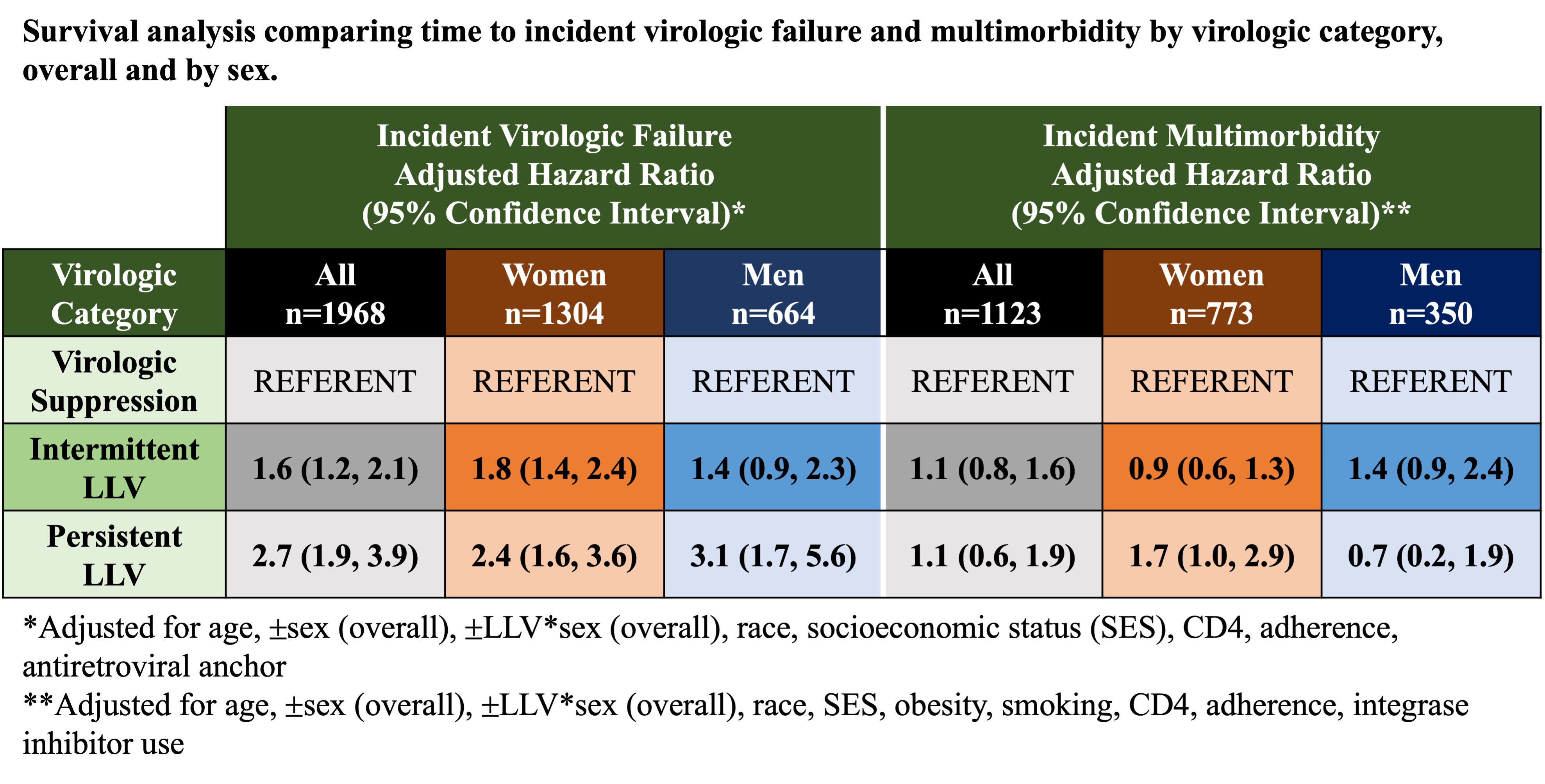
Of 2,395 PWH, 67% were women, median age was 48 years, 53% were Black, 20% were Hispanic, median CD4 count was 616 cells/µL, and 89% reported ≥95% ART adherence. Over the baseline period (median 1.5 years), VS, iLLV, and pLLV occurred in 61%, 18%, and 6%, respectively. Among 1968 and 1123 PWH included in each analysis, incident VF and multimorbidity occurred in 25% and 21%, respectively. Compared to PWH with VS, the adjusted hazard ratio (aHR) for incident VF in women was 1.8 (95% CI 1.4,2.4) for iLLV and 2.4 (1.5,3.6) for pLLV, while in men was 1.4 (0.9,2.3) for iLLV and 3.1 (1.7,5.6) for pLLV (LLV*sex interaction p=0.4). Compared to PWH with VS, the aHR for incident multimorbidity in women was 0.9 (0.6,1.3) for iLLV and 1.7 (1.0,2.9) for pLLV, while in men was 1.4 (0.9,2.4) for iLLV and 0.7 (0.2,1.9) for pLLV (LLV*sex interaction p=0.1) (Table).
Conclusions:
In a diverse cohort of US PWH, LLV was associated with an increased risk of developing VF, regardless of sex. There was a trend toward pLLV being associated with increased risk of multimorbidity in women but not in men. Further research is needed to mitigate the adverse consequences of LLV in men and women.