Background:
Elevated levels of inflammatory markers are linked to increased morbidity/mortality in people with HIV (PWH) and often remain elevated after suppression of HIV-1 replication below the limit of detection by antiretroviral therapy (ART). As new combinations of ART become available, an evaluation of their effects on biomarkers of inflammation are needed. Additionally, it remains unknown whether transient elevations of viral load (‘blips’) during ART are associated with increases in inflammatory biomarkers. This study analyzed the effect of ART on selected biomarkers of inflammation and immune activation.
Methods:
We utilized cryopreserved samples from treatment-naïve PWH enrolled in two Phase 3 clinical studies investigating the efficacy and safety of B/F/TAF, DTG/ABC/3TC and DTG+F/TAF over a 5-year window (GS-US-380-1489/1490). At wk144, participants were switched to open label B/F/TAF. We measured levels of interleukin-6 (IL-6), C-reactive protein (hsCRP), D-dimer, soluble CD14 (sCD14), and tumor necrosis factor-α receptor 1 (TNFR1) by ELISA from select baseline, wk 24, 48, 144, and 240 samples (B/F/TAF, N=123; DTG/ABC/3TC, N=62; DTG+F/TAF, N=58). Samples from PWH who experienced a viral blip (n=44, defined as single VL>50c/mL) were also analyzed and paired with the most recent suppressed sample. Longitudinal biomarker changes were assessed using a constrained mixed effects linear regression model adjusting for covariates.
Results:
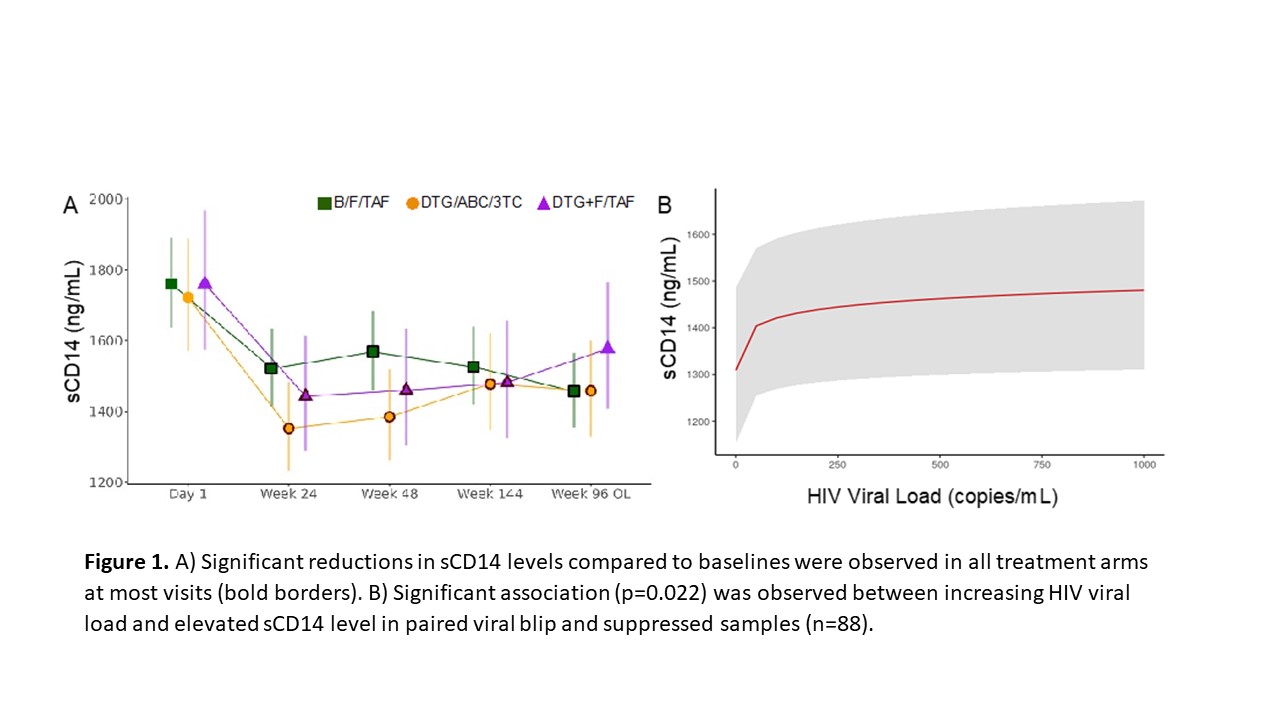
Baseline demographics and selected laboratory characteristics were similar across studies. Significant decreases in D-dimer, sCD14, and TNFR1 were observed in all treatment arms, with no significant differences between arms at any timepoint. Similarly, biomarker levels also remained stable following ART-switch at week 144. No significant changes in hsCRP or IL-6 were observed in any arm at any timepoint. In the analysis of viral blips, a significant association was observed between sCD14 and increasing viral load (p=0.022); a similar trend was seen with D-dimer
Conclusions:
Viral suppression was associated with significantly reduced inflammation in treatment-naïve PWH, with no significant differences in selected inflammatory biomarkers among the three ART regimens during the 144-week randomized period and each was sustained after the open label switch to B/F/TAF. Viral blips were associated with increases in some of the markers. The small number of available samples limited this study, thus the findings warrant additional investigation.