Background:
Broadly neutralizing antibodies (bNAbs) are being investigated as long-acting antiviral therapies, but sensitivity to bNAbs in persons with multidrug-resistant HIV is unknown. Here, we characterized sensitivity to teropavimab (GS-5423; 3BNC117-LS; TAB) and zinlirvimab (GS-2872; 10-1074-LS; ZAB) in people living with 4-class drug-resistant HIV (4DR-PWH).
Methods:
Multicenter, observational study using plasma or peripheral blood mononuclear cells collected from 50 4DR-PWH (25 with HIV-1 RNA > 1000 copies/mL matched by age, sex, nadir CD4+ and years on ART to 25 virologically suppressed [HIV-1 RNA < 50 copies/mL]) enrolled in the PRESTIGIO Registry (NCT04098315) with a documented 4DR (NRTI, NNRTI, PI and INSTI). Phenotypic sensitivity to bNAbs was determined using the PhenoSense Monoclonal Antibody assay (Monogram), with susceptibility defined as IC90 ≤2 µg/mL. Descriptive statistics are used to present results. Spearman's rank test used for associations between phenotypic susceptibility and clinical variables.
Results:
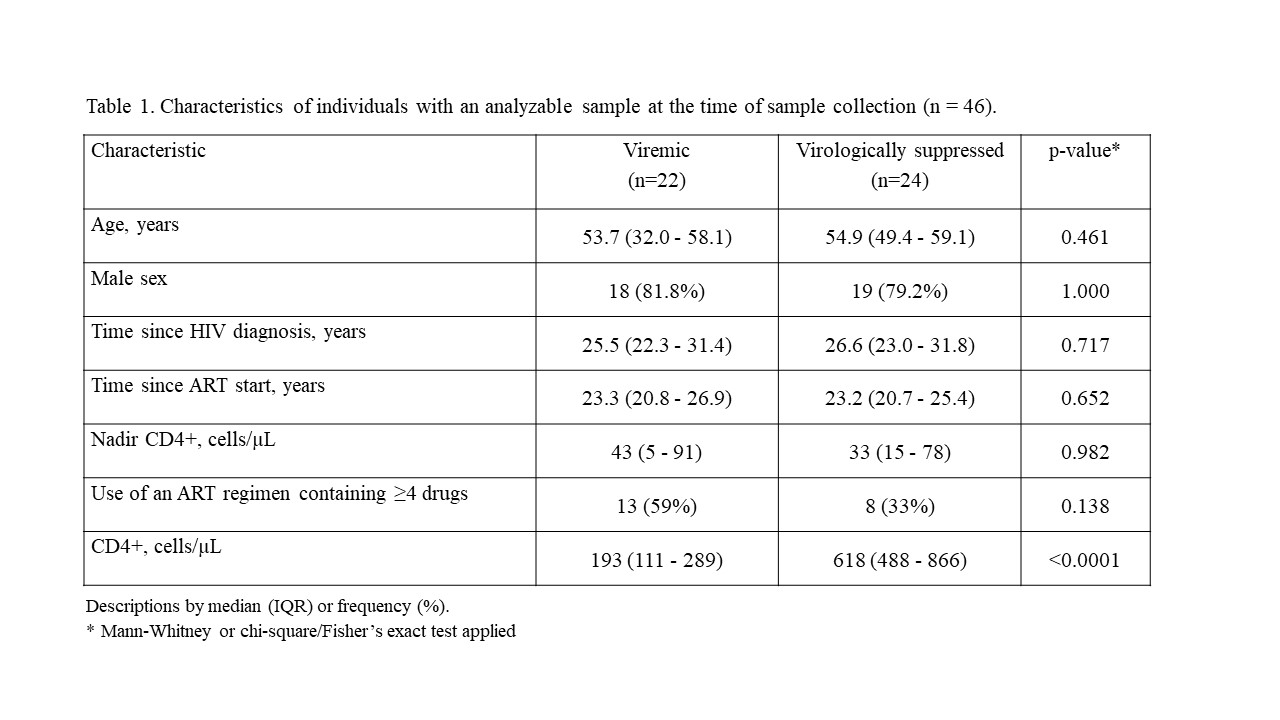
Characteristics of included individuals with analyzed samples were indicative of extensive treatment history (Table1). Of 46/50 (92%) participants with PhenoSense mAb assay results, 35 (76%) were phenotypically sensitive to TAB, 23 (50%) to ZAB, and 19 (41%) to both bNAbs; 7 (15%) had phenotypic resistance to both bNAbs. Of 22 viremic participants, 19 (86%) were phenotypically sensitive to TAB, 10 (45%) to ZAB, 9 (41%) to both bNAbs, and 2 (9%) to neither. Of 24 participants with virologic suppression, 67% were phenotypically sensitive to TAB, 54% to ZAB, 42% to both bNAbs, and 5 (21%) to neither. The proportion of participants with sensitivity to both bNAbs was similar (p=0.99) in viremic participants (9/22 [41%]) compared to those with virologic suppression (10/24 [42%]). Nonsignificant correlations between phenotypic sensitivity to bNAbs and age, years of ART, CD4+ cell count, HIV-RNA, type of ART regimen at the sample collection, viral tropism and HIV subtype. There were marginal correlations between phenotypic sensitivity to TAB and years since HIV diagnosis (Spearman r= 0.287, p=0.053) and phenotypic sensitivity to ZAB and CD8+cell count (Spearman r= -0.317, p=0.049).
Conclusions:
A significant number of the analyzed 4DR-PWH were found to have virus susceptible to TAB and ZAB. These data provide proof-of-concept that selected multidrug-resistant PWH may be candidates for future trials investigating bNAbs-containing regimens to achieve or maintain virologic suppression.