Background:
The life expectancy among people living with HIV approaches that of the general population but little is known about the expectations people living with HIV have regarding aging. Studies suggest that an individual’s perception of aging can have a significant impact on their personal health behaviors, healthcare utilization and quality of life. We set out to evaluate what expectations older adults living with HIV have regarding aging and whether expectations differ according to sociodemographic and clinical factors, hypothesizing that those living longer with HIV have lower expectations regarding aging.
Methods:
We performed a cross-sectional analysis of the Correlates of Healthy Aging in Geriatric HIV (CHANGE HIV) study, a Canadian cohort of people living with HIV age 65 and older. Participants completed the Expectations Regarding Aging Survey (ERA-12) at cohort entry; subscale (physical health, mental health and cognitive function) and total scores were calculated on a scale of 0-100 with lower scores indicating lower expectations regarding aging. Multivariable linear regression was used to estimate the association between ERA-12 score, duration of HIV infection, and sociodemographic and clinical factors selected a priori (age, gender, race, depression, social support).
Results:
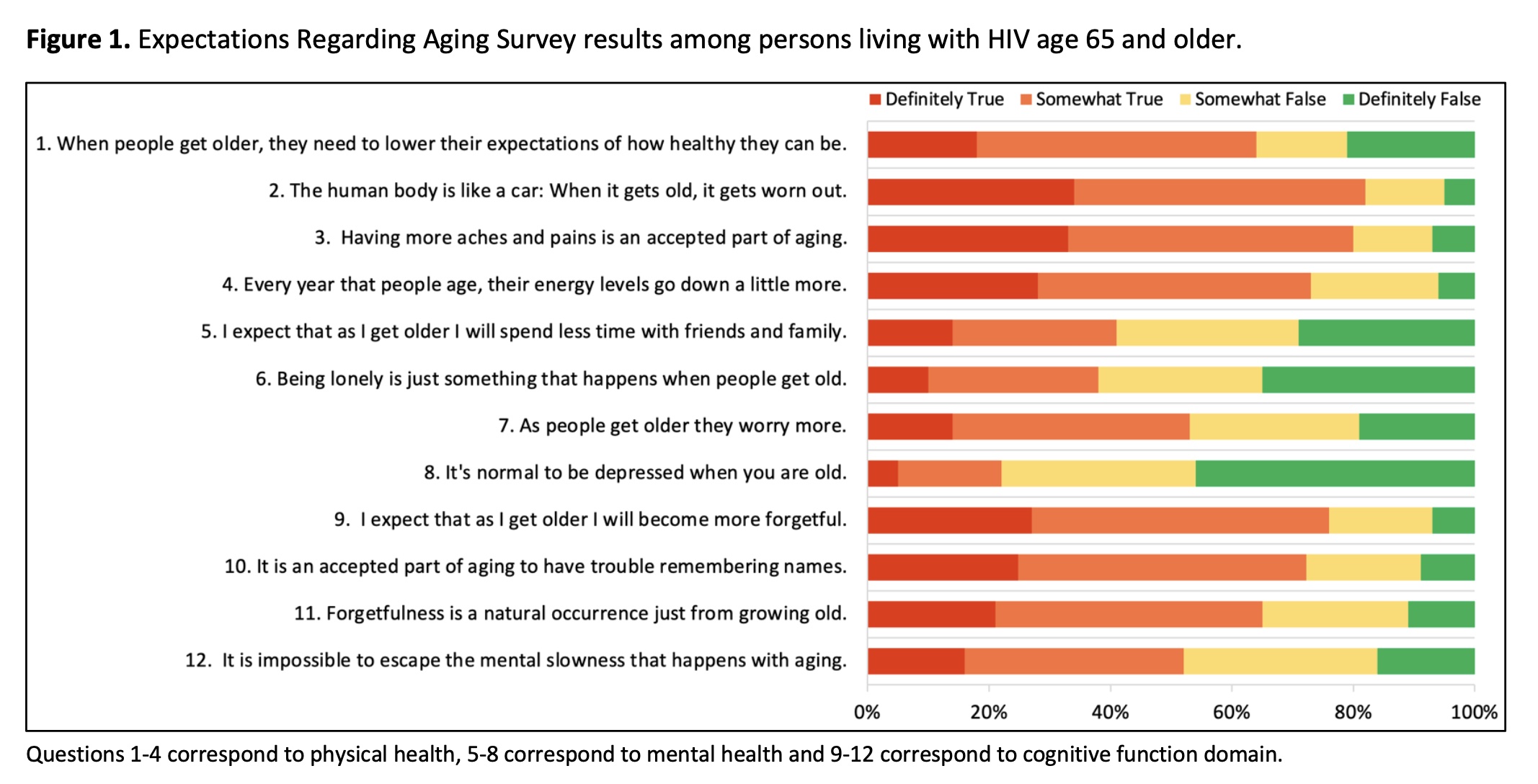
320 participants were included in the analysis, of whom 91% identified as men and 78% as white, with a median (interquartile range [IQR]) age of 69 [67,73]. The median [IQR] ERA-12 score was 47 [33,58]. Expectations regarding mental health (median [IQR] score 58 [42, 83]) were higher than those for physical health (median [IQR] score 33 [17,50]) and cognitive function (median [IQR] score 42 [25,58]). In multivariable analysis, ERA-12 scores did not differ according to age, race, or duration of HIV infection. After accounting for other factors, women (β -9.87, 95% CI -18.39, -1.38, p 0.023), persons experiencing depression (β -15.96, 95% CI -22.34, -9.59, p <0.001) and those with greater degree of social isolation (β -0.05, 95% CI -0.22, -0.04, p 0.007) had lower expectations regarding aging.
Conclusions:
Older adults living with HIV seem to have have low expectations regarding their physical health and cognitive function, regardless of how long they’ve been living with HIV. Gender-specific differences in expectations persist after taking into account demographic factors, depression and lack of social supports. This reinforces the need to address physical and cognitive health concerns among persons aging with HIV.