Background:
PrEP and HIV stigma are common and potential barriers for PrEP use. We used multiple approaches to measure stigma among young women accessing PrEP in a trial of a novel, peer-supported, community-based delivery system.
Methods:
In Kisumu, Kenya, 18-24-year-old women were recruited at PrEP initiation (July 2021-March 2022) and followed for 6 months. Participants received peer-supported, community-based delivery of PrEP and other sexual health services vs standard-of-care clinic-based services. We measured PrEP stigma at 0 and 6 months using a 13-item Likert response scale (range 1-5) and a 10-item semantic differential scale (the HIV PrEP Stigma Scale). We similarly measured HIV stigma with a 4-item modified Berger scale (range 1-4). Baseline socio-behavioral and demographic factors were assessed for association with each stigma type by multivariable linear regression analysis. PrEP use was determined at 6 months with dried blood spots.
Results:
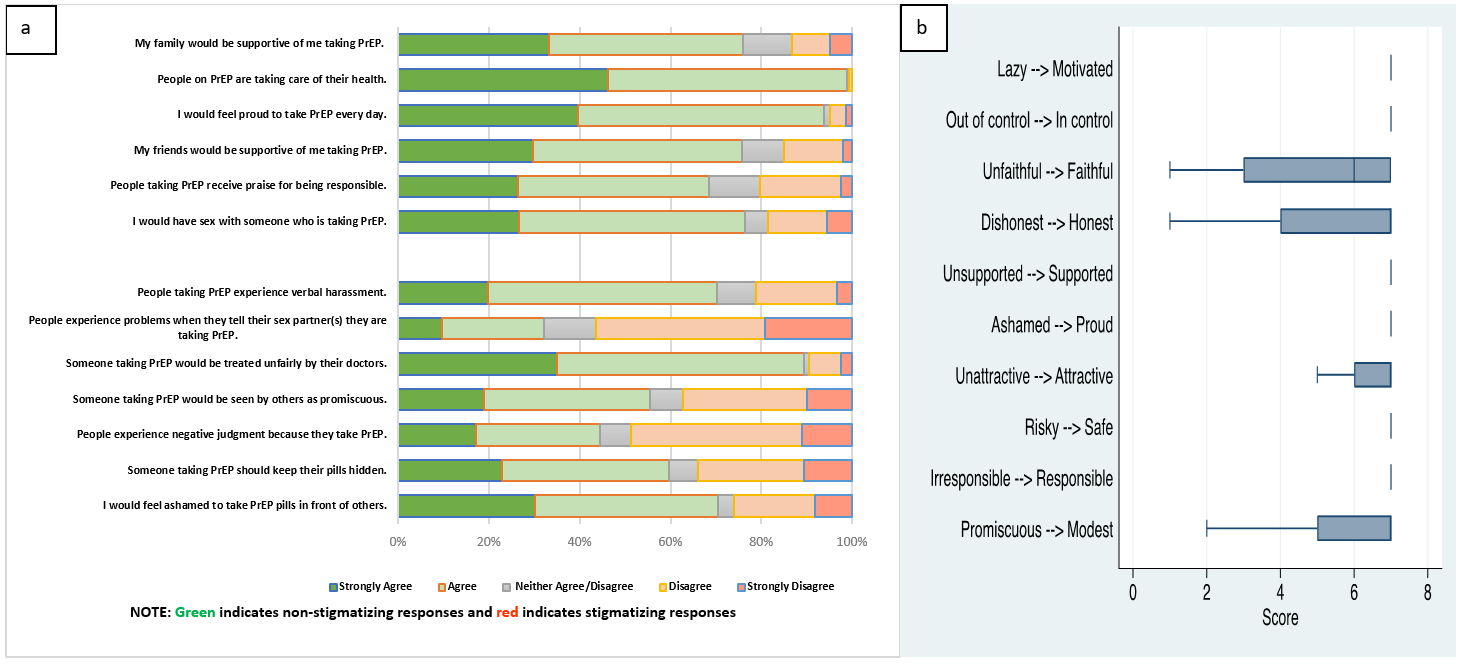
Of 150 women, 75 received the intervention and 75 received standard-of-care. Mean baseline HIV stigma was 2.8 (SD 0.6) and mean PrEP stigma was 3.5 (SD 0.5); neither differed by trial arms. Mean HIV stigma increased to 3.2 (SD 0.8) at Month 6 (p<0.001) and mean PrEP stigma increased from 3.5 (SD 0.5) to 3.8 (SD 0.6) (p<0.001). Using the Likert scale, most reported strongly agreeing/agreeing to positive feelings about PrEP use (taking care of their health, receiving support/praise, having sex with someone taking PrEP). To a lesser extent, most also strongly agreed/agreed with negative feelings (experiencing harassment, being treated unfairly/judged, feeling ashamed). On the semantic differential scale, almost all reported 'People on PrEP are…' motivated, in control, supported, proud, safe, and responsible. Views on faithfulness, honesty/trust, attractiveness, and modesty/promiscuity varied. Education was associated with less HIV and PrEP stigma (-0.05 and -0.04 points/year, respectively; p=0.04). History of STI was associated with PrEP stigma (0.5, p=0.003). PrEP use at 6 months was modest (16/123, 13%) in women with ongoing HIV prevention needs and not associated with either stigma type.
Conclusions:
PrEP and HIV stigma are moderately high among young women accessing PrEP in Kenya and multidimensional. Stigma was not improved by peer-supported, community-based PrEP delivery. As we work to scale up PrEP, more research is needed to understand and address stigma as a barrier to PrEP use.