Background:
Managing COVID-19 in jails/prisons is challenging due to high density of contacts. The state of Georgia has limited COVID vaccine uptake plus high incarceration. Using a network-based SARS-CoV-2 transmission model parameterized with data from Atlanta GA’s Fulton County Jail (FCJ, population 3000, rated capacity 2600), this study investigates the impact of three SARS-CoV-2 prevention strategies: vaccination, contact tracing and quarantining, and release of residents to decrease population to the jail’s capacity.
Methods:
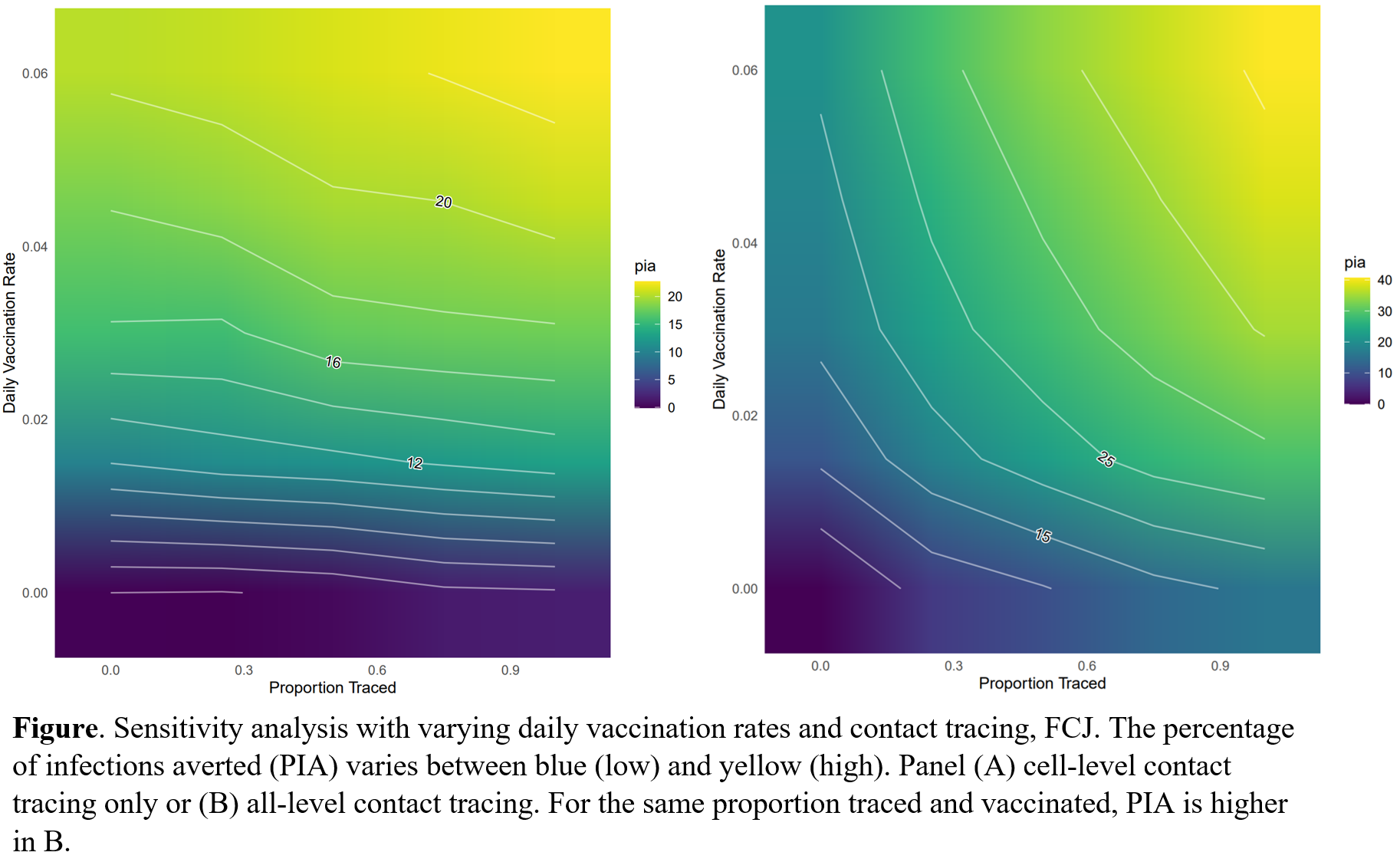
Contact networks were simulated at 2 different overlapping network layers: cell and housing block. Cell-level contacts represented shared confined sleeping space, whereas block-level contacts represented shared common space. Contact tracing and quarantining were simulated at the cell-level, or both the cell- and block-levels. A reference scenario and 9 intervention scenarios using different combinations of the 3 prevention strategies – vaccination, contact tracing/quarantining, and resident release – were simulated to estimate median and interquartile range (IQR) of the outcome measures. Each scenario was simulated 300 times with each simulation measuring the prolonged effects of the interventions amid a potential COVID outbreak in the jail over a 185-day period. The cumulative incidence, number of infections averted (NIA), and percentage of infections averted (PIA) were calculated for all scenarios. For the 7 scenarios involving contact tracing and quarantining, total quarantines and the number of quarantines/day were calculated to determine the quarantine requirements. Also, a sensitivity analysis was conducted to compare the interaction between vaccination and contact tracing rates.
Results:
Our model demonstrated cell-level contact tracing was relatively ineffective by itself (3.2% PIA), but its effectiveness increased when combined with other interventions (i.e., vaccination or jail release). Each of the other intervention strategies produced a PIA > 10% independently, with the 13% jail release scenario producing a PIA of nearly 20%. The all-level contact tracing only scenario was effective at both 50% and 100% of contacts traced, but feasibility is limited without a reduction in the jail population.
Conclusions:
Implementing combined interventions could substantially reduce the morbidity and mortality from COVID-19 and future airborne pathogens in a jail setting while providing secondary protection to the community.