Background:
Pediatric WHO dosing guidance recommends using dosing weight bands, but these are not standardized across therapeutic areas. This adds to the complexity of drug prescribing and administration when treating individual children for multiple diseases and comorbidities, increasing the risk of dosing errors. Harmonized weight bands across therapeutic areas are expected to simplify dosing, relieve the burden on practitioners and caregivers, reduce dosing errors, and provide clear dosing guidance for future pediatric drug development programs. However, this cannot come at the expense of drug efficacy or safety. We investigated the impact of harmonizing weight bands for HIV, tuberculosis (TB), malaria, and Hepatitis C (HCV) treatment, based on simulated drug exposures, with the goal of providing evidence for future harmonization of pediatric weight bands.
Methods:
Weight bands recommended in the Pocket Book for Hospital Care in Children, WHO Antibiotic Book, and guidance documents for HIV, TB, malaria, and HCV were selected to assess the potential for harmonization. Using available population pharmacokinetic models for individual drugs, the impact of harmonizing weight bands on drug exposures were simulated and the corresponding changes discussed with panels of clinical and pharmacological experts.
Results:
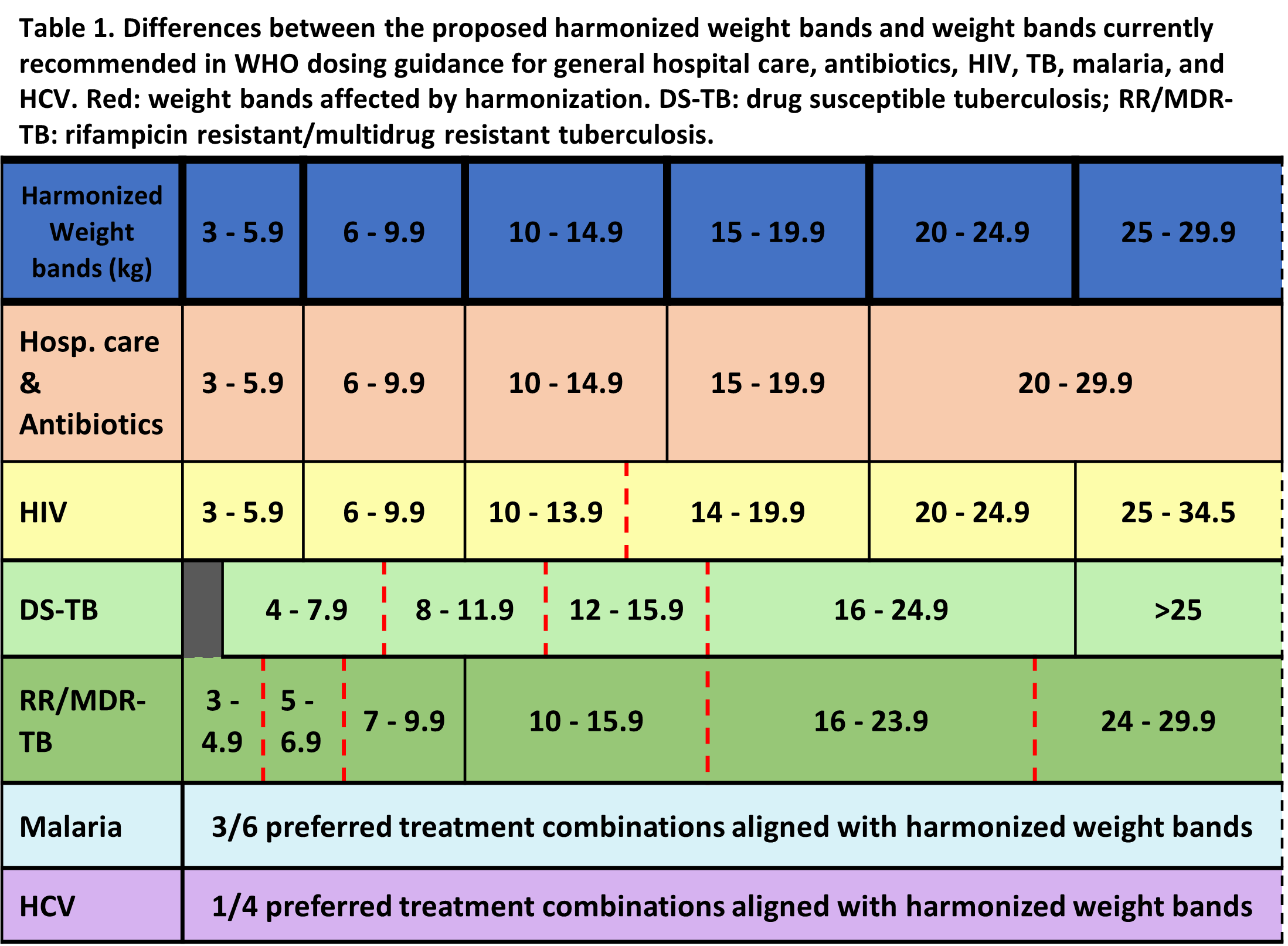
The proposed weight bands align with those recommended in the WHO antibiotic book and the pocket book, Table 1. For drugs used in HIV, HCV, and for treatment and prevention of drug-susceptible TB, harmonization had minimal impact on drug exposures and are not expected to affect drug efficacy or safety. For children weighing <10 kg treated for drug-resistant TB, harmonization had a pronounced impact; nevertheless, safe, and effective exposures are expected after optimizing drug doses based on age to account for maturation of elimination pathways. Safe and effective exposures are expected with harmonized dosing for 7/9 priority malaria drugs and for all 3 drugs currently used for seasonal malaria chemoprevention.
Conclusions:
This work demonstrates that harmonized pediatric weight bands, with additional age-based dosing for infants, provides sufficient flexibility for safe and effective pediatric dosing for treatment of HIV, HCV, TB, and seasonal malaria chemoprevention. For malaria treatment, additional safety, and efficacy studies are recommended due to expected exposures in 2/9 priority drugs. This analysis is expected to inform future revision of WHO guidelines.