Background:
The perinatal and post-partum (PP) period is a window to future metabolic health, including type 2 diabetes (T2D). Between the 1st and 3rd trimester (T3), the gut microbiota (GM) is altered and associated with increased inflammation and reduced insulin sensitivity (IS) at T3. Similarly, among persons with HIV (PWH), there is emerging evidence for GM alterations, including reduced microbial diversity and altered functional features. Approximately 30% of pregnant South African (SA) women are PWH. We hypothesized that the composition of the GM differed by HIV status and PP period among SA women.
Methods:
We performed a cross-sectional analysis of GM composition, using 16S rRNA amplicon sequencing, on early morning stool samples collected from 65 PP women originally enrolled in the Cardiometabolic Health in Pregnancy study (2019-2022). Body composition was measured using dual x-ray absorptiometry and IS measured using an oral glucose tolerance test to derive the Matsuda Index.
Results:
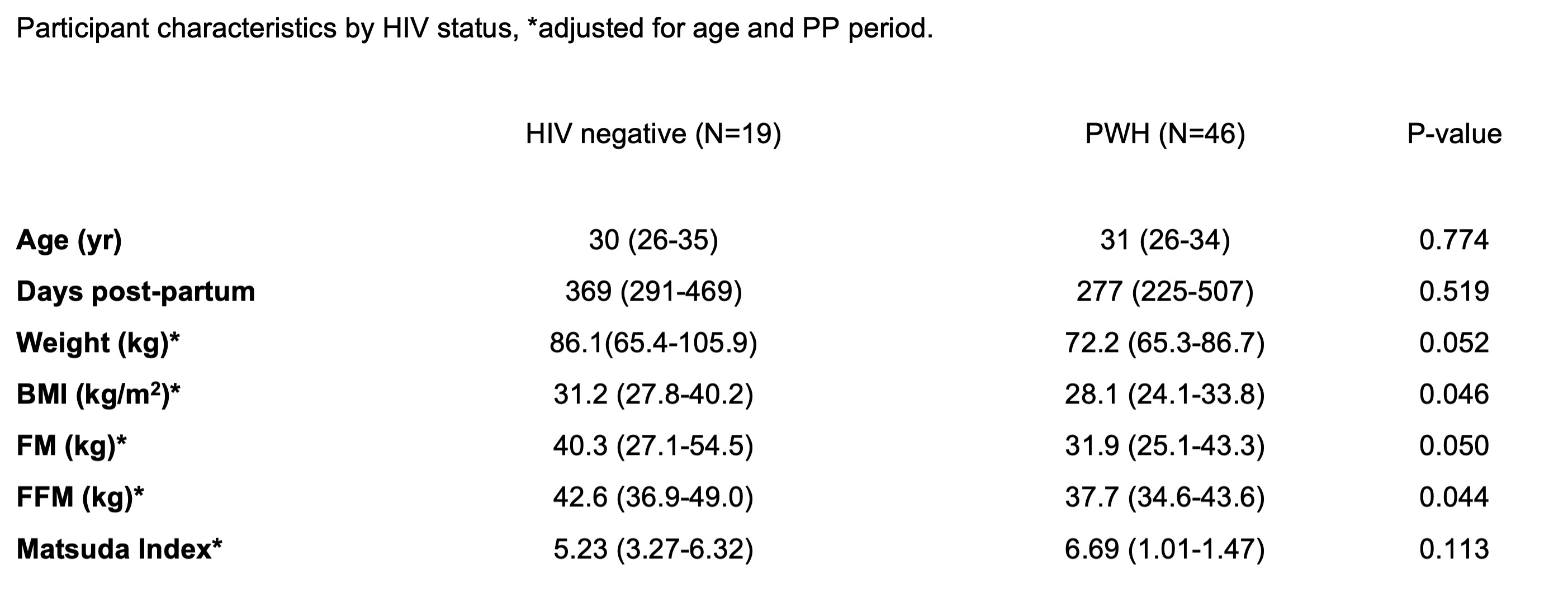
Of 65 PP women, 46 were PWH, with no differences in the length of the PP period by HIV status. PWH had lower BMIs (28.1 [24.1-33.8] vs. 31.2 [27.8-40.2] kg/m2, p=0.046), and fat (31.9 [25.1-43.3] vs. 40.3 [27.1-54.5] kg) and fat free mass (37.7 (34.6-43.6) vs. 42.6 [36.9-49.0] kg), but similar fasted glucose, insulin, and Matsuda Index. After demultiplexing, 2,162,496 sequence reads were obtained from the stool samples, with a median of 32,990 sequence reads. Overall, 1,569 amplicon sequence variants (ASVs) including 19 phyla and 370 genera were identified, with the most abundant phyla across all the two groups being Firmicutes, Bacteroidetes, Firmicutes C and D and Proteobacteria. At the genus level, most ASVs belonged to Prevotella, Faecalibacterium, Agathobacter_164117, Dialister and Blautia_A_141781. Thirteen microbial taxa differential abundance differed by HIV status, with 11 being over-represented in PWH, including Fusobacterium, Bilophila, Sneathia and Clostridium. These genera have previously been associated with persistent immune dysfunction. The PP period also differed by microbial taxa, whereby those >12 months had a greater proportion of Ellagibacter, associated with anti-inflammatory activity, irrespective of HIV status.
Conclusions:
We confirm that the GM differs by HIV status and the length of PP period. Future research should explore the persistent effects of the PP period and HIV status on the composition of the gut microbiota, given the syndemic of HIV and T2D in SA.