Background:
Kidney function estimation equations were revised in 2021 to exclude race, refuting earlier assumptions that creatinine (Cr), a by-product of muscle metabolism, consistently differs by race. Cystatin C (CysC) is a biomarker produced by nucleated cells and can be used in conjunction with creatinine to estimate kidney function. We sought to understand the effects of different estimating equations and biomarkers on Chronic Kidney Disease (CKD) stage estimates among persons with HIV (PWH), for whom CKD is an important comorbidity.
Methods:
CysC and Cr was measured in this cross-sectional single site U.S. clinic-based study from 2014-2016. The 2009 CKD-EPI-Cr and 2012 CKD-EPI-Cr-CysC (which include race), and 2021 CKD-EPI-Cr and 2021 CKD-EPI-Cr-CysC (which exclude race) estimating equations were applied to categorize CKD stage, and agreement was assessed using differences of proportions. Regression analyses evaluated factors associated with CKD stage, and the Breslow-Day test evaluated whether race served as an effect modifier.
Results:
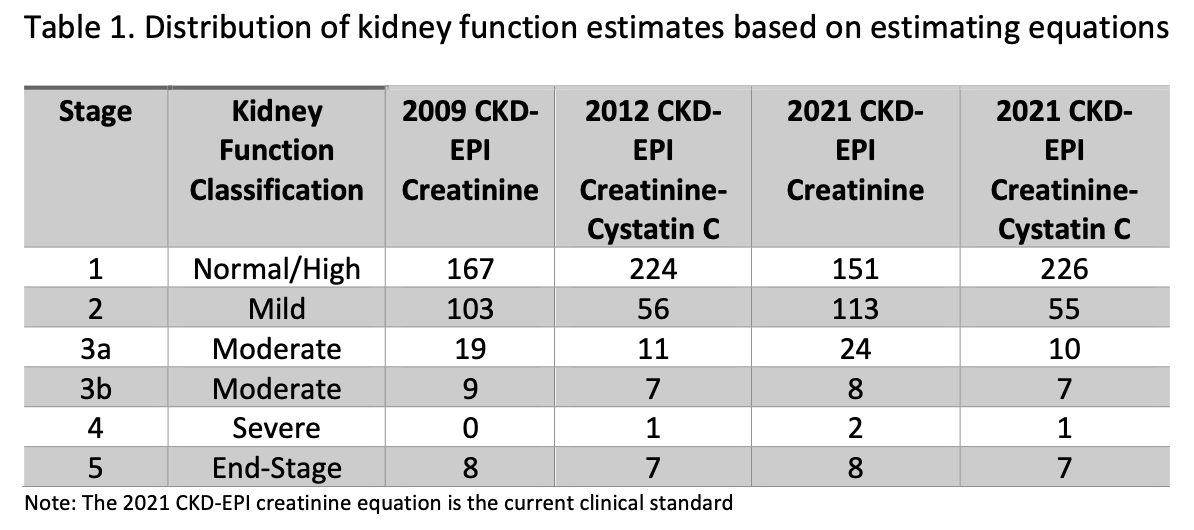
Among 306 PWH, the median age was 48.2 years, 86 (28.1%) were female,185 (60.5%) were Black,91 (29.7%) Caucasian,13 (4.3%) Latinx, and 46 (15%) had HCV co-infection. The median CD4+ count was 659/mm3, 97.7% were on ART, and 74.5% had HIV VL < 20 c/mL. Using the 2009 and 2012 equations (including race), more individuals were categorized as having normal kidney function (Stage I) with inclusion of CysC than Cr alone (73.2% vs 54.6%, p<0.00001); fewer individuals were classified in CKD stages III-V using CysC than Cr alone, but this did not meet statistical significance (8.2% vs 11.8%, p=0.14). Using 2021 equations (excluding race) a larger proportion were classified as normal kidney function with inclusion of CysC than Cr alone (73.8% vs 49.3%, p=0. 0.00001); fewer were categorized as CKD III-V with inclusion of CysC than Cr alone (8.1% vs 13.1%, p=0.026). Multivariate linear regression identified age, the interaction between tobacco use and absolute CD4+ count, and the interaction between HCV co-infection and nadir CD4+ count as factors associated with kidney function. Race was not an effect modifier based on our analyses.
Conclusions:
Among PWH, CysC shifted estimates of kidney function towards normal and resulted in shifts in kidney function categorization much more so than the small race effect. As some antiretrovirals raise creatinine without affecting renal function, CysC remains an important but under-utilized biomarker to confirm diminished kidney function