Background:
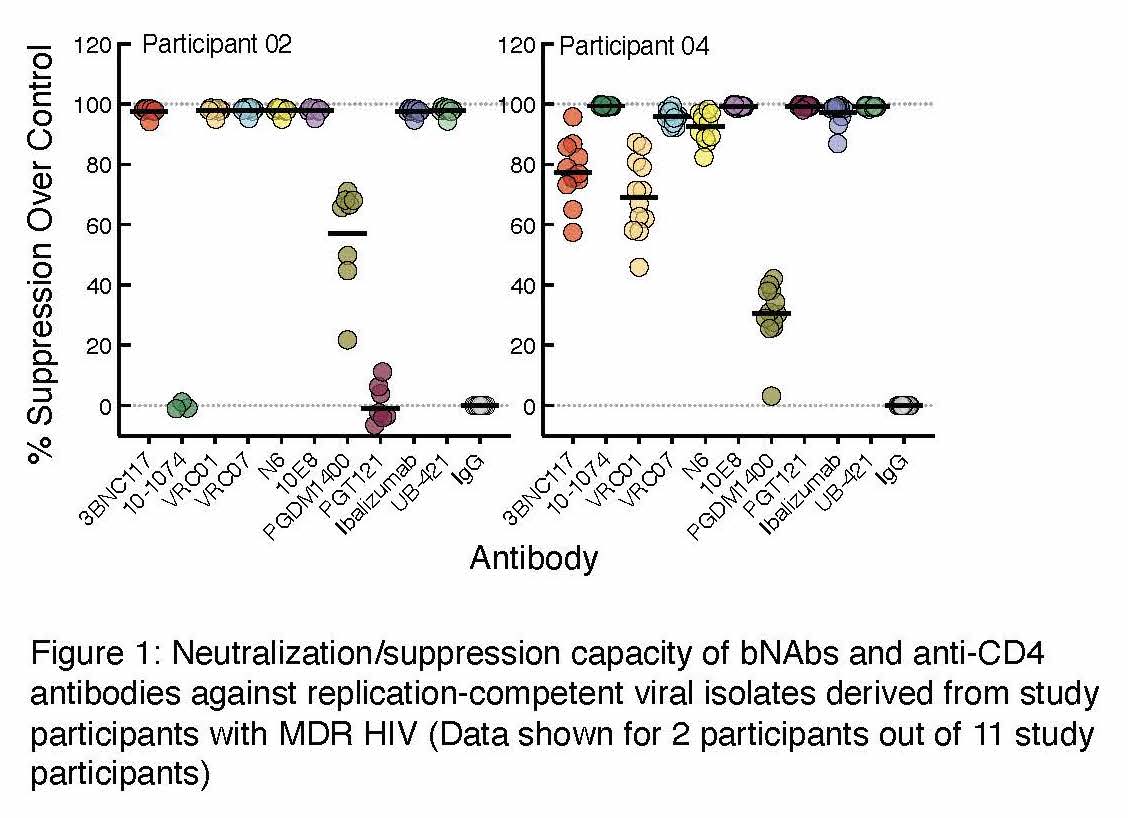
People living with HIV (PLWH) who harbor multidrug-resistant (MDR) viruses have limited therapeutic options and present extensive challenges in clinical management. We examined the capacity of HIV-specific broadly neutralizing antibodies (bNAbs) and anti-CD4 antibodies to suppress infectious viral isolates derived from PLWH with MDR viruses.
Methods:
We conducted immunologic and virologic analyses on 11 PLWH with MDR viruses. We measured the intact HIV proviral DNA burden and examined levels of immune activation and exhaustion markers by flow cytometry. For comparison, we included a control group of 27 ART-naïve viremic PLWH. We determined the sensitivity of infectious viral isolates obtained from the participants against 8 bNAbs (3BNC117, 10-1074, VRC01, VRC07, N6, 10E8, PGDM1400, and PGT121) and 2 anti-CD4 antibodies (ibalizumab and anti-domain 1 CD4 antibody UB-421) using a TZM-bl-based neutralization/suppression assay.
Results:
There was no significant difference in plasma viremia between the study participants with MDR HIV and the control group (P=0.2929). However, the CD4+ T cell counts of the MDR HIV group were significantly lower than those of the control group (P<0.0001). The level of intact HIV proviral DNA was comparable between the two groups (P=0.5895). Levels of activation and exhaustion markers PD-1 (P=0.0019), TIGIT (P=0.0222), 2B4 (P=0.0015), CD160 (P=0.0015), and CD38+/HLA-DR+ (P=0.0138) were significantly lower in the CD8+ T cells of the MDR HIV group. The infectious viral isolates from each study participant with MDR HIV were resistant (IC80 >10µg/ml or % suppression <80.7%) to at least 2 bNAbs (average 4 bNAbs per participant); however, they were sensitive to at least one of the CD4-binding and non-CD4-binding site antibodies. The majority of study participants had ibalizumab-sensitive viruses although the isolates from some participants showed reduced sensitivity to the antibody. Notably, none of the 93 infectious viral isolates obtained from the study participants were resistant to UB-421.
Conclusions:
The data from our study has direct clinical implications. Our data suggest that the therapeutic options for heavily treatment-experienced PLWH with MDR viruses could be potentially expanded to include HIV-specific bNAbs and UB-421, an avenue that has not been explored until now.