Background:
We present baseline data from ‘Improving RETention and viral load outcomes for people taking Antiretroviral therapy through early IdentificatioN of missed doses (RETAIN)’, a cohort study exploring detailed adherence metrics [viral load (VL), electronic adherence monitoring (EAM); tenofovir diphosphate (TFV-DP) concentrations and self-report (SR)] in people on ART, when initially flagged for reduced adherence.
Methods:
ART-naïve people from three Cape Town ART clinics had adherence monitored by missed doses (EAM), missed clinic visits or by raised VL. At the time of first flagging by any measure, participants received an adherence support call, and were invited for blood draw for HIV-1 VL and TFV-DP (indicating dosing over 4-8 weeks); urine collected for tenofovir rapid assay (indicating dosing over 3-5 days). SR adherence and EAM data were collected for the prior 30 days. Initial adherence data at the time of first non-adherence are presented here.
Results:
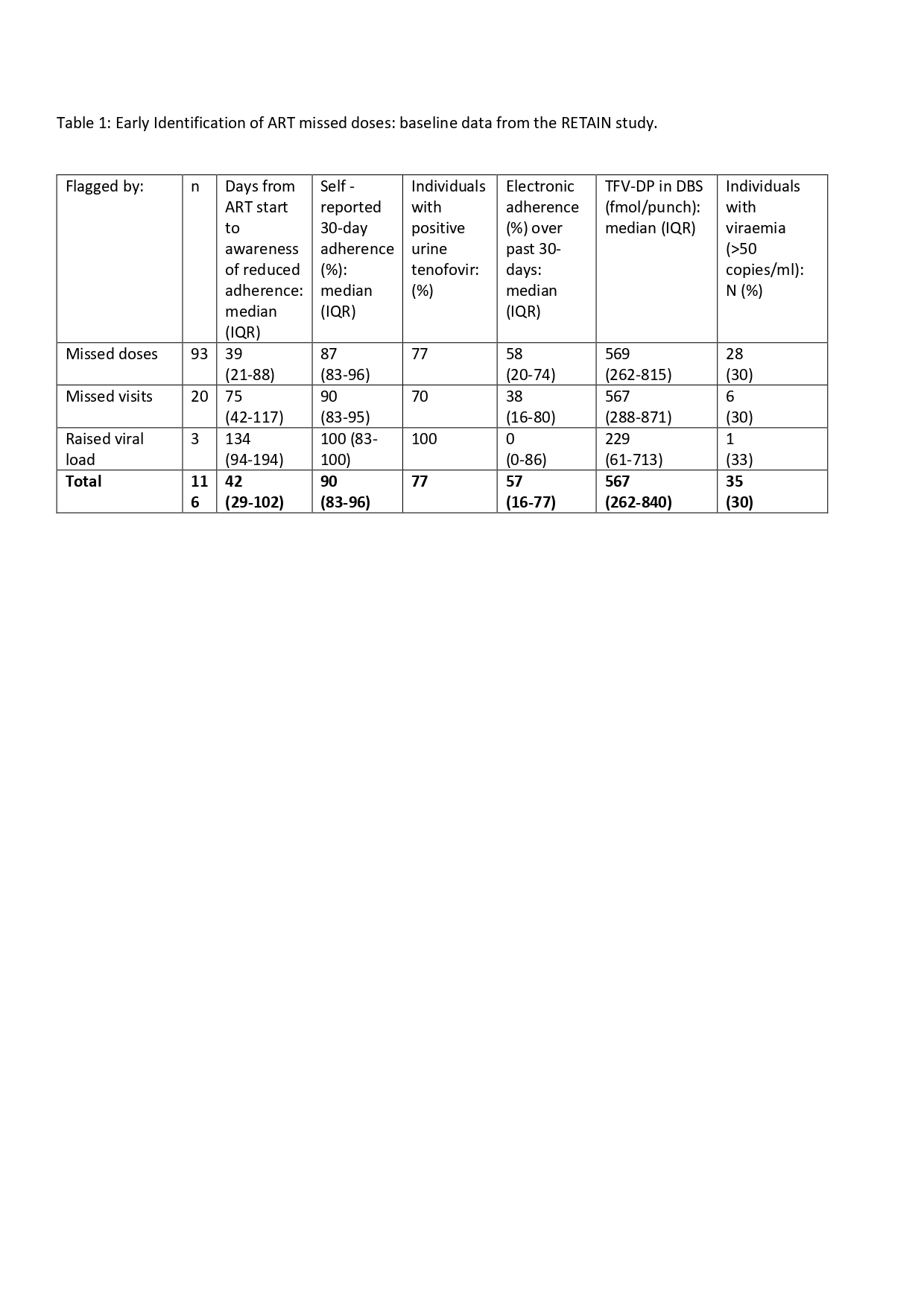
Between July22 and August23, 116 of 427 (27%) people were flagged for poor ART adherence; 93(80%) by missed doses, 20(17%) by missed visits and 3(3%) by raised viral load. 87 (75%) were women, with mean (±SD) age of 28 (±8) years. Median (IQR) self-reported adherence was 90% (83-97) doses taken in past 30 days; EAM showed reduced adherence across all groups 57% (16-77) doses taken over past 30 days; with suboptimal median (IQR) TFV-DP concentrations: 567 (263-864) fmol/punch (normal range >800fmol/punch)]. 89(76.7%) had tenofovir in their urine. 35 (30%) of all individuals had VL>50 copies/ml. The median VL was suppressed in all groups by the time of the blood draw. Missed doses and missed visit were flagged sooner: median (IQR) 39 (21-88) and 75(42-117) days than raised viral load: 134(94-194) days. Non-parametric analysis showed no significant associations between flagging method and TFV-DP concentrations, EAM or VL at this early stage of the study.
Conclusions:
All those flagged for reduced adherence had poor adherence confirmed by objective measures, EAM and TFV-DP concentrations, despite self-reporting near perfect dosing. Positive urine tenofovir reflects reasonable dosing near to the study visit (white-coat dosing). A third of the cohort were viraemic. Poor adherence was noted most rapidly by detection of missed doses and missed visits; allowing time for adherence support before breakthrough viraemia occurs.