Background:
Tenofovir diphosphate (TFV-DP) concentrations in dried blood spots (DBS) in people with HIV (PWH) receiving tenofovir alafenamide (TAF)-based antiretroviral therapy (ART) are not defined. QUANTI-TAF (NCT04065347) aimed to establish adherence:concentration benchmarks in PWH receiving TAF-based ART by quantifying TFV-DP concentrations in DBS, leveraging digital pills to organically capture directly observed therapy (DOT) adherence in a real-world clinical cohort.
Methods:
PWH receiving TAF-based ART for ≥6 months were prospectively enrolled in a 16-week pharmacokinetic study. Digital pills captured DOT adherence by co-encapsulation of each TAF-based ART dose with an ingestible biosensor powered by gastric fluid. Blood for TFV-DP concentrations in DBS (fmol/2x7mm punches) was collected at each visit and quantified using a validated LC-MS/MS method. TFV-DP steady-state concentrations (Css) in DBS were assessed at weeks ≥12 overall, by DOT adherence, booster status, and HIV viral load (VL; all weeks), reported as median (IQR).
Results:
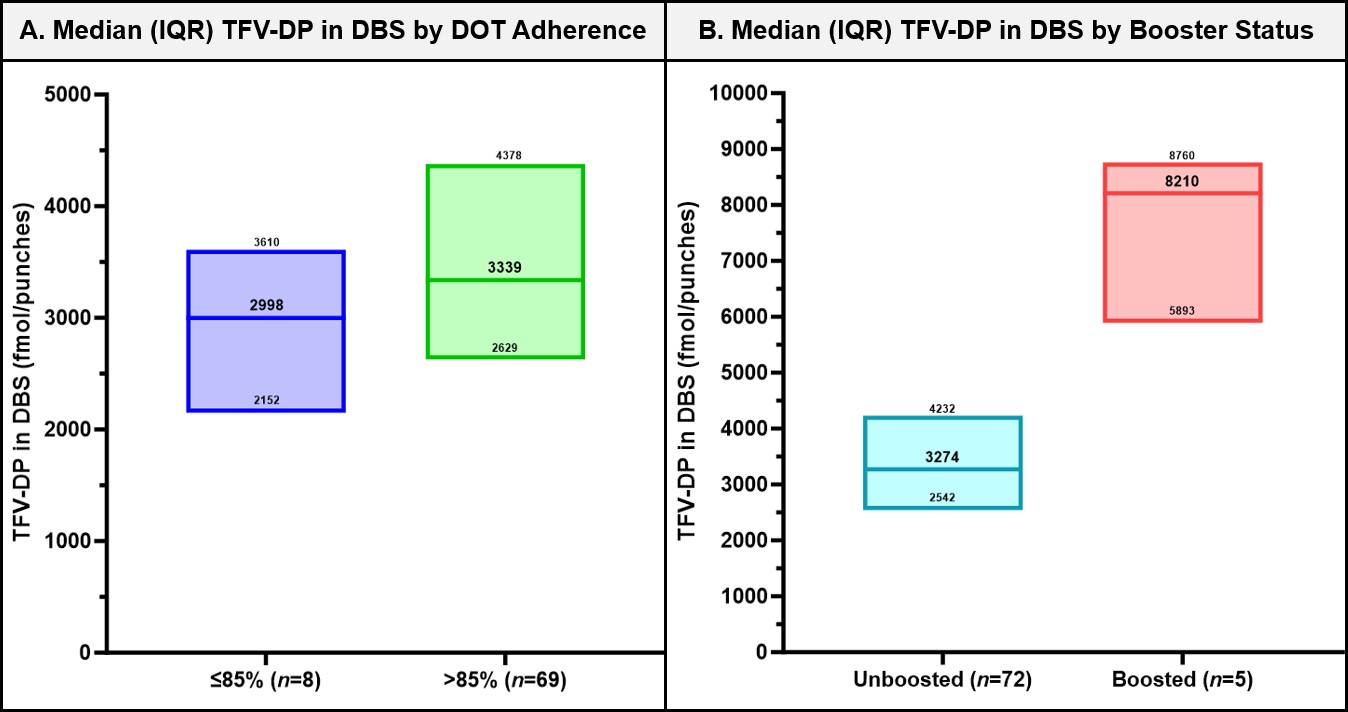
N=84 participants (median age 54 [43, 59] years) receiving TAF for median 32 (18, 45) months were enrolled. Most were males (89%) receiving integrase strand transfer inhibitors (88%). Race/ethnicity was 55% White, 24% Black, and 21% Hispanic/Latino. TFV-DP Css in DBS (n=77) were median 3301 (2580, 4362) fmol/punches. PWH with ≤85% DOT adherence (n=8) had median 2998 (2152, 3610) fmol/punches; PWH with >85% DOT adherence (n=69) had median 3339 (2629, 4378) fmol/punches (A). TFV-DP Css in DBS were higher with boosted (b/) than unboosted (un/) ART. PWH receiving un/ART (n=72) had median 3274 (2542, 4232) fmol/punches; PWH receiving b/ART (n=5) had median 8210 (5893, 8760) fmol/punches (B). No HIV VL was >200 cps/mL. Low-level viremia (LLV) occurred at 60/335 (18%) visits from 33/84 (39%) participants (VL range: 20-149 cps/mL), with similar TFV-DP concentrations in DBS: median 3176 (2494, 4145) fmol/punches at LLV visits, median 3278 (2585, 4404) fmol/punches at suppressed (VL <20 cps/mL) visits. Digital pills were well tolerated.
Conclusions:
We describe initial TFV-DP benchmarks in DBS in PWH receiving TAF-based ART as digital pills to capture DOT adherence in a real-world clinical study. We observed higher TFV-DP Css with b/ART than un/ART. The lack of relationship between LLV and TFV-DP concentrations in DBS in this cohort suggests mechanisms other than variable adherence for LLV. Future analyses will explore additional factors that may be associated with LLV.