Background:
Sub-Saharan Africa (SSA) accounts for nearly two-thirds of global HIV infections. Despite access to therapy, comorbidities in the region remain prevalent, including cognitive impairment (CI). The neuropathogenesis of CI among treated people with HIV is thought to be driven by inflammation, particularly that linked to monocytes.
Methods:
We characterized the relationship between inflammatory plasma biomarkers (CXCL10, CCL2, sCD163, and sCD25) and cognitive performance in a Sub-Saharan African cohort of people living with HIV and people without HIV at sites in Kenya, Nigeria, Tanzania, and Uganda (AFRICOS). All assessments were completed at the time of enrollment into the AFRICOS cohort. Neuropsychological tests included the WHO/NIMH Auditory Verbal Learning task with recall and recognition trials, Trails A, Action Fluency and the Grooved Pegboard tests. Analyses were completed using linear regression models of the mean (NPZ) summary z-score of individual tests.
Results:
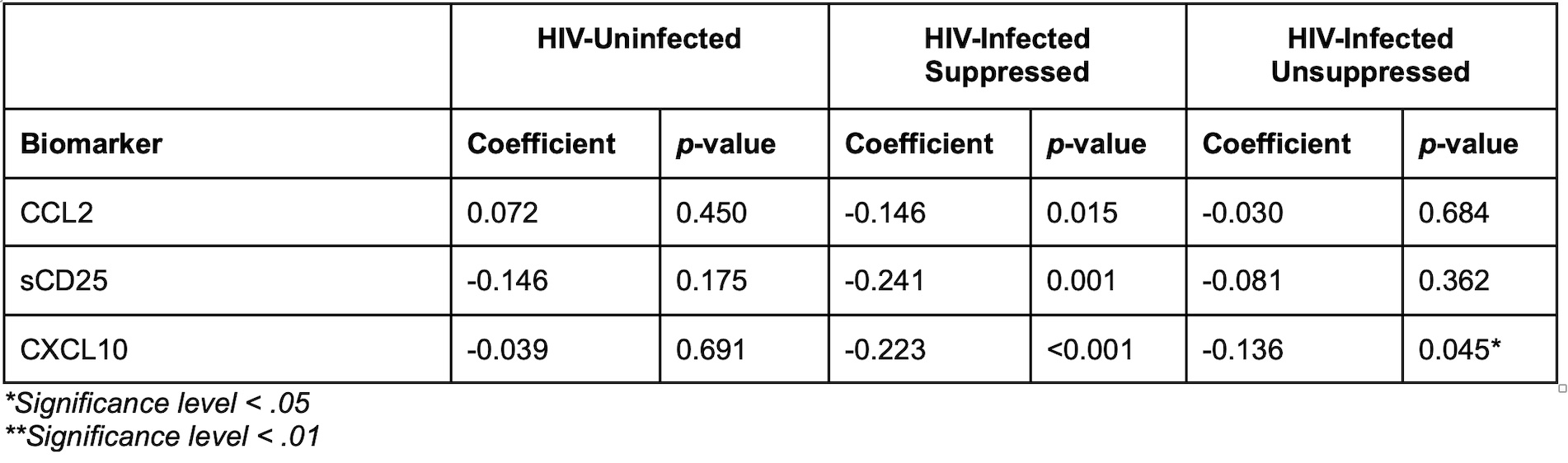
In all, 473 (17%) were living without HIV, 1393 (51%) were living with HIV and suppressed plasma viremia, whereas 871 (32%) had unsuppressed plasma viremia (>1000 copies/mL). Compared to controls, the group of people living with HIV was older (p<0.001) and less literate (p=0.013). We found inverse relationships (see Table)) between plasma biomarkers and cognitive performance on all measures except sCD163 in the people living with HIV, particularly in the suppressed group. Inflammation was not associated with cognitive performance among controls. The Grooved Pegboard test appeared to have the strongest associations between inflammatory markers and worse cognitive performance.
Conclusions:
In the sub-Saharan African context, chronic inflammation among people living with HIV is linked to worse cognitive performance. This association persists even in those with suppressed plasma viral load. *First and second authors contributed equally