Background:
The adverse effect of cardiovascular disease (CVD) risk factors on cognitive health may be greater for women than men. We evaluated if sex and HIV modify the effect of CVD risk on cognition in the Women’s Interagency HIV Study (WIHS) and the Multicenter AIDS Cohort Study (MACS).
Methods:
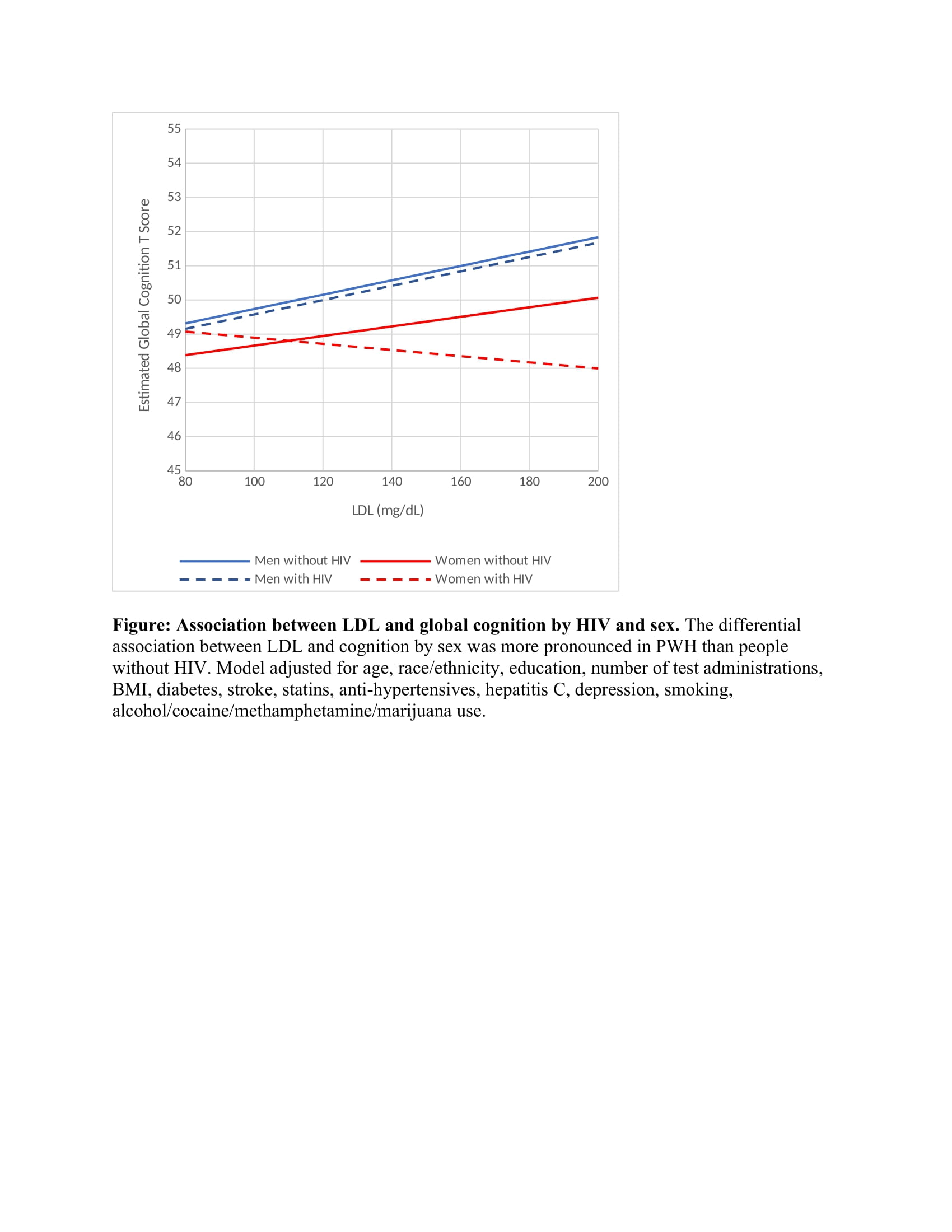
People living with HIV (PWH) and without HIV who underwent neuropsychological testing at least once beginning in 2005 in the MACS and in 2009 in the WIHS were eligible. We examined performance on overlapping tests (TrailMaking A and B, Symbol Digit Modalities, Stroop Color Word Trials 1-3, Grooved Pegboard) in the two cohorts and averaged demographically-adjusted T scores into a global summary score and within domains. We calculated cumulative years of exposure for binary CVD risk factors and the average cumulative level of continuous CVD risk factors at each follow-up visit. We constructed adjusted mixed-effects linear regression models (Figure) to estimate separate and interactive associations of each time-dependent CVD risk factor with sex and HIV on cognition.
Results:
Among 2,993 women from WIHS (mean follow-up 4.4 y), 2098 were living with HIV, 54% on ART at baseline. Among 2,702 men from MACS (mean follow-up 9.0 y), 1,477 were living with HIV, 44% on ART at baseline. BMI (-0.89 per 5 kg/m2/yr [95% CI -1.27, -0.52], p<0.001), LDL (-0.24 per 10 mg/dL/yr [-0.36, -0.11], p<0.001), and methamphetamine (-0.74 per yr exposure [-1.36, -0.12], p=0.020) had a greater negative association with global cognition in women than men. Statins (0.39/yr exposure [0.11, 0.67], p=0.006), antihypertensives (0.28/yr exposure [0.13, 0.43], p<0.001), and antidepressants (1.58/yr exposure [0.02, 3.13], p=0.047) had a greater positive association with global cognition for women than men. We observed a 3-way sex*LDL*HIV interaction, with a greater negative association of the sex*LDL interaction on motor function assessed by Grooved Pegboard test (-0.59 per 10 mg/dL/yr [-0.99, -0.19], p=0.004) and global cognition (-0.23 per 10 mg/dL/yr [-0.50, 0.04], p=0.09) in PWH than without HIV (Figure).
Conclusions:
BMI, LDL, and methamphetamine use had greater negative associations with cognition in women, including women with HIV, though the clinical significance of these modest differences is unclear. Future directions include evaluating interactive effects of sex and CVD risk factors on cognition in the combined cohort of PWH, accounting for HIV-related factors including ART use and viral load.