Background:
Improved characterization of the HIV reservoir is crucial for devising effective cure strategies. We developed a strategy for isolating and characterizing the viral reservoir in peripheral blood from people with HIV (PWH). We hypothesize that short abortive HIV transcripts are present in latently infected cells, and based on this we developed an innovative flow cytometry-fluorescent in situ hybridization (flow-FISH) allowing HIV reservoir detection and cell sorting without prior activation. This method was used for direct ex vivo detection and isolation of HIV+ CD4 T cells harboring transcriptionally latent or active HIV and allowed for transcriptomic analysis of the viral reservoir.
Methods:
Peripheral blood mononuclear cells (PBMCs) from 21 ART-naïve PWH from the Amsterdam Cohort Studies were used for this study. Flow-FISH was performed with probes targeting either abortive (TAR+Gag-) or elongated HIV transcripts (TAR+Gag+), representing latently and productively infected cells, respectively. Flow cytometry sorting was used to isolate three distinct cell populations (i.e. TAR+Gag-, TAR+Gag+, and probe-negative) from CD4 T cells of five PWH. The transcriptomic profile was determined by 3′ RNA sequencing (RNAseq).
Results:
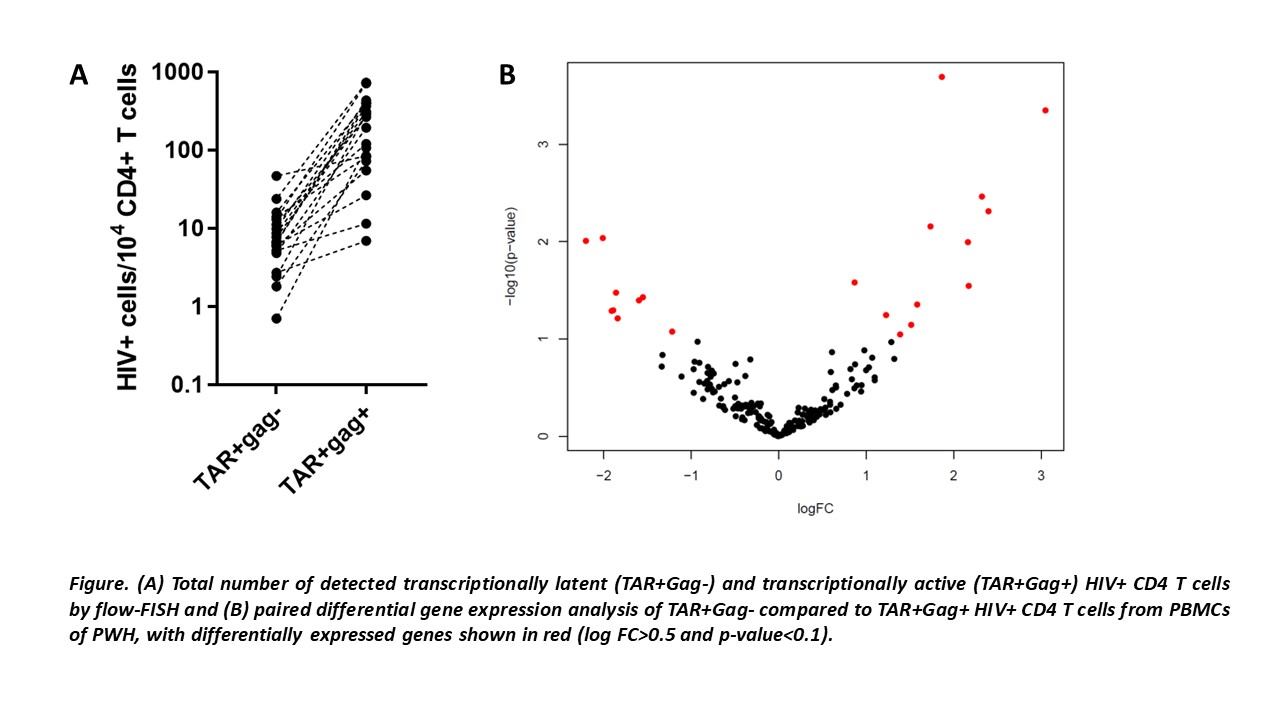
Our flow-FISH method detected between 10-751 HIV+ cells per 104 CD4 T cells in PBMCs from PWH, of which 1-47 per 104 CD4 T cells harbored transcriptionally latent HIV (TAR+Gag-) and 7-727 per 104 CD4 T cells harbored transcriptionally active HIV (TAR+Gag+; Figure A). Supervised RNAseq analysis allowed for the identification of transcriptomic signatures that separate the isolated populations independently of person-related characteristics. Notably, we identified several differentially expressed mitochondrial genes in latently infected (TAR+Gag-) compared to productively infected (TAR+Gag+) CD4 T cells (Figure B). Interestingly, enhancing mitochondrial function increased HIV transcriptional activity in latently infected CD4 T cells from PWH.
Conclusions:
Our flow-FISH approach was able to detect and differentiate between cells with transcriptionally latent or active HIV in PBMCs from PWH without the need for ex vivo stimulation. Transcriptomic profiling showed an association between diminished mitochondrial functioning and the transcriptional activity of the viral reservoir. These findings underline the relevance of altered cellular metabolism in HIV infection, and support the development of therapeutics that take this into consideration.