Background:
Despite a decline in HIV incidence in South Africa associated with the increased provision of HIV prevention services, there remains a lack of evidence on whether this progress has been experienced equitably by those most economically disadvantaged. We assessed whether the risk of acquiring HIV has changed over time for those in different socio-economic strata.
Methods:
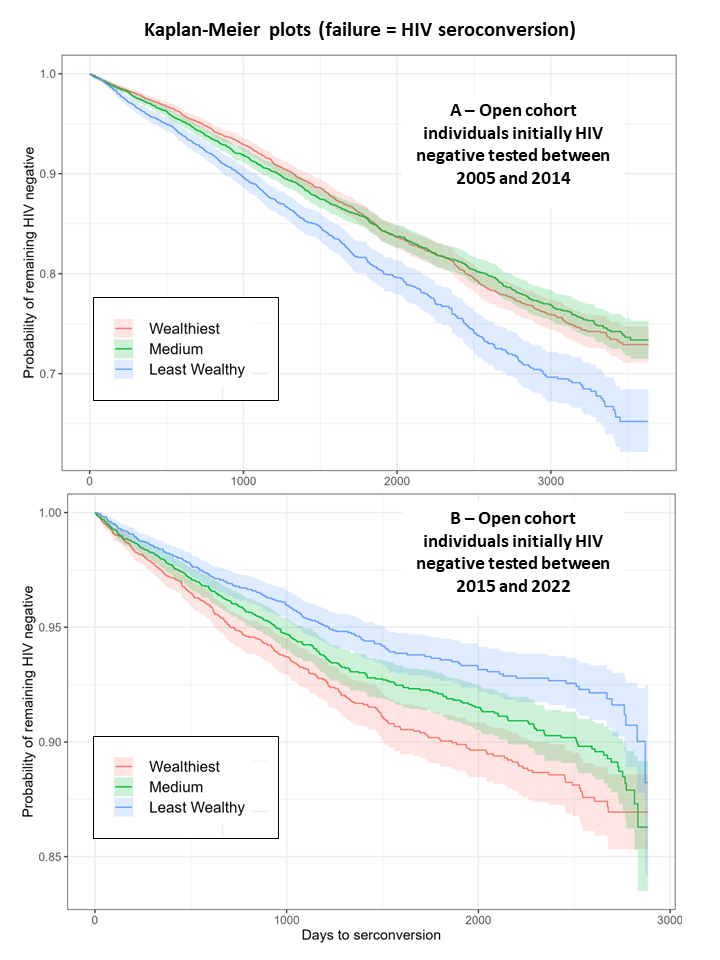
The study used data from a population-based HIV testing platform run by the Africa Health Research Institute (AHRI) in KwaZulu-Natal, South Africa. Socio-economic status was derived using a Principal Components Analysis, with input variables representing asset ownership and services used. The households were stratified into three equal wealth quantiles in each year. Time to seroconversion was defined as the time between the first observation and the seroconversion date, randomly imputed between the dates of the last negative and positive HIV tests. Kaplan-Meier curves stratified by socio-economic strata were constructed using two open cohorts. For period 1 (2005 to 2014) the criteria for ART initiation was CD4 count <= 350 cells/ml. For period 2 (2015 to 2022) the criteria was CD4 count <= 500 cells/ml until 2016 and then ART initiation at any CD4 count starting in 2017. The p-value of a Mantel-Haenszel (MH) test was used to assess whether the trajectories of the curves differed significantly. A Cox PH model was developed to test statistical significance controlling for other covariates.
Results:
During the 2005 to 2014 period (N=18,236) there were 2521 seroconversion events over 75086 person-years (PY) of observation (Fig A). Those in the least wealthy socio-economic strata had a higher rate of seroconversion (MH p-value <= 0.001) and a higher incidence than those in the wealthiest strata (4.19/100 PY vs 3.13/100 PY). During the 2015 to 2022 period (N= 14594), there were 901 seroconversions recorded over 51485 PY (Fig B). The wealth trend had reversed with the least wealthy having a lower rate of seroconversion (MH p-value <= 0.001) and a lower incidence than those in the medium and wealthiest strata (1.37/100 PY vs 1.76/100 PY and 2.12/100 PY respectively). A Cox PH multivariate analysis controlling for age and sex confirmed these findings.
Conclusions:
This study provides clear evidence that dramatic changes have occurred over time in the association between wealth status and the risk of acquiring HIV, with those in the lowest wealth strata having the lowest seroconversion rate since the move towards universal ART.