Background:
Children and adolescents with HIV experience high rates of treatment failure. Antiretroviral therapy (ART) containing dolutegravir has recently been rolled out across much of Africa and has several potential benefits over previously preferred ART regimens, though long-term real-world data in pediatric populations are lacking. Here, we report treatment outcomes among children and adolescents in Lesotho, southern Africa, who transitioned from non-nucleoside reverse transcriptase inhibitor- (NNRTI-) to dolutegravir-based ART through two years’ follow-up.
Methods:
Data were derived from two open cohort studies in Lesotho (Baylor College of Medicine Children’s Foundation Lesotho and Viral Load Cohort North-East Lesotho). Children and adolescents aged <18 years who transitioned from NNRTI- (efavirenz or nevirapine) to dolutegravir-based ART ≥18 months before data closure were included. We report viral load (VL) results <12 months before, 12 (window: 6-17) months after, and 24 (window: 18-29) months after transition to dolutegravir. Associations of demographic and clinical factors with 24-month viremia were assessed through multivariable logistic regression.
Results:
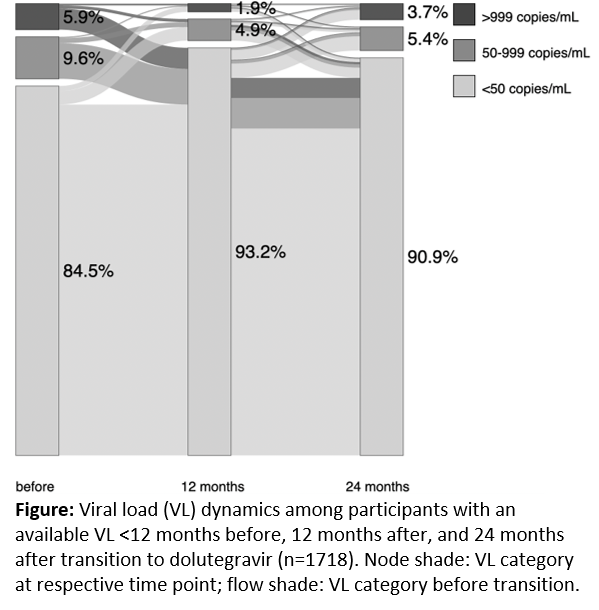
Among 2121 children and adolescents included, 1099 (51.8%) were female. At transition to dolutegravir, median age was 14.0 years (interquartile range [IQR] 11.5-15.8), median time taking ART was 7.6 years (IQR 4.4-10.6), and most participants had been taking an efavirenz-based regimen (1433/2121 (67.6%)). Participants were followed up over a median of 2.6 years (IQR 2.3-2.9). A VL was available for 1971/2121 (92.8%) <12 months before, 2006/2121 (94.6%) 12 months after, and 1887/2121 (89.0%) 24 months after transition to dolutegravir. Among those with a VL result at the respective time points, viral suppression to <50 copies/mL was achieved by 1633/1971 (82.9%) <12 months before, 1840/2006 (91.7%) 12 months after, and 1708/1887 (90.5%) 24 months after transition to dolutegravir. The Figure shows VL dynamics for participants with VL data at all time points. Pre-transition viremia was associated with viremia at 24 months, though 227/272 (83.5%) and 232/272 (85.3%) participants with pre-transition viremia had achieved resuppression to <50 copies/mL at 12- and 24 months after transition to dolutegravir, respectively.
Conclusions:
Rates of viremia dropped after transition to dolutegravir. However, further progress is needed to reach global targets in children and adolescents.