Background:
The incidence of syphilis is increasing worldwide. Little is known about the combined impact of maternal HIV and syphilis coinfection on birth outcomes, especially in sub-Saharan Africa (sSA), where HIV prevalence is high.
Methods:
We analyzed data from two prospective birth cohorts enrolled in southwestern Uganda from 2017 – 2023. All PHIV reported taking antiretroviral therapy (ART). Participants were tested for syphilis using a Treponema pallidum particle agglutination (TP-PA) rapid test on peripheral blood (positive test indicates treponemal exposure but cannot distinguish current vs prior infection). In one cohort, we also tested umbilical cord blood for and performed rapid plasma reagin (RPR) testing for TP-PA positive blood samples. Our primary outcome was a composite adverse birth outcome, including low birthweight (<2.5kg), stillbirth, neonatal death within 14 days of birth, or 5-minute APGAR<7. We compared outcomes by HIV and TP-PA seropositivity using chi-square tests and fitted multivariable logistic regression models to determine adjusted associations between maternal HIV and syphilis infection and birth outcomes.
Results:
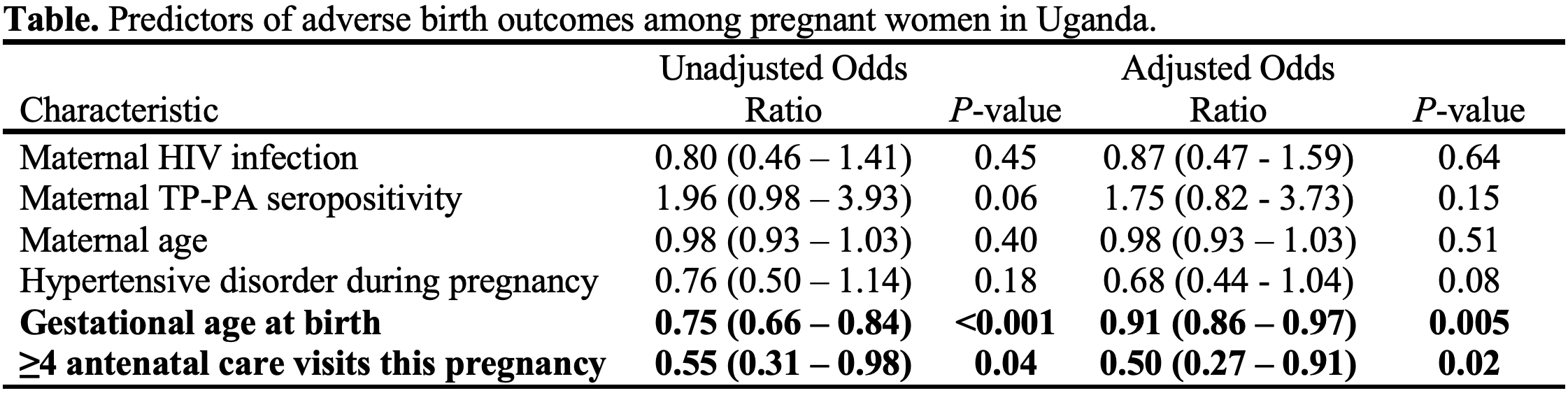
Of 944 women, 93 were TP-PA positive PHIV, 385 were TP-PA negative PHIV, 24 were TP-PA positive people without HIV and 442 were TP-PA negative people without HIV. Mean age of TP-PA positive PHIV was 28±6 years, 60/93 (65%) initiated ART before conception, and 13% had detectable HIV viremia. Of 117 (12%) TP-PA positive people, 93 (79%) were PHIV (P<0.001). There were 52/944 (6%) adverse birth outcomes, occurring in 9/93 (10%) TP-PA positive PHIV (including 5/93 [5%] stillbirths), 20/385 (5%) of TP-PA negative PHIV, 2/24 (8%) of TP-PA positive people without HIV, and 21/442 (5%) of TP-PA and HIV negative people (P=0.26). Of 54 PHIV with RPR titers available, 8 (15%) were non-reactive, 38 (70%) were <1:32 and 8 (15%) were ≥1:32. In multivariable analysis, gestational age and attending ≥4 antenatal care visits were independently associated with the composite adverse birth outcome, but maternal TP-PA seropositivity and HIV infection were not (Table). An HIV × TP-PA product term was not statistically significant.
Conclusions:
Maternal HIV or TP-PA seropositivity did not increase the risk of adverse birth outcomes, though stillbirth incidence among TP-PA positive PHIV was higher than prior studies from sSA. High TP-PA seroprevalence and RPR positivity among PHIV emphasize the need to improve prenatal care for PHIV with enhanced syphilis screening and treatment.