Background:
The impact of immunocompromised states on pediatric COVID-19 and outcomes remains unclear. We aimed to evaluate clinical features and severity of SARS-CoV-2 infection in hospitalized children with and without immunocompromising conditions.
Methods:
We conducted a national surveillance study of children <17 years hospitalized for COVID-19 from April 2020–May 2022. Data were captured through two surveillance programs The Canadian Pediatric Surveillance Program and the Canadian Immunization Monitoring Program, ACTive which covers ~90% of all Canadian tertiary-care pediatric beds. Incidental SARS-CoV-2 positive cases were excluded. Immunocompromised children (IC) were defined as those with an immunocompromising condition and/or on immunosuppressive treatment(s). Severe COVID-19 was defined as a requirement for intensive care unit (ICU) admission, ventilator or hemodynamic support, organ system complications (neurologic, cardiac, and respiratory), or death. Adjusted risk ratios (aRR) for severe COVID-19 among IC versus non-IC were calculated using robust Poisson regression, adjusted for age, sex, non-IC comorbidities, lineage, and vaccination status.
Results:
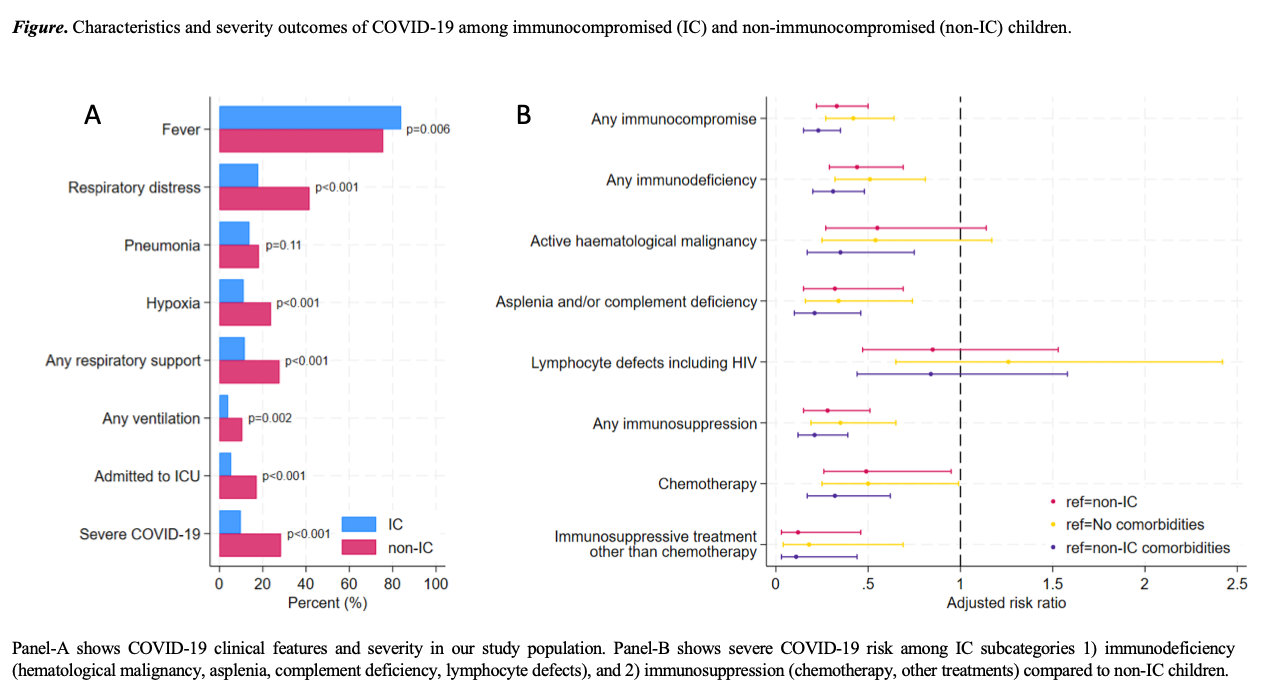
Overall, 1874 children were hospitalized with COVID-19, of which 224 (12%) were IC. IC were older (median age 7 years [interquartile range (IQR) 3.6–12.0] than non-IC (1.3 years [IQR 0.3–2.9] years; p<.001) and had fewer comorbidities other than immunocompromise (31.7% vs 39.6%; p=.02). A lower frequency of respiratory distress was observed in IC compared to non-IC (17.9% vs 41.6%; p<.001). Severe COVID-19 (9.8% vs 28.4%; p<.001), as well as the need for any respiratory support (11.6% vs 27.7%; p<.001) and ICU admission (5.4% vs 17.1%; p<.001) were less frequent among IC (Panel-A). In multivariable analyses, IC were less likely to have severe COVID-19 compared to non-IC (aRR=0.33 [95%CI:0.20-0.50]). Subcategories of immunocompromise, such as immunodeficiency (aRR=0.44 [95%CI:0.29-0.69]) and immunosuppression (aRR=0.28 [95%CI:0.15-0.51]) were individually also associated with a reduced likelihood of severe COVID-19. Compared to children with comorbidities other than immunocompromise, IC were also less likely to have severe COVID-19 (aRR=0.23 [95%CI:0.15-0.35]) (Panel-B).
Conclusions:
Lower risk of severe COVID-19 was observed in hospitalized IC compared to non-IC and to those with other comorbidities, potentially in part due to lower thresholds for hospital admission for IC. Population-based studies are needed to confirm these findings.