Background:
Hepatitis B virus (HBV) infection affects >10% of the population in West Africa and is the most common cause of liver cirrhosis and hepatocellular carcinoma. Circulating HBV RNA may help improve the characterization of HBV disease and prognosis. We aimed to evaluate the associations between HBV RNA and conventional biomarkers of HBV replication in the Senegalese Hepatitis B Cohort study (SEN-B).
Methods:
We included all treatment-naïve participants without HIV infection from SEN-B. We measured HBV RNA levels using the cobas HBV RNA investigational assay (Roche Molecular Diagnostics, Pleasanton, CA) with a lower limit of quantification of 10 copies/ml. Participants were classified into three phases of HBV infection: Hepatitis e antigen (HBeAg)-positive (EP), HBeAg-negative chronic infection (ENCI) and HBeAg-negative chronic hepatitis (ENCH). ENCH was defined by HBV DNA ≥2000 IU/ml in combination with elevated alanine aminotransferase (ALT ≥30 IU/ml for men, ≥19 IU/ml for women) and/or significant liver fibrosis (liver stiffness measurement >7.0 kPa). We compared participants with and without detectable HBV RNA using descriptive statistics and evaluated associations between HBV RNA, HBV DNA, and quantitative hepatitis B surface antigen (qHBsAg) using Spearman’s rank correlation coefficient among participants with detectable HBV RNA levels.
Results:
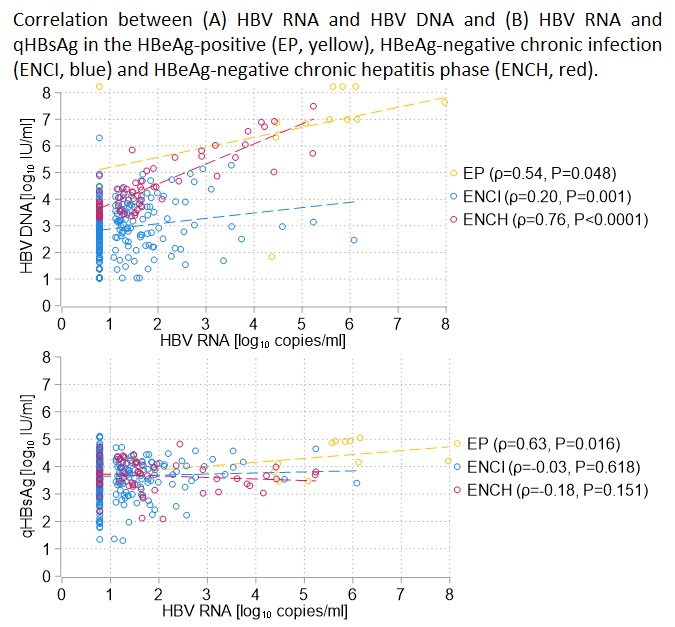
Among 713 participants, 17 (2.4%) were in the EP phase, 615 (86.3%) in the ENCI phase and 81 (11.4%) in the ENCH phase. Median age was 31 years (interquartile range 25-38) and 335 (47.0%) were female. HBV RNA was undetectable in 3/17 (17.6%) of EP individuals, 338/615 (55.0%) of ENCI individuals and 19/81 (23.5%) of ENCH individuals. The 353/713 (49.5%) participants with detectable HBV RNA were more likely to have HBV DNA >20 IU/ml (95.8% vs. 80.0%) and to have significant fibrosis (13.9% vs. 7.5%) than participants with undetectable HBV RNA levels. We did not observe significant differences in age, sex, ALT levels and qHBsAg levels between the two groups. As depicted in the Figure, HBV RNA showed strong correlation with HBV DNA in EP, moderate correlation in ENCH and poor correlation in ENCI participants. HBV RNA and qHBsAg correlated moderately in EP, but not in ENCI and ENCH participants.
Conclusions:
In our cohort of treatment-naïve persons with HBV in Senegal, approximately 50% had detectable HBV RNA levels. HBV RNA correlated well with HBV DNA in the EP and ENCI groups, whereas qHBsAg levels correlated with HBV RNA only in EP individuals.