Background:
The perinatal virtual clinic (PVC); a monthly multidisciplinary forum reviews complex management decisions for children and adolescents living with HIV (CALWHIV) referred from high (HIC) and low/middle income countries (L/MIC). We investigated the prevalence of emergent integrase drug resistance mutations (INSTI-DRMs) necessitating protease inhibitor (PI) based regimens.
Methods:
Review of 5 years of PVC referrals; October 2018-September 2023. Demographic data included age, sex, country of residence. Clinical data included: comorbidities, antiretroviral therapy (ART) history, HIV viral load (VL) and CD4 count. Resistance mutations were interpreted using the Stanford HIV Drug Resistance database and CALWHIV with emergent INSTI-DRMs described.
Results:
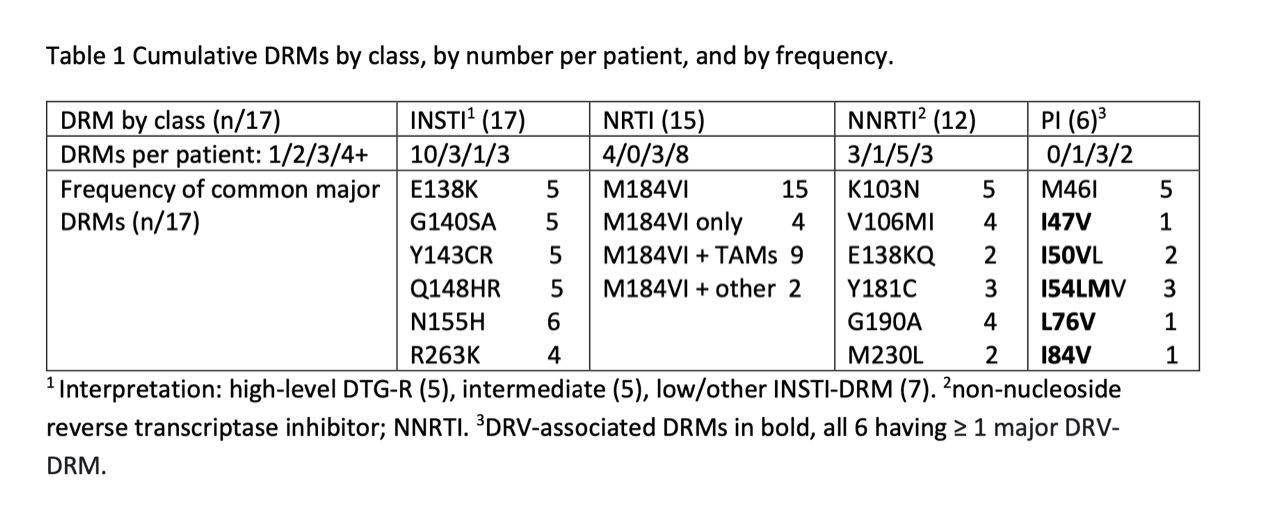
341 CALWHIV were discussed; 51 (15%) from L/MIC, 106 (31%) with virological failure (VF) of which 96 (91%) had resistance sequences available. 17/96 (18%) had INSTI-DRMs, median (IQR) age 11 (6-14) years, weight 24 (17-49) kg, CD4 430 (77-805) cells/ul, and VL 35,000 (2380-132000) c/ml. Current region; Africa (7), Americas (2), Europe (5) and Western Pacific (2), with 11 (65%) from L/MIC. 12/17 (74%) were referred in 2022/23. Six had current AIDS diagnoses and 4 concomitant antimycobacterial therapy. 15/17 were on second/subsequent ART (median 2 [IQR 2-3] prior regimens) comprising nucleoside reverse transcriptase inhibitors (NRTI) with: dolutegravir (DTG) (7), raltegravir (4), DTG and darunavir/ritonavir (DRV/r) (4). One adolescent failed first line DTG/lamivudine (3TC)/abacavir (ABC) with E138K S147G Q148R N155H M184V (high-level DTG resistance (R)) after 5 years. A second suppressed on nevirapine/3TC/ABC for 11 years simplified to DTG/3TC/ABC but failed 4 years later with an R263RK (intermediate DTG-R). Cumulative resistance by number of ART classes was 1 (1), 2 (5), 3 (7), 4 (4) with DRMs described in Table 1. PVC recommendations were for tenofovir (TXF) with lamivudine or emtricitabine, using split adult tablets in 5, with DRV/r (17), twice daily (BD) in 6, with BD DTG (6), and novel agents sought for 2.
Conclusions:
INSTI resistance is emerging in CALWHIV, most commonly in highly treatment experienced individuals from L/MIC. This highlights the global need for access to DRV/r, TXF and novel classes, including formulations for children <35kg.