Background:
The persistence of replication-competent proviruses during ART is a key barrier to an HIV cure. A previous study identified 3 cell clones carrying replication-competent proviruses that were integrated in genes and were the sources of non-suppressible viremia (NSV). Here, we asked if additional clones carrying intact proviruses were present in these 3 individuals; and, if so, where the proviruses were integrated in the host genome.
Methods:
Three donors on ART for 10-20 years who recently developed NSV were sampled over 1-4 years. PBMCs were subjected to endpoint diluted multiple displacement amplification (MDA). MDA wells were screened for HIV LTR, psi (Ψ), and RRE. Proviruses that were positive for LTR, Ψ, and RRE underwent full-length HIV sequencing and integration sites analysis. The % predicted-intact proviruses were calculated as in the IPDA and also using HIV LTR+ MDA wells as the denominator. A custom pipeline was used to map both discrete and non-discrete (e.g., centromeric) integration sites. Gene expression levels in memory CD4+ T cells were determined using the Human Protein Atlas Database (www.proteinatlas.org).
Results:
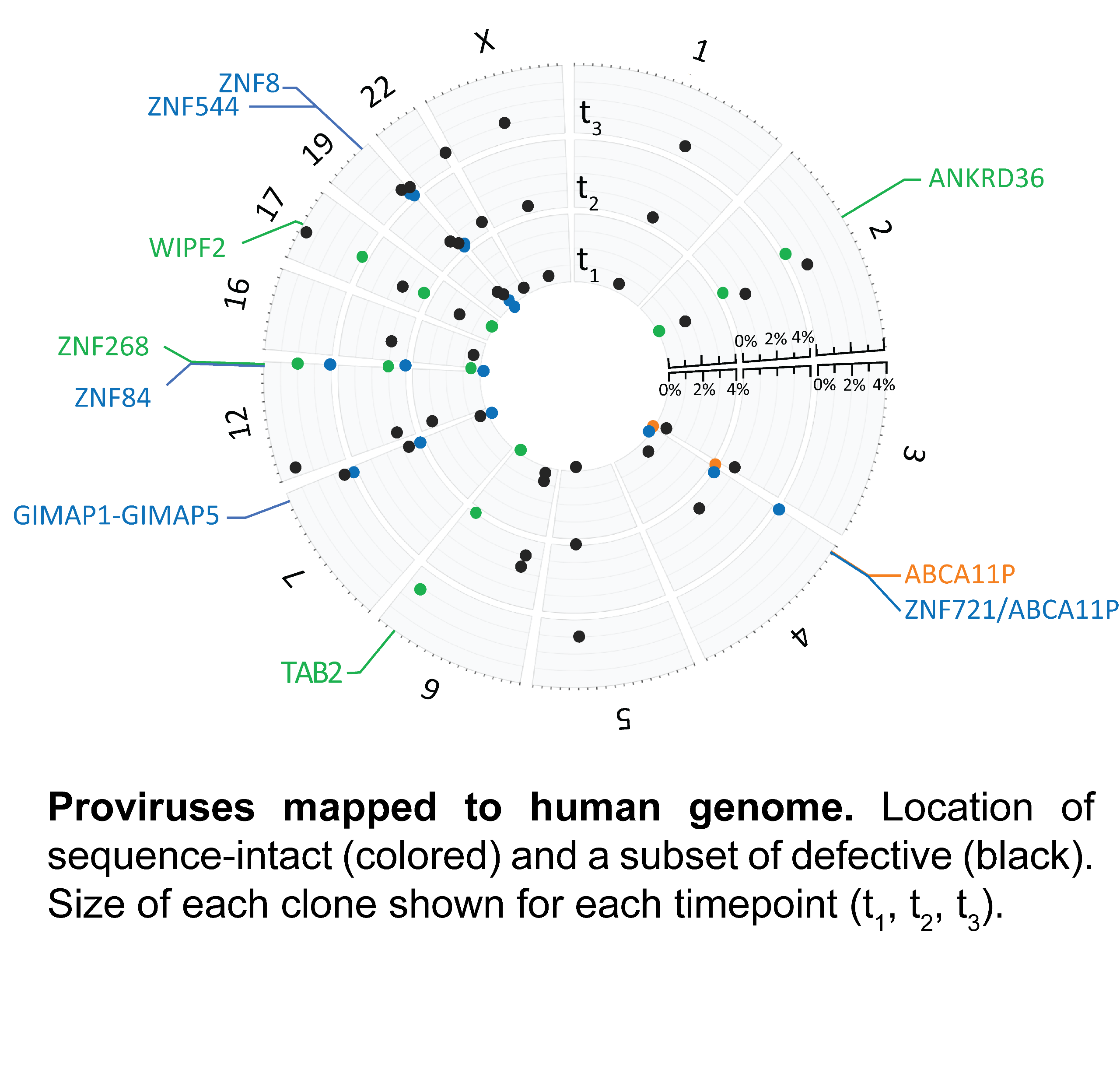
We identified 7 additional clones carrying sequence-intact HIV proviruses (10 total). All 10 integration sites mapped to expressed genes (Figure) and 4 were in the same orientation as the gene. Five were in KRAB-ZNF genes (50%), compared to the 3.7% of total proviruses (which are mostly defective) in KRAB-ZNF genes in one of the donors (p<10-4). Reported gene expression levels were not significantly different for the genes with intact vs defective proviruses (median=33.9 vs 61.0 TPM; p=0.3). Predicted-intact proviruses (Ψ+RRE) comprised 9-10% of the total population using the IPDA approach and 2-4% using LTR as the denominator. Proviruses that were confirmed intact by full-length sequencing comprised 0.07-2% of the LTR+ MDA wells. Two of the 10 clones carrying sequence-intact proviruses increased in size, one decreased, and seven did not change significantly over 1-4 years.
Conclusions:
In 3 donors with non-suppressible viremia on ART, we identified 10 clones carrying sequence-intact proviruses comprising <2% of the total proviral population. All 10 intact proviruses were integrated in genes that are normally expressed in memory CD4+ T cells, including the 5 in KRAB-ZNF genes. Only 1/10 clones declined in size on long-term ART. These results indicate that a stable pool of intact proviruses integrated in expressed genes can persist on long-term ART.