Background:
Absence of vaginal lactobacilli and corresponding genital inflammation is associated with adverse reproductive health outcomes, including female HIV acquisition. In women in sub-Saharan Africa, a high prevalence of vaginal dysbiosis may offer an opportunity to develop Lactobacillus crispatus biotherapeutics for HIV prevention.
Methods:
We conducted a randomized, placebo-controlled, trial of cis-women age 18-23 with Nugent score 4-10 on vaginal Gram stain who completed a course of oral metronidazole (MTZ). Women were randomized (2:1) to use vaginal applicators containing 2X10[sup]9[/sup] CFU of [i]L. crispatus[/i] CTV-05 (LACTIN-V) or placebo for 4 weeks. Vaginal samples were collected prior to MTZ, at enrollment (0-wks), immediately after study product (4-wks), and 4 weeks later (8-wks). The vaginal microbiota was assessed by 16S rRNA gene sequencing, endocervical immune cells by flow cytometry and vaginal fluid inflammatory markers by Luminex.
Results:
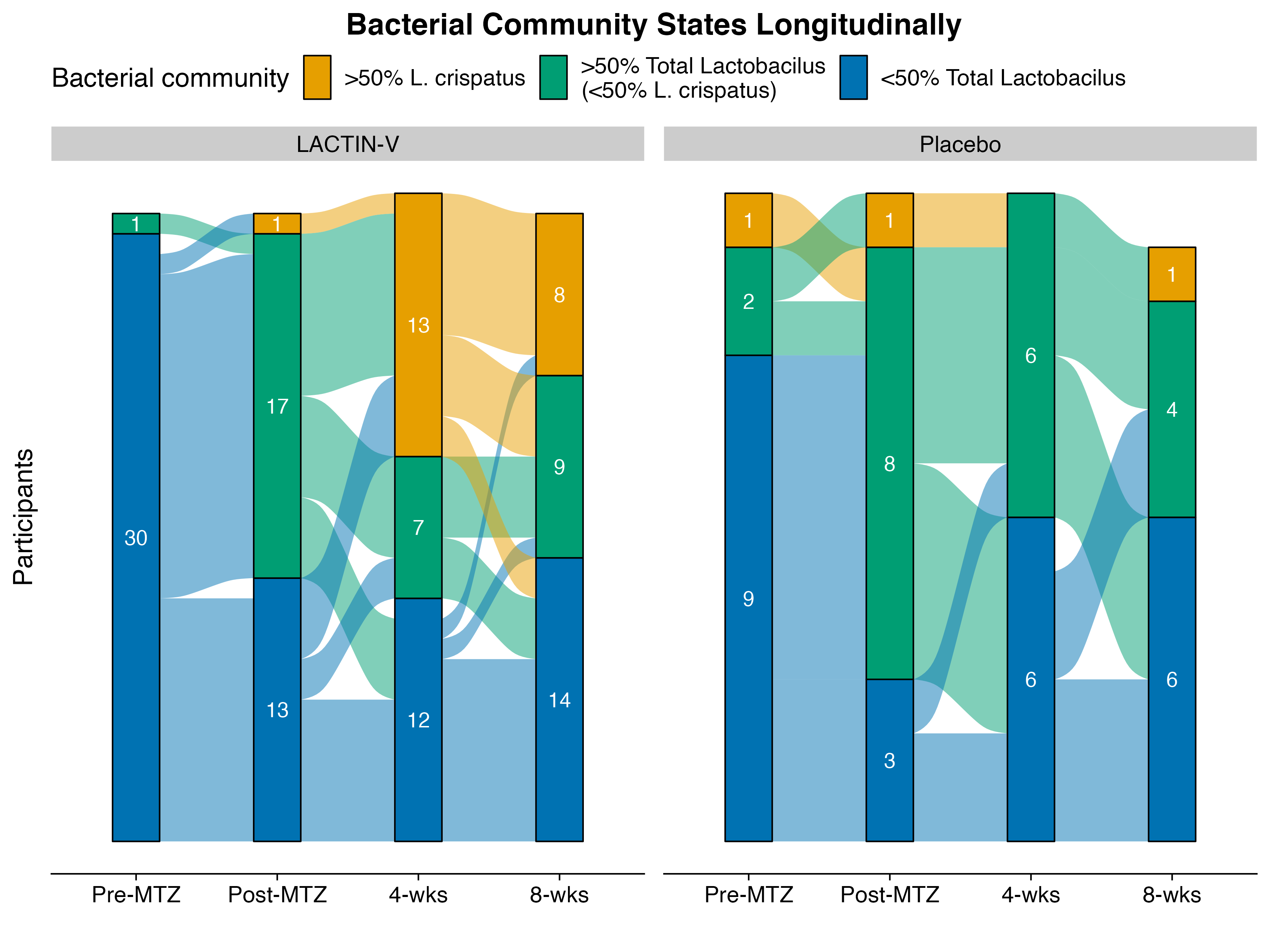
45 black South African women were randomized to LACTIN-V (N=32) and placebo (N=13). At enrollment, immediately after MTZ, 54.8% (LACTIN-V) vs. 66.7% (placebo) presented with Lactobacillus-dominant microbiota other than L. crispatus, most often L. iners (Figure). A L. crispatus-dominant microbiome was identified in 40.6% (4-wks) and 25.8% (8-wks) of participants in the LACTIN-V arm compared to 0% and 9%, respectively in the placebo arm (4-wks: p= 0.047; 8-wks: p= 0.096). The proportion of activated HIV target cells (CD3+/CD4+/CD38+/HLA-DR+/CCR5+ T cells) within the total T cell population (CD3+) increased from post-MTZ (0-wks) to 4-wks in the placebo arm (0.38 log10 fold change) which was not observed in the LACTIN-V arm (0.03 median log10 fold change; p = 0.009). The change in 13 cyto/chemokines between pre-MTZ and 4-wks was not statistically different by arm. Three quarters of participants in both arms ‘strongly agreed’ or ‘agreed’ they would use the product again. Adverse events (AEs) occurred in 77.8% of all participants. All local solicited AEs, most commonly vaginal discharge, were grade 1 with no significant difference by arm.
Conclusions:
LACTIN-V after MTZ increased L. crispatus colonization. Women treated with LACTIN-V had fewer activated cervical CD4+ HIV target cells than those in the placebo arm. We did not observe statistically significant differences in vaginal cytokines between arms. The product was safe and highly acceptable (clinicaltrials.gov:NCT0502221).