Background:
Eswatini has adopted the WHO guideline-recommended cut-off of HIV RNA above 1000c/ml as a criterion for virologic treatment failure. Consequently, we describe the association between different detectable viral load (VL) levels and subsequent virological failure in a cohort of ART clients in Eswatini.
Methods:
We conducted a cross-sectional secondary analysis of HIV care data from the Lubombo and Manzini regions. We used data from adult ART clients with a baseline and one-year VL result from October 2021 to September 2022 from the client management information system (CMIS). Data included clients’ sociodemographic and clinical information. Clients with VL <1000 were suppressed, and VL ≥50 were suppressed but detectable. Viral load was categorized into <50, 50-200, 201-500, 501-999 and ≥1000. We analyzed the data using descriptive, comparative, and multivariate logistic regression analysis reporting adjusted odds ratios (AOR).
Results:
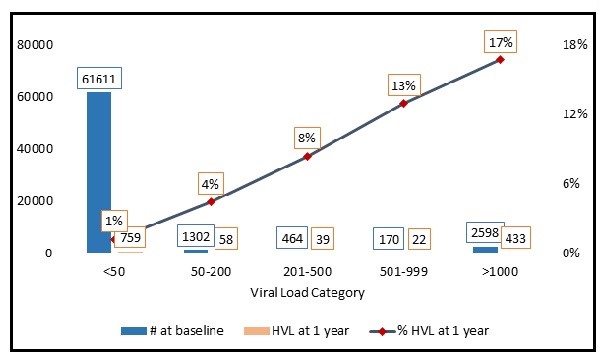
Of 66,145 PLHIV in the database, 63,547 (96%) had a suppressed viral load. Most clients (N=43,394; 65.6%) were from the Manzini region, and 57,547 (87%) were on a Dolutegravir-based ART regimen. Median age was 39 (IQR: 32, 48); 43,879 (66.3%) were females, and the median duration on ART was six years (IQR: 4, 10). Of 2598 with a high viral load (HVL) (VL≥1000) at baseline, 1,550 (59.8%) had follow-up VL data; 1,117 (72%) were suppressed, and 433 (28%) remained unsuppressed. Amongst clients with suppressed baseline VL (n=63,547), 34,757 (54.7%) had follow-up VL data; 33,879 (97.5%) remained suppressed and 878 (2.5%) had HVL. Comparison of clients with HVL at follow-up with baseline categories of VL indicates a linear increase in the proportion of clients with HVL (Figure 1). Baseline predictors of HVL at follow-up were age <15 (AOR 2.0; 95%CI: 1.46,2.74; p<0.001), 15-24 (AOR 2.72; 95%CI:2.17,3.40; P<0.001), 25-34 (AOR 1.62;95% CI: 1.33, 1.99;p<0.001) compared to ≥45 years; males (AOR 1.15; 95%CI:1.01,1.31; p=0.029) compared to females; baseline viral load 50-200 (AOR 3.52; 95%CI:2.65,4.67; p<0.001), VL=201-500 (AOR 7.22; 95%CI: 5.1, 10.3; p<0.001), VL=501-999 (AOR 11.4; 95%CI: 6.9, 18.8; p<0.001), ≥1000 (AOR 13.1; 95%CI: 11.4, 15.1; p=0.001) compared to baseline VL<50.
Conclusions:
Any detectable VL is a risk for virological failure.This requires strategies that support and strengthen stepped-up adherence counselling for all clients with a detectable VL to limit progression to virological failure and for contextualized care for males and PLHIV aged <35 years.