Background:
Post-COVID conditions (PCC), or long COVID, are part of a persistent, multisystemic syndrome occurring after COVID-19. The effect of the antiviral remdesivir (RDV) on subsequent outcomes associated with PCC is unknown. Of particular interest are RDV’s effects stratified by age, which is a predictor of outcomes in patients hospitalized with COVID-19.
Methods:
The HealthVerity database of hospital chargemaster data linked to closed claims for >25 million US patients was queried for individuals aged ≥12 years hospitalized for ≥2 days with COVID-19 between 5/1/2020 and 9/30/2021. The analysis was stratified by age category (<65 vs ≥65 years of age). Cox proportional hazards models used inverse probability of treatment weighting to calculate hazard ratios (HR) for 16 individual PCC-related symptoms or diagnoses and a composite of any PCC, occurring 90-270 days posthospitalization, in patients hospitalized with COVID-19 receiving RDV versus comparators not receiving RDV. Individuals without ≥90 days of follow-up still contributed person-time up to their day of censoring.
Results:
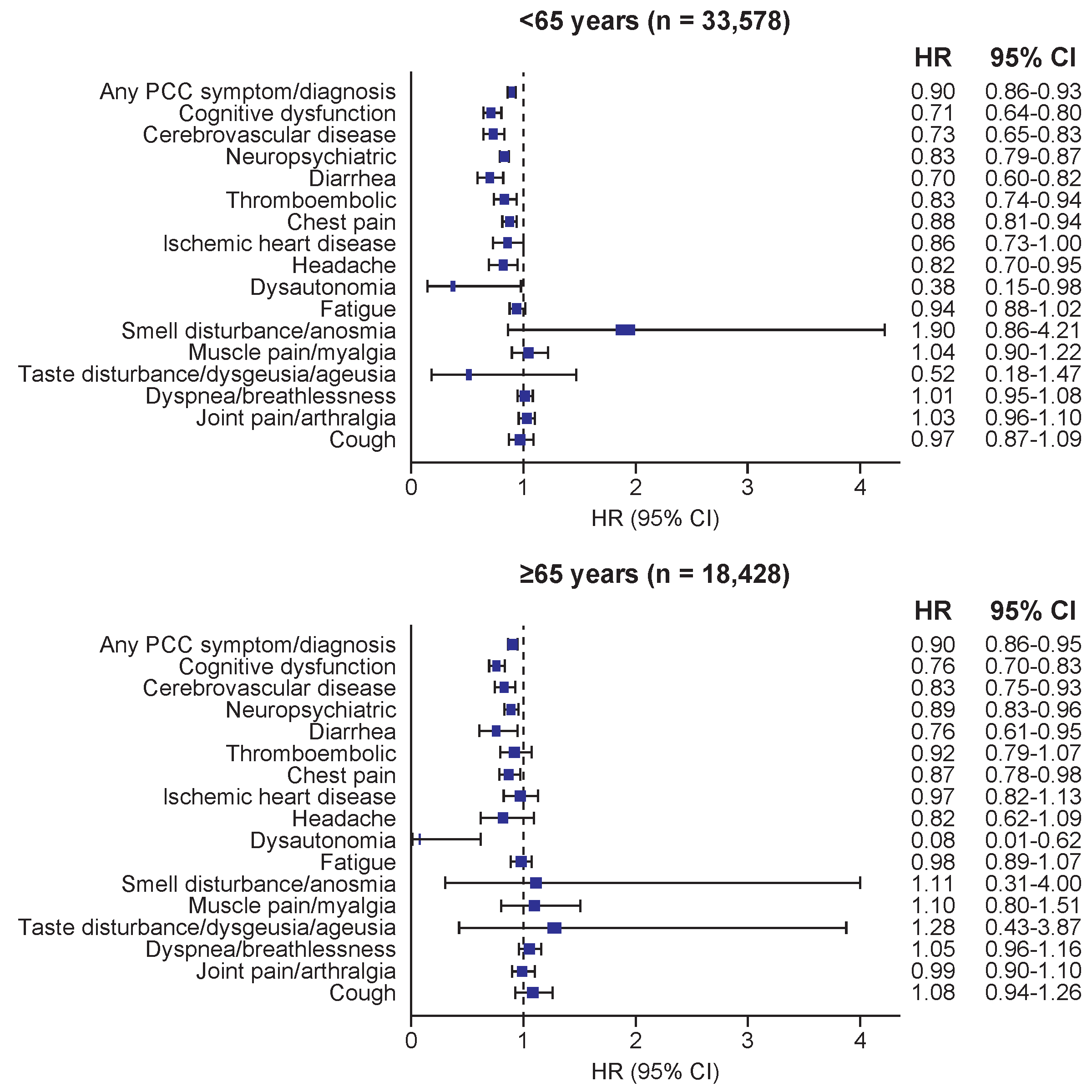
Of 3,661,303 individuals hospitalized for any reason during the study period, 52,006 had acute COVID-19 and met inclusion criteria, of which 33,578 (64.6%) were <65 years of age. In the <65 and ≥65 age groups, respectively, 36.1% and 27.2% received RDV. The most common PCC-related symptom/diagnosis was neuropsychiatric features, with an incident rate per 100 person-years of 58.0 and 52.4 in <65 and ≥65 age groups, respectively. Overall, RDV (vs no RDV) was associated with significantly lower relative hazard of any PCC in both age groups: HR 0.90 (95% confidence interval [CI]: 0.86–0.93) in those <65 years old and HR 0.90 (95% CI: 0.86–0.95) in those ≥65 years old. RDV was associated with lower risk for 6 of 16 individual symptoms/diagnoses in the ≥65 age group (cognitive dysfunction, cerebrovascular disease, neuropsychiatric features, diarrhea, chest pain, and dysautonomia) and for 8 of 16 individual symptoms/diagnoses in the <65 age group (including the same 6 symptoms, as well as thromboembolic disease and headache).
Conclusions:
RDV was associated with reduced risk of PCC after COVID-19 hospitalization in patients <65 and ≥65 years of age, though more symptoms were impacted, and the effect size tended to be stronger in the younger age group. The majority of patients did not receive RDV, indicating a missed opportunity for treatment of acute COVID-19 and potential prevention of long-term sequelae of infection.