Background:
10% of people with HIV (PWH) show low-level viremia (LLV) under antiretroviral therapy (ART). We evaluated the influence of this poor virological response on the immune system in comparison to individuals with suppressed viremia (SV).
Methods:
Prospective observational study in 54 subjects matched by clinical and epidemiological characteristics: i) n=27 PWH with persistent LLV (50-200 copies/mL) and ii) n=27 PWH with SV (<50 copies/mL) as controls. 45 soluble biomarkers of systemic inflammation were evaluated by multiplex immunoassays. Activation (CD25, HLADR and CD38) and senescence (CD57, PD1 and TIM-3) levels in peripheral T-cell subsets were characterized by spectral flow cytometry. Differences in plasma biomarkers and cell frequencies were evaluated by generalized linear models, adjusted by age, gender, and ART.
Results:
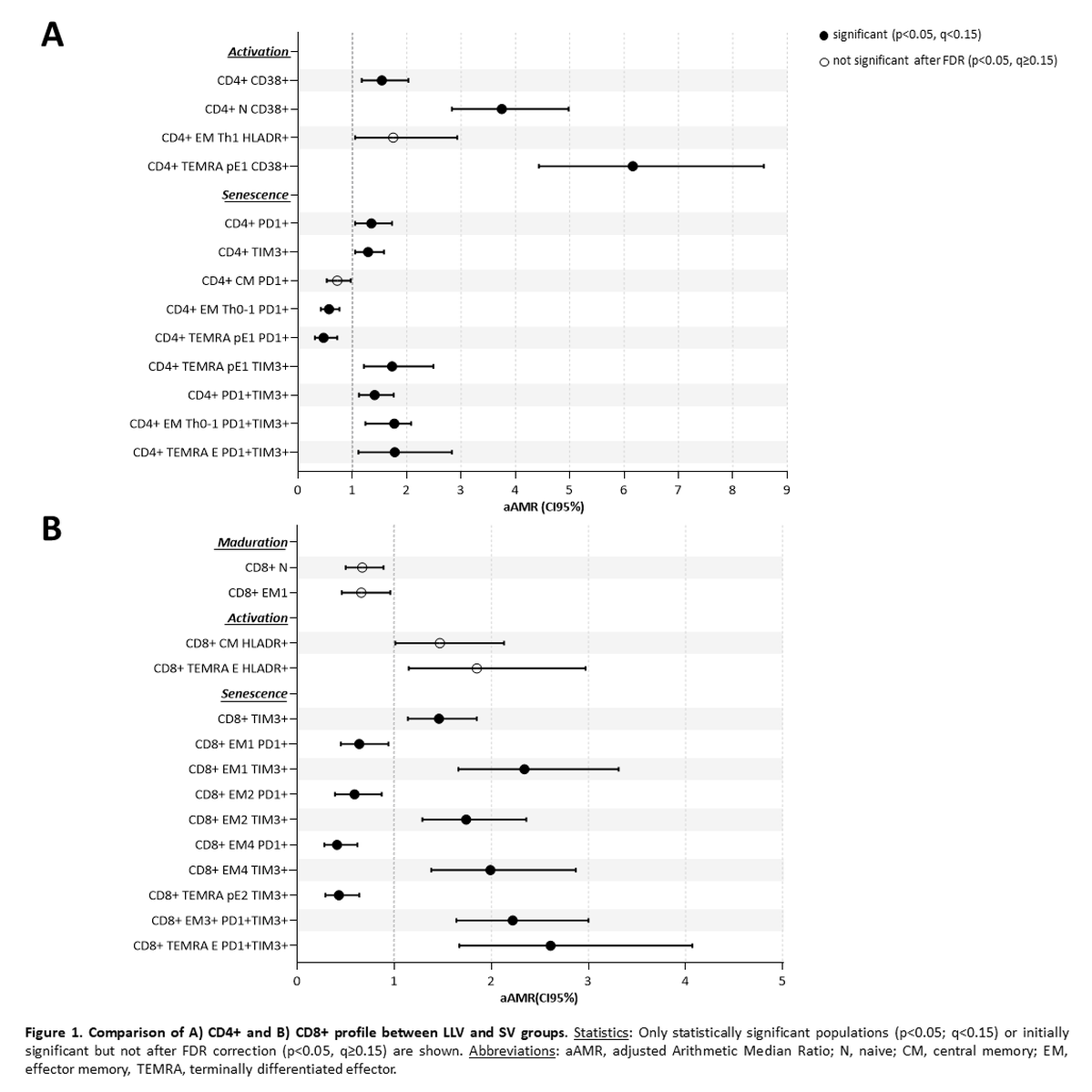
The median age was 53 years and 77.8% were male. 74% of PWH with LLV were on integrase inhibitors compared to 48% in SV group. LLV group showed no significant differences in the maturation of CD4+ T cells, which were more activated (CD38+) and exhausted (PD1+, TIM3+ and PD1+TIM3+) compared to SV, especially the more immature stages of development (Figure 1A). A decrease in PD1+ subpopulations in effector memory (EM) (Th0-1 and TEMRA pE1) and a trend in central memory (CM) were also observed in LLV group, as well as an increase in TIM3+ expression. Significant differences were observed in the most senescent phenotype (PD1+TIM3+) in EM Th0-1 and TEMRA E populations in the LLV group. In addition, LLV group showed a trend towards a lower CD8+ naïve and EM1 T cell count and a higher frequency of CM and TEMRA E cells (HLADR+), as well as a higher up-regulation of TIM3+ in CD8+ compartment (Figure 1B). We also observed a lower frequency of CD8+ EM PD1+ subpopulations (EM1, EM2, EM4, TEMRA pE1 and TEMRA pE2) and an increase of these same subpopulations expressing TIM-3+. Overall, LLV group showed a highly senescent EM response (EM3 PD1+TIM3+ and TEMRA E PD1+TIM3+) compared to controls. No significant differences were found in inflammatory markers between groups.
Conclusions:
The persistence of LLV (50-200 copies/mL) leads to a decrease of CD8+ EM1 population and an increase in activation mainly in EM subpopulations that are functionally exhausted. This could partially explain the absence of significant differences in the inflammatory profile between both groups, suggesting an aberrant immune function in LLV individuals unable to control and eliminate infected cells.