Background:
Intracellular tenofovir-diphosphate (TFV-DP) concentration benchmarks in dried blood spots (DBS) from oral emtricitabine-tenofovir disoproxil fumarate (F/TDF) pre-exposure prophylaxis (PrEP) have informed adherence-concentration-efficacy relationships for men who have sex with men, derived from observed dosing studies in US populations. Similar thresholds for African cisgender women have not been defined.
Methods:
Between April 2022 and June 2023, we conducted a prospective, randomized, pharmacokinetic study of TFV-DP in DBS and peripheral blood mononuclear cells (PBMCs) among 54 non-pregnant Kenyan women without HIV taking 2, 4, or 7 oral F/TDF PrEP doses per week and 18 pregnant women without HIV taking 7 doses per week (clinicaltrials.gov: NCT05057858). Dosing was directly observed until 8 weeks to achieve 90% steady-state in DBS. TFV-DP was quantified in DBS and PBMCs using validated LC-MS/MS assays at University of Colorado. TFV-DP concentrations were compared between groups using Wilcoxon test.
Results:
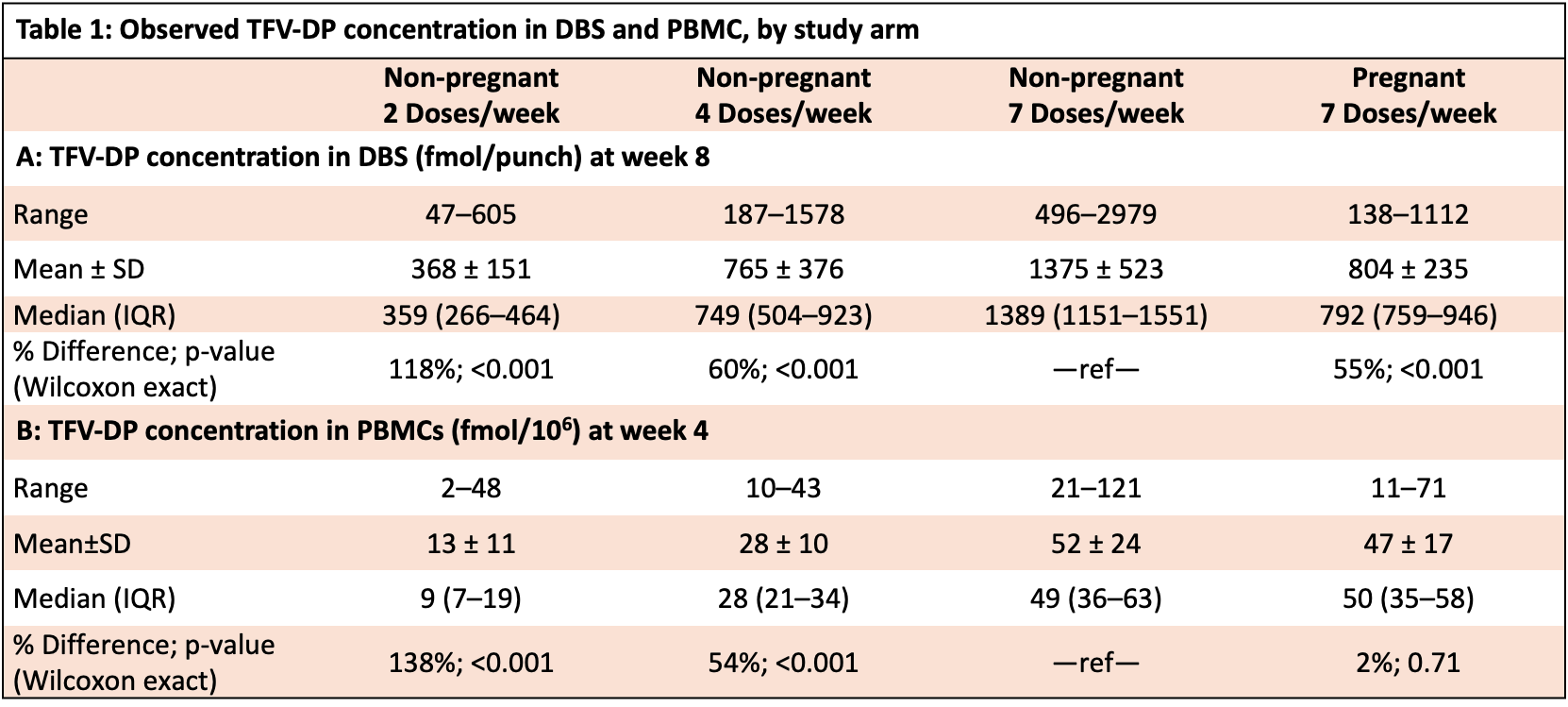
Median (IQR) age was 23 (20–25) years for nonpregnant and 23 (20–27) years for pregnant participants; baseline gestation age was 16 (14-20) weeks. TFV-DP was dose proportional in DBS and PBMCs. Observed median (IQR) week 8 TFV-DP concentrations in DBS in non-pregnant women were 359 (266–464), 749 (504–923), and 1389 (1151–1551) fmol/punch for 2, 4, and 7 doses/week, respectively (Table 1). During pregnancy, observed median (IQR) week 8 TFV-DP in DBS from daily dosing was 792 fmol/punch (759–946), similar to concentrations arising from 4 doses/week in non-pregnant women, but 55% lower than corresponding concentrations from daily dosing in non-pregnant women (p<0.001). Importantly, pregnant women achieved similar median (IQR) steady-state TFV-DP concentrations in PBMCs versus those observed in non-pregnant women on daily dosing [50 (35–58) versus 49 (36–63) fmol/10∧6, p =0.71]. TFV-DP concentrations in PBMCs for both pregnant and non-pregnant women were lower than levels (>80 fmol/10∧6) previously observed in US populations.
Conclusions:
In this adherence benchmark study among African women, TFV-DP in DBS was more than one-half lower in pregnant versus non-pregnant women, but PBMC concentrations were similar. Concentrations were lower than levels observed in US cohorts. These benchmarks will help to define women-specific concentration-efficacy relationships and accurate interpretation of HIV prevention trials in African women.