Background:
Pitavastatin reduced major adverse cardiac events (MACE) and non-calcified coronary artery plaque volume (NCPvol) among people with HIV (PWH) in REPRIEVE. However, the biological pathways responsible are not well understood. We utilized a targeted discovery proteomics approach to evaluate the biological pathways mediating statin effects on NCPvol in REPRIEVE.
Methods:
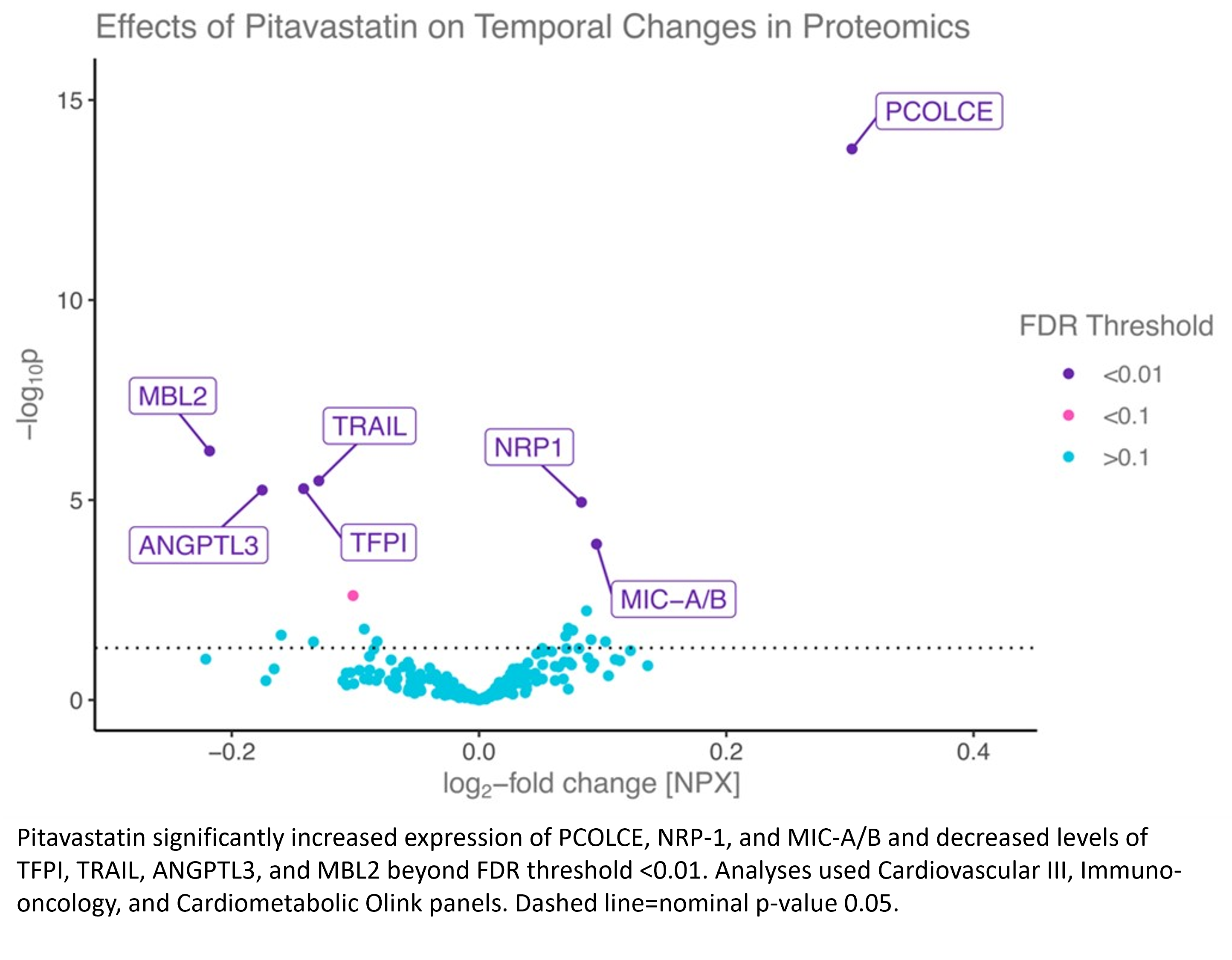
Changes in 255 plasma protein levels (Olink, see Figure 1) were analyzed among REPRIEVE mechanistic substudy participants continuing their assigned treatment over a 2-year follow-up period. Changes in protein levels were related to changes in NCPvol in mediation analysis among participants with evidence of plaque on baseline coronary CT angiography using linear regression analysis.
Results:
Among the 542 individuals (age: 51 years, 18% female) included in the assessment of protein changes, 275 received placebo and 267 pitavastatin. After correcting for false discovery rates, pitavastatin use was significantly associated with increased expression of 3 proteins (PCOLCE, NRP-1, MIC-A/B) and decreased expression of 4 proteins (TFPI, TRAIL, ANGPTL3, MBL2, Figure 1). Among the 196 participants (107 pitavastatin, 89 placebo) with plaque at entry, while pitavastatin associated changes in LDL were observed, they did not correlate with NCPvol (ρ=0.08, p=0.20). However, among the proteins changing with pitavastatin, the increase in PCOLCE was significantly related to the reduction in NCPvol (ρ=-0.27, p<0.001). Mediation analysis including PCOLCE and LDL indicated that pitavastatin resulted in a 26% [CI: 16; 38%, p<0.001] increase in PCOLCE and a 30% [CI: 23; 37%, p<0.001] decrease in LDL. While each fold increase in PCOLCE was associated with a 25% decrease in NCPvol [CI: 13; 35%, p<0.001], LDL changes had no relationship (2%, CI: -12; 18%, p=0.82). Overall, 93% of the 8.8% reduction in NCPvol was mediated through the effects of pitavastatin on PCOLCE. Other proteins were either borderline or nonsignificant in the mediation analysis.
Conclusions:
The effects of pitavastatin to reduce NCPvol in REPRIEVE were significantly mediated by changes in PCOLCE, the rate-limiting enzyme in collagen deposition. Surprisingly, LDL change was not related to changes in NCPvol. Further studies will investigate if higher levels of PCOLCE mediates the beneficial effects of pitavastatin on MACE. Statin effects on collagen formation to stabilize noncalcified plaque may be an important unrecognized mechanism to reduce coronary artery disease in PWH.