Background:
Longitudinal data on sex behaviors and STIs among Chinese PrEP users is limited. Here we reported self-reported newly diagnosed STIs and sex behaviors among MSM who are on daily and on-demand PrEP regimens in China.
Methods:
MSM in Wuhan and Guangzhou were recruited by online ads, clinic flyers, and community referrals to a PrEP demonstration trial. Behavioral survey data were collected at baseline and quarterly follow-ups over 12 months (M3, M6, M9, M12). MSM were prescribed TDF/TFC as oral PrEP and could opt for daily or on-demand regimens. Descriptive analysis and multivariable logistic regressions were conducted in Stata 15.0.
Results:
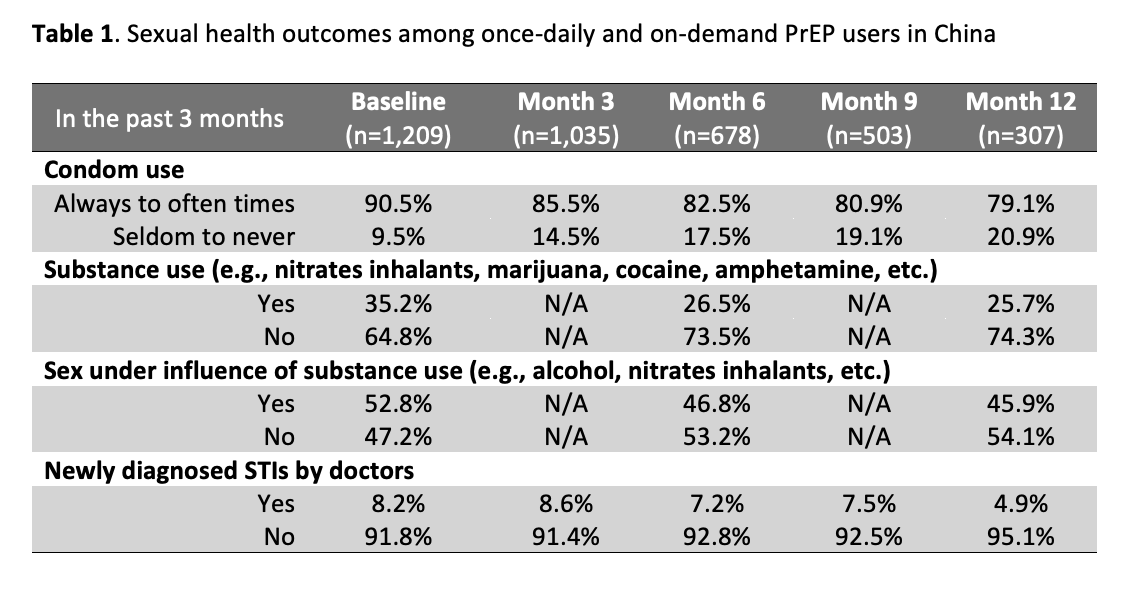
From September 2021 to September 2023, 1,209 MSM were enrolled and initiated PrEP (mean age=28.0, IQR 24.0-31.4), with 164 (16.0%) dropping out before the trial ended. About half of the participants opted for daily PrEP, while the rest chose on-demand (2+1+1). MSM reporting not having penetrative sex during the three months increased from 3.9% at baseline to 11.1% at M12 (p<0.001). Regarding condom use behaviors, we observed a notable increase of MSM reporting 'never to seldom using condoms in sex' at M9 & M12 (17.3%, 18.6%) compared to baseline (10.1%) (p<0.001). The proportion of people having sex under the influence of substance use (predominantly alcohol & nitrate inhalants) remained persistently high (52.8% at baseline vs. 46.0% at M12). The proportion of people who self-reported any STI diagnosed in the past 3 months remained 4.9 to 8.0% during the study period, with the syphilis prevalence stabling from 3.6-5.0%. Multivariate analyses indicated that PrEP dosing strategies were not associated with newly diagnosed STIs, condom use habits change, or sex under the influence of substances over time. However, MSM of higher income levels (OR=3.9, 95% CI: 1.7-9.1) and those who seldom to not use condoms (OR=3.4, 95% CI: 1.8-6.7) were more likely to report having sex while using substances.
Conclusions:
Our study results showed comparable impact on risks of STIs or sex behavior changes between once-daily and on-demand oral PrEP dosing strategies. Nonetheless, the observed increased number of MSM not having sex, less condom use habits, and persistent prevalence of engaging in sex activities under the influence of substance use underscore the evolving sexual behavior patterns within Chinese MSM PrEP users. Engaging PrEP users in routine testing and safe sex counseling is critical to the holistic health promotion of MSM communities.