Background:
Four counties within the Atlanta, Georgia 20-county eligible metropolitan area (EMA) are currently prioritized by the US ‘Ending the HIV Epidemic’ (EHE) initiative which aims for 90% reduction in HIV incidence by 2030. Disparities driving Atlanta’s HIV epidemic warrant an examination of local epidemiology, service availability, and organizational capacity to reach EHE targets. We conducted a mixed-methods evaluation of the Atlanta EMA to assess geographic HIV epidemiology and distribution of services, service needs, and organization infrastructure to implement or expand services for each pillar of the EHE initiative.
Methods:
We collected 2021 county-level data from multiple sources including: AIDSVu (HIV prevalence and new diagnoses), the Centers for Disease Control and Prevention web-based tools (HIV testing and pre-exposure (PrEP) locations), and the Georgia Department of Public Health (HIV testing, PrEP screenings, viral suppression, and partner service interviews). We additionally distributed an online survey to key local stakeholders working at major HIV care agencies across the EMA to assess availability of services, unmet needs, and organization infrastructure during June to December 2022. The Organizational Readiness for Implementing Change (ORIC) questionnaire assessed organization climate for services in need of scale-up or implementation.
Results:
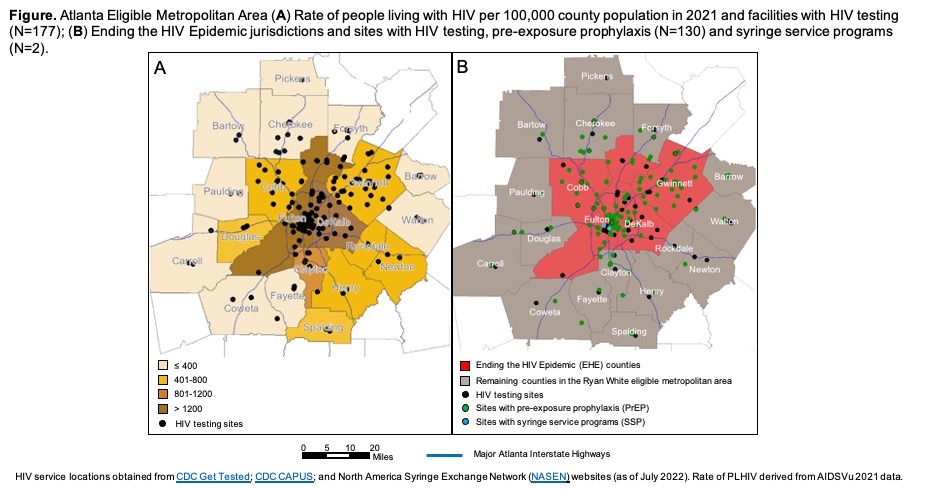
We found racial/ethnic and geographic disparities in HIV disease burden and service availability across the EMA – particularly for HIV testing and PrEP in the EMA’s southern counties. Five counties not currently prioritized by EHE (Clayton, Douglas, Henry, Newton, and Rockdale) accounted for 16% of the EMA’s new diagnoses, but <9% of its 177 testing sites and <7% of its 130 PrEP sites. Survey respondents (N=48; 52% care providers, 42% other health agency staff, 10% people living with HIV) reported high unmet need for HIV self-testing kits, mobile clinic testing, HIV case management, peer outreach and navigation, integrated care, housing support, and transportation services. Respondents highlighted insufficient existing staffing and infrastructure to facilitate the necessary expansion of services, and the need to reduce inequities and address intersectional stigma.
Conclusions:
Service delivery across all EHE pillars must substantially expand to reach national goals for metro Atlanta. High-resolution geographic data on HIV epidemiology and service delivery with community input can inform equitable strategies for local EHE efforts.