Background:
Despite recent progress in reducing HIV infections, many cities in the US are not on track to reach the ambitious targets set by the Ending the HIV Epidemic initiative. We sought to identify attainable ten-year goals for the US HIV epidemic through improved pre-exposure prophylaxis (PrEP) programming and efforts to strengthen the HIV cascade of care.
Methods:
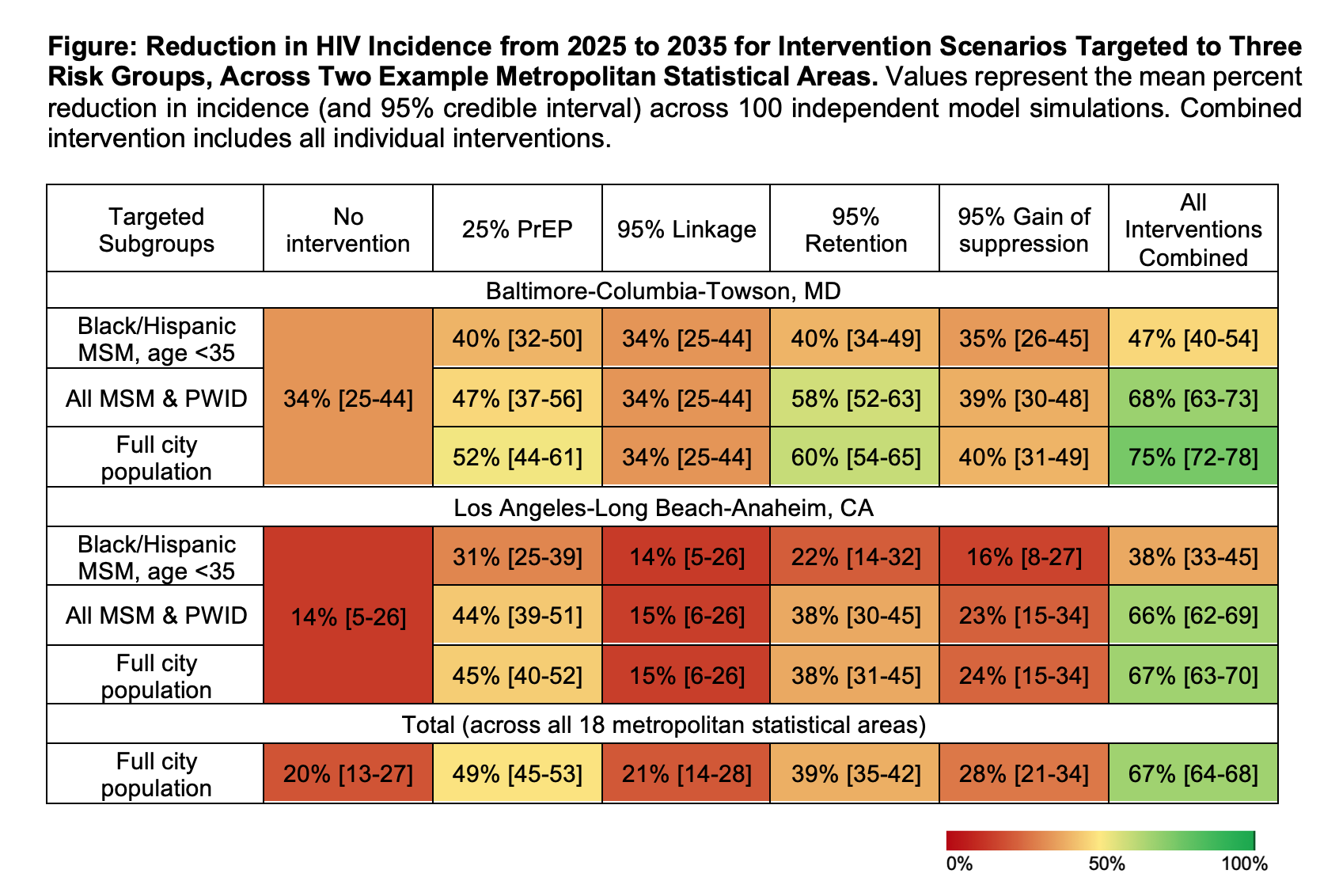
We adapted the Johns Hopkins Epidemiological and Economic Model, a dynamic model of HIV epidemics in US cities, to quantify the impact of improved PrEP coverage, linkage to HIV care, retention, and viral suppression among key risk groups across 18 metropolitan statistical areas (MSAs) in the US. Interventions were scaled up from 2025-2035 in three groups: young (age <35) Black and Hispanic men who have sex with men (MSM); all MSM and persons who inject drugs (PWID); and the full city population. Our primary outcome was the average projected reduction in HIV incidence across modeled MSAs from 2025 to 2035.
Results:
Assuming continuation of current trends in HIV transmission and care, HIV incidence was projected by fall by 20% on average across all MSAs (ranging from 14% in Dallas and Los Angeles to 46% in Detroit). Combined improvements to PrEP coverage, linkage, retention, and viral suppression provided an additional 47% reduction, resulting in an average total incidence reduction of 67% (ranging from 60% in Miami to 78% in Detroit). Among interventions considered, expansion of PrEP coverage and increasing retention in care had the greatest individual impact: averaged across all MSAs, HIV incidence was projected to fall by 49% if PrEP were scaled up to 25% of the eligible city population, and by 39% if retention in HIV care were increased to 95%. Some cites (such as Los Angeles) benefited more from improvements in PrEP coverage, while others (such as Baltimore) benefited more from increased retention. The impact of expanding interventions to different populations also varied. In Atlanta, 51% of the maximum added benefit of the combined intervention came from targeting only young Black and Hispanic MSM. By contrast, in San Francisco, 64% of the maximum added benefit resulted from expansion from this group to include all MSM and all PWID.
Conclusions:
This analysis provides information to local decision-makers as they seek to identify the combinations of interventions and risk groups that will maximize impact with limited resources in their cities, ultimately helping chart a strategic roadmap to the US HIV policy through 2035.