Background:
Persons seeking emergency injury care have high-risk profiles for HIV. While facility-based HIV Testing Services (HTS) in Kenya are effective, emergency department (ED) delivery is limited, despite the potential of this venue to reach key populations (KPs) and vulnerable populations (VPs). This study assessed impacts of the HIV Enhanced Access Testing in the Emergency Department (HEATED) program in enhancing HTS delivery for high-risk ED patients.
Methods:
The HEATED program employed evidence-based behavior-change interventions to promote ED-HTS utilizing resource reorganization and sensitization on HIV care for KPs/VPs. KPs included commercial sex workers, gay men, men who have sex with men, transgender persons, and persons who inject drugs. VPs included persons 18-24 years , interpersonal violence victims, persons with hazardous alcohol use (HAU). Data were collected in pre-implementation (6 March-16 April 2023), post-implementation (1 May-26 June 2023), with a two-week implementation period. Data were obtained from a sample of enrolled patient participants with injuries and via standard HTS records. Chi-squared tests and risk ratios were computed with Wald confidence intervals.
Results:
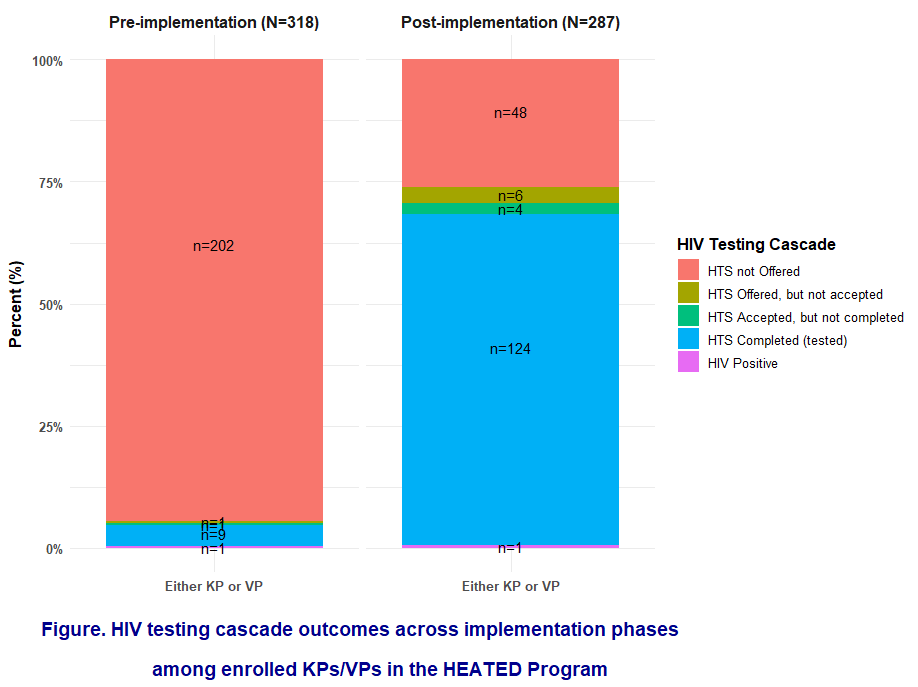
Among 2,578 injury care encounters, 2,303 (89.3%) patients were screened, 605 (26.3%) met inclusion and were enrolled. Overall, 442 (73.1%) participants identified as a KP (7.7%) or VP (89.4%). Commercial sex workers accounted for 68.4% of KPs, and interpersonal violence victims 23.7% of VPs. HTS delivery per 100 patient encounters increased significantly among KP/VP from pre- to post-implementation (RR=12.2; 95% CI: 7.50-19.68). Post-implementation, HTS delivery was significantly greater among participants identifying as a KP/VP than other enrolled participants (p=0.03). Identification of persons living with HIV (PLHIV) increased non-significantly from pre-implementation (n=26) to post-implementation (n=53) (RR=1.15; 0.73-1.87). 73% of these PLHIV were newly diagnosed, and new diagnoses increased non-significantly across phases (RR=1.26; 0.72-2.12), in addition to linkage of new diagnoses to care (RR=1.10; 0.54-2.25).
Conclusions:
The HEATED program increased HTS delivery targeting KP/VP and enhanced identification and linkage of new HIV diagnoses, suggesting that broader implementation in Kenya ED settings could support service improvement for high-risk persons already in contact with health systems, who are integral to achieving HIV control targets.