Background:
While India has made significant progress in engaging people on antiretroviral therapy (ART), people who inject drugs (PWID) living with HIV (PLWH) remain under-engaged in treatment with only ~26% on ART and 32% virally suppressed. Using geospatial data to identify geographical clusters of viremia could help find optimal locations to intervene.
Methods:
Respondent-driven sampling was used to enroll a sample of ~750 PWID in New Delhi from April-August 2023. Participants were ≥18 years and reported injection drug use in prior 2 years. Participants underwent HIV testing and provided up to 5 locations where they injected in the prior year. Viral load testing was conducted on all positive specimens. We mapped locations where PWID injected and used scan statistics to assess spatial clustering of HIV viremia (>1000 copies/mL). We explored distance from treatment centers (ARTCs) among PLWH and sociodemographic/risk behaviors associated with reporting injecting at a cluster location among PLWH with viremia using Fisher’s exact test and logistic regression.
Results:
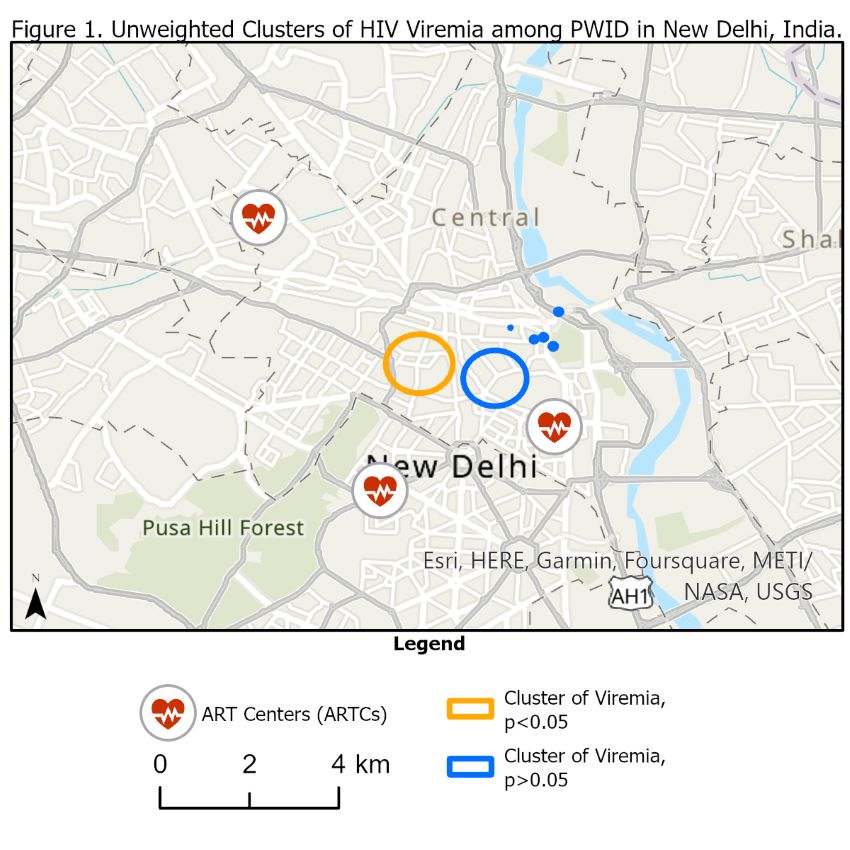
Among the 752 enrolled PWID, median age was 27, 99% were male, 66% experienced recent homelessness, 74% inject daily, and 32% of PLWH were viremic. Participants injected in places a median distance of 2.4km (IQR, 2.3 – 2.6) from ARTCs. This did not vary by viremia status. Only 39% of PLWH were previously diagnosed. Seven clusters were identified, and one (C1) was statistically significant, located near ‘Old Delhi’ (Figure 1). A higher proportion of PWID with viremia injecting in C1 reported injecting daily (94% v. 72%), missing treatment due to drug use (75% v. 29%), and a larger network size (median 60 v 12 PWID) compared to those not in C1. PWID with viremia who injected in C1 also had higher proportions of moderate/severe depression (50% v 21%) and of injecting with multiple persons over half the time (72% v 37%).
Conclusions:
In an urban setting with a growing HIV epidemic among PWID, there was a geospatial cluster of PWID with untreated HIV associated with higher levels of risk behaviors – potentially facilitating transmission. Most PWID injected daily and at least 2km from ARTCs. Finding additional areas of high viremia using other point pattern and spatial autoregressive techniques can further assess spatial associations with ARTCs. Identifying distinct geographic areas characterized by high viremia can provide targets for field-based mobile strategies incorporating testing, prevention and treatment to interrupt transmission.