Background:
Identifying transmission predictors among people who inject drugs (PWID) is vital for curbing HIV spread. We previously described the role of a particular venue on transmission of HIV among PWID in New Delhi. COVID-19 lockdowns forced PWID at this venue to return home or relocate. The impact of such regulations on HIV transmission remains unknown.
Methods:
From 2017-19 (Pre-COVID), 2,512 PWID were recruited into a dynamic cohort and followed semi-annually until March 2020. Over 1,000 participants were lost (migrated or deceased) when the site re-opened. An additional 987 PWID were recruited to replace lost participants using identical procedures between February 2022 and April 2023 (Post-COVID). In both samples, indexes initiated sampling; they recalled who they injected with in the past month and recruited them. Similarly, each recruit named and recruited their recent injection network. Biometric data was used to identify duplicates and establish cross-network links. Injection venues were captured via a survey. Individual and network factors were analyzed for associations with HIV seroconversion using Poisson regression.
Results:
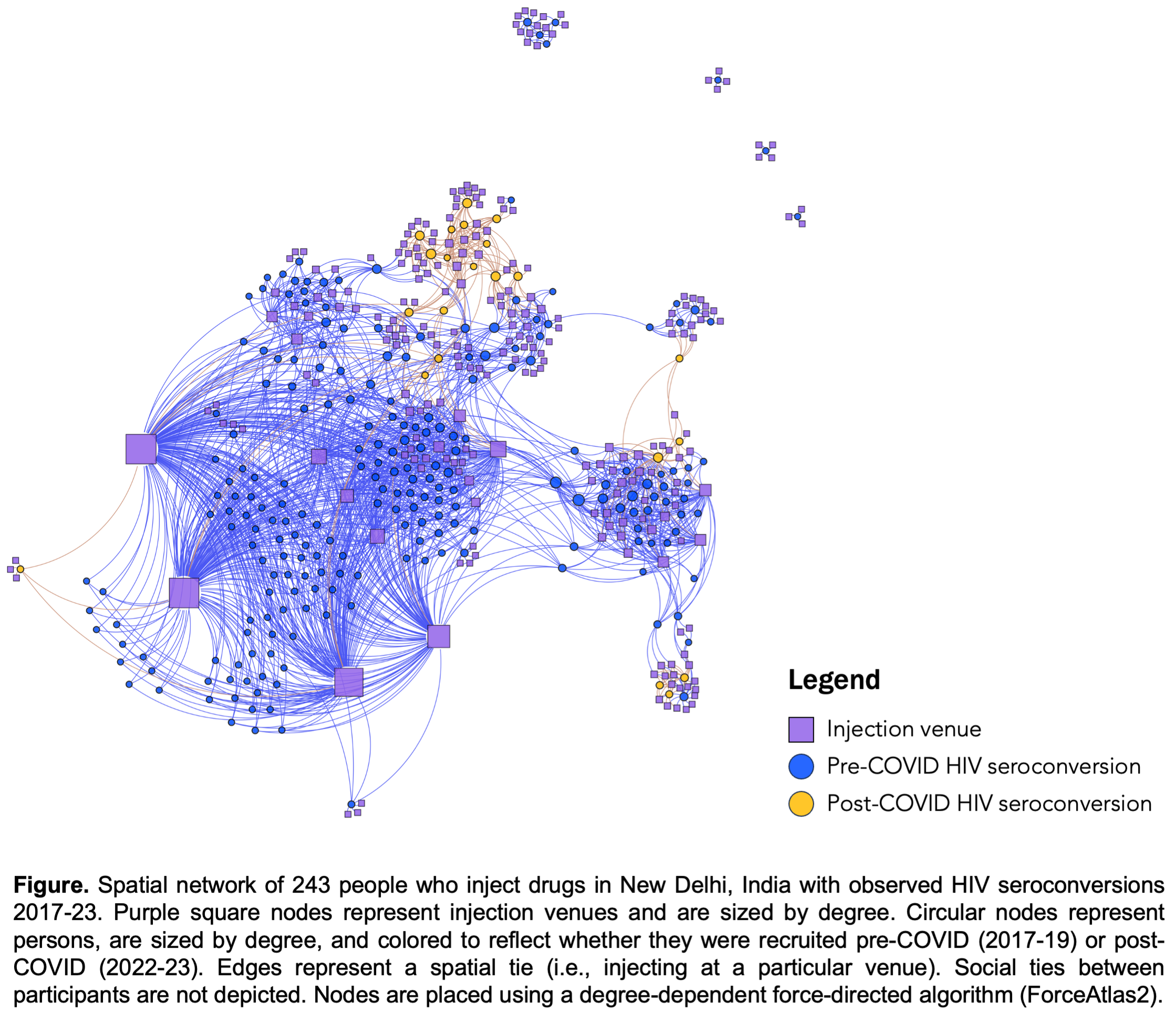
Since 2017, 3,499 PWID were recruited; 37.2% were living with HIV (37.0% and 37.6% in the pre- and post-COVID recruits, respectively). Among those without HIV, median age was 28 years; 98% were male, 69% reported daily injection and 48% reported needle sharing in the prior 6 months. 243 seroconversions were observed over 1912.5 person years (HIV incidence of 12.7 per 100 p-y); incidence in the pre- and post-COVID recruits was 13.8 and 7.3 per 100 p-y, respectively. In pre-COIVD recruits, individual and network factors, and one particular venue were predictors of seroconversion. In post-COVID recruits, depression, needle sharing, network distance to an HIV-positive person, and 19 venues were associated. Further, venues associated with seroconversion in the new recruits differed from those pre-COVID (Figure). The post-COVID network was sparser with greater diameter, path length, and fewer injection partners, featuring linear recruitment chains and fewer cross-network links.
Conclusions:
Post-COVID, the network structure of PWID was altered. HIV seroconversion in the post-COVID recruits was more strongly driven by spatial ties rather than individual-level behavior, though behaviors were largely comparable to the original cohort. The diffusion of incidence across several newer venues could signal an impending outbreak of HIV at venues that were previously low risk.