Background:
Methamphetamine (MA) is a powerful, addictive stimulant drug disproportionately used among men who have sex with men (MSM) in the United States (US). MA facilitates HIV acquisition and undermines HIV care engagement, threatening the US’s goal of Ending the HIV Epidemic. Using a large, national dataset, we examined trends and correlates of MA use among US MSM to identify which subpopulations of MSM in the US have the highest use burden.
Methods:
We used data from the 2014-2021 American Men’s Internet Survey, a serial, cross-sectional, web-based survey of cisgender MSM in the US conducted by PRISM Center at Emory University. Each year, approximately 10,000 MSM participate and provide behavioral and health data on the 12 months preceding the survey, including non-injection drug(s) used. We estimated the proportion of MSM who reported non-injection MA use in the past 12 months during each survey year. We used univariate log binomial regression to identify correlates associated with MA use and, with those variables, constructed a multivariate model. As a significantly higher proportion of MSM reported MA use in 2021 than in prior years, we repeated this analytic approach using data from only 2021.
Results:
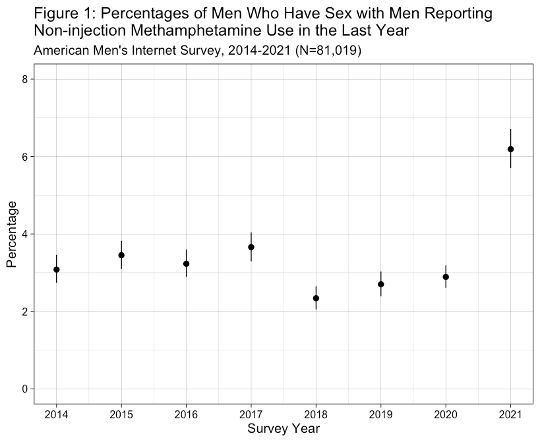
Between 2014 and 2017, the proportion of MSM who reported last-year MA use remained from 3.1%-3.7%. In 2018, that proportion dropped significantly to 2.3%, then increased to 2.9% in 2020 and more than doubled to 6.2% in 2021 (Figure 1). In the multivariate model including all survey years, last-year non-injection MA use had notable associations with: living with HIV and using antiretroviral therapy (ART, PR: 4.83 [4.43, 5.27]); living with HIV and not using ART (PR: 4.38 [3.65, 5.19]); being HIV-negative and using pre-exposure prophylaxis (PR: 1.54 [1.37, 1.72]); and Indigenous race (PR: 1.39 [1.18, 1.62]). Results were similar when limited to 2021 respondents.
Conclusions:
From 2014-2020, non-injection MA use was largely stable, followed by a sharp increase in 2021. MSM living with HIV reported the highest use burden throughout the period. Those who did not use ART reported notably high rates of MA use, signaling potential for HIV transmission to their partners. Our finding that MA use increased after the first year of the COVID-19 pandemic suggests that there is an increased need for MA prevention efforts among MSM. Future work should explore the extent to which MA use has remained high post-pandemic.