Background:
Common mental disorders are a leading global cause of disability. Little is known about the prevalence and nature of depression and anxiety symptoms among women living with HIV taking dolutegravir (DTG)-based antiretroviral treatment (ART), particularly in southern Africa.
Methods:
From March 2021 to May 2023 (a period affected by COVID-19), we enrolled women living with HIV (most on DTG-based ART at enrollment) and without HIV in the ‘Motheo’ study of child neurodevelopment and maternal mental health, in one city and one village in Botswana. At enrollment, trained staff administered the Patient Health Questionnaire (PHQ-9) and Generalized Anxiety Disorder (GAD-7) in Setswana or English. PHQ-9 score >8 was defined as probable depression (per prior Botswana data) and GAD-7 >8 as probable anxiety. For 3-category ordinal endpoints, we used PHQ-9 score 1-4 (minimal), 5-9 (moderate), and >9 (moderate/severe) for depression; and GAD-7 score 0-4 (minimal), 5-9 (moderate), and >9 (moderate/severe) for anxiety. Unadjusted and adjusted analyses were performed using GEE regression.
Results:
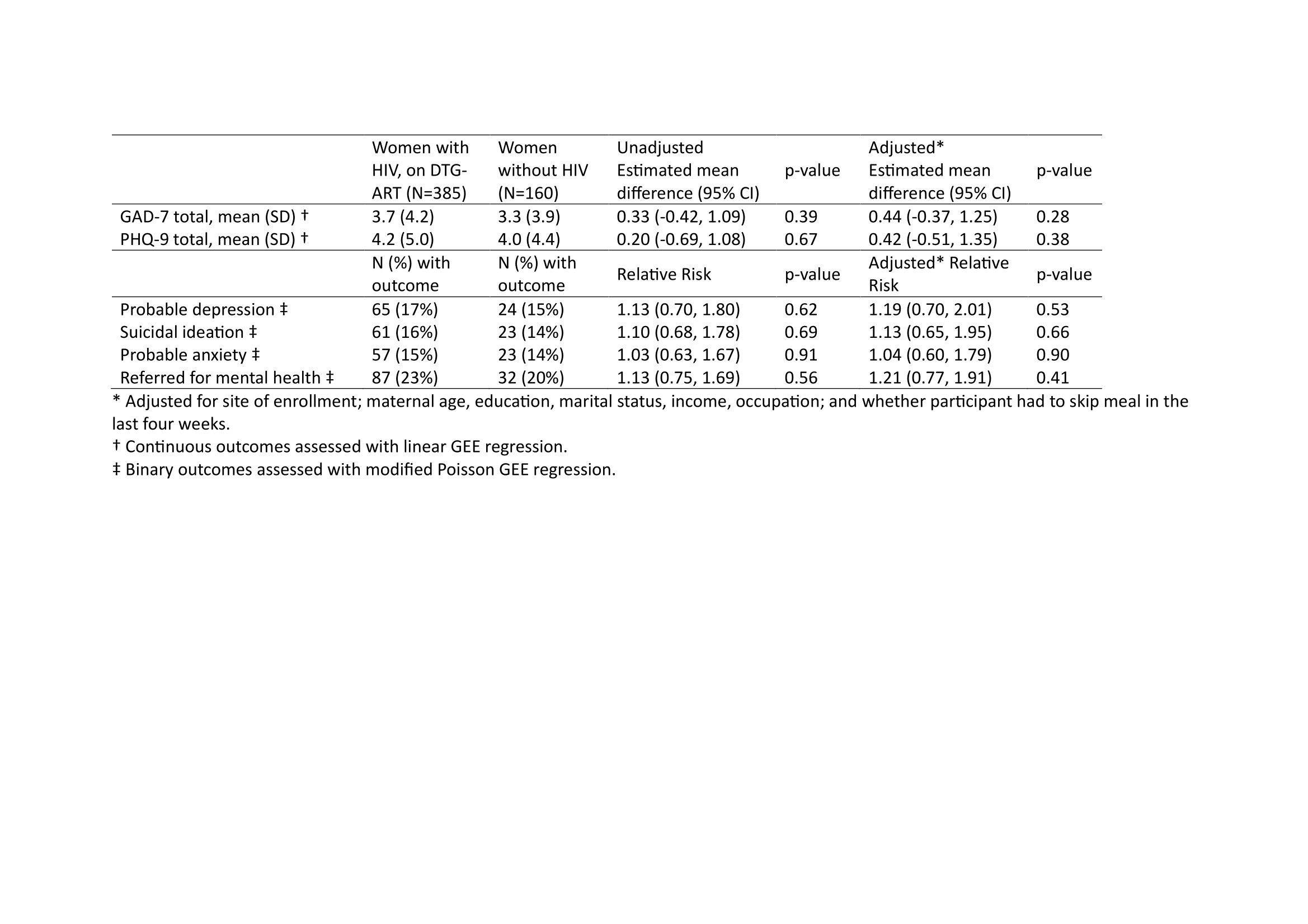
We evaluated 385 women living with HIV on DTG-based ART and 160 without HIV. Women living with HIV were older than women without HIV (mean 35 vs. 30 years) and were less likely to be from a village (31% vs. 44%) or to have completed senior secondary school or higher education (40% vs. 62%). Overall, 13% of women had scores consistent with moderate/severe depression and 8% with moderate/severe anxiety. Test scores and prevalence of probable depression or anxiety were numerically higher in (but did not differ significantly between) women living with HIV compared with without HIV: probable depression (17% vs. 15%), suicidal ideation (16% vs. 14%), probable anxiety (15% vs. 14%), and referral for mental health services (23% vs. 20%), respectively (Table). After adjustment, differences between women living with and without HIV remained non-statistically significant (Table); severity of depression and anxiety (mild/moderate/severe) also did not differ by HIV status.
Conclusions:
We observed relatively high overall prevalence of probable depression, anxiety and suicidal ideation. Compared to women without HIV, women living with HIV on DTG-based ART had numerically higher prevalence of depression, anxiety, and suicide ideation, but differences were not statistically significant We referred more than 20% of women for mental health services. Additional mental health services are urgently needed to meet the high demand.