Background:
Use of long-acting injectables (LAIs) has the potential to simplify tuberculosis preventive therapy (TPT) addressing issues such as pill burden and adherence. Rifapentine (RPT) is a key component of shorter TPT regimens and has physicochemical and pharmacokinetic (PK) properties amenable to LAI formulation. The aim of this work was to characterize preclinical performance of a new RPT single phase spray dried nanosuspension LAI for use in TPT.
Methods:
Single intramuscular dose PK profiles were first characterized in mice and rats. Based on mouse PK, 8 RPT-LAI regimens were used to evaluate bactericidal activity in a validated mouse model of TPT. RPT (93.75, 187.5, and 375 mg/kg) was administered via 1, 2 or 4 injections over 4 weeks in expectation of clearing a 0.6 μg/mL plasma target. With 3 control groups [untreated negative control; positive control daily oral isoniazid and RPT (1HP); 4 weeks of oral RPT], a total of 186 adult female BALB/c mice were used. Lung bacterial colony-forming units (CFU) counts and plasma RPT exposures were measured 2-8 weeks after the start of treatment. Group mean CFU counts were analyzed using 1-way ANOVA and plasma exposure with compartmental PK analysis.
Results:
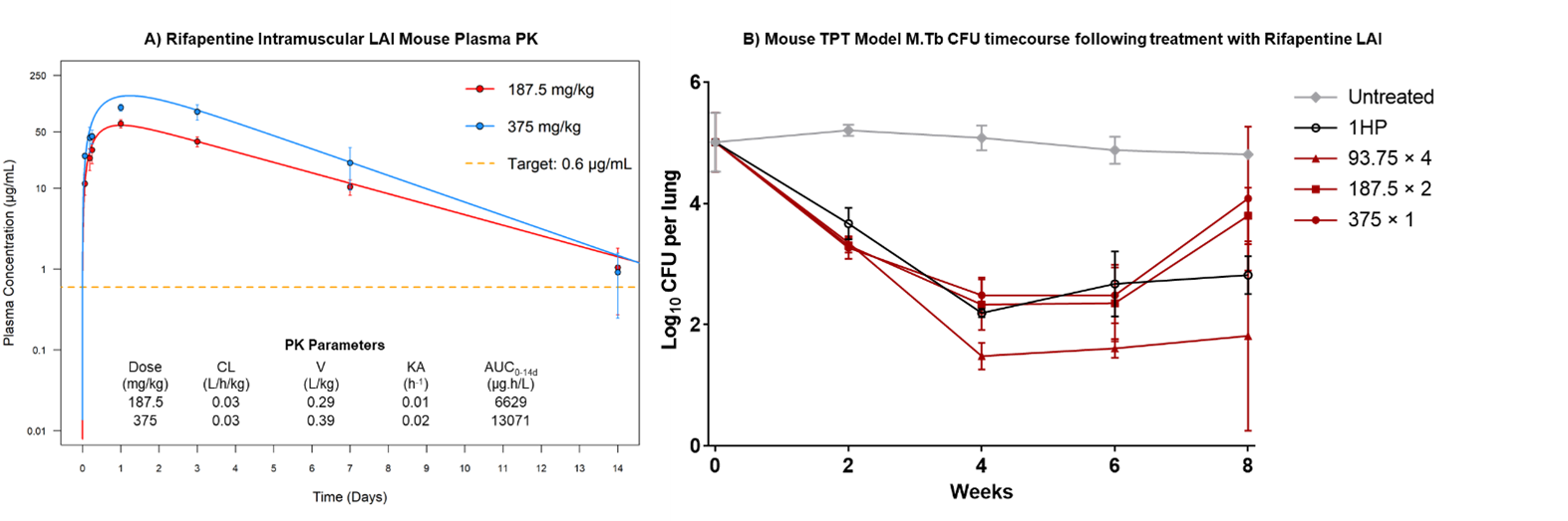
LAI-RPT demonstrated dose-linear PK for single injection doses of 187.5 and 375 mg/kg (AUC0-14d 6629 and 13071 μg·h/mL, respectively) in mice, with PK disposition parameter estimates in keeping with reported mouse RPT values and a release-dependent, ‘flip-flop’ terminal phase (Fig.1A). As for other successful LAI which demonstrate longer half-lives in larger species, longer exposure durations were observed in rats. All RPT-LAI regimens had bactericidal activity in mice, which was dose-dependent and greatest when divided into 4 weekly injections. Several regimens had bactericidal activity equal to or greater than the 1HP control regimen: 375 mg/kg x 1, 93.75 mg/kg x 2, 187.5 mg/kg x 2, 93.75 mg/kg x 4, and 46.9 mg/kg x 4 injections (Fig.1B). PK after 2nd, 3rd or 4th dose in multiple injection regimens were inconsistent with single injection PK, with plasma exposures falling below 0.6 μg/mL target by 1 week post dose.
Conclusions:
These data provide proof-of-concept for RPT-LAI to achieve efficacy comparable to 1HP in a validated mouse TPT model. Cross-species PK data suggest that efficacious RPT exposures should be achievable in humans. Further work to characterize the impact of repeat dosing on PK and conduct GLP toxicology studies to support first in human evaluation are underway.