Background:
Tuberculosis (TB) contributes to high morbidity and mortality worldwide. TB may also impair people’s quality of life (QoL) and physical fitness. We studied the change in health-related QoL and functional exercise capacity (cardio-pulmonary function) in TB patients living with and without HIV between treatment start and end.
Methods:
We recruited people with TB aged ≥15 years between October 2022 and July 2023 in five ongoing cohorts in Zambia, South Africa, Malawi, Mozambique, and Zimbabwe. At the start (baseline) and end of TB treatment, we measured physical and mental health outcomes using the standardized QoL Short Form Health Survey (SF-12), depression using the Patient Health Questionnaire (PHQ-9), and physical fitness using the 6-min walk test (6MWT). We also collected age, sex, HIV status, type of diagnosis (clinical vs microbiologically confirmed), chest X-ray findings, and TB multidrug resistance. We estimated changes in the QoL physical (QoL-PCS) and mental (QoL-MCS) t-score component, the depression score (PHQ9-S), and 6MWT distance (6MWT-D) between the start and end of TB treatment. We estimated the association of these changes with baseline characteristics using Bayesian multivariable log-linear regression models and cohort-specific random effects.
Results:
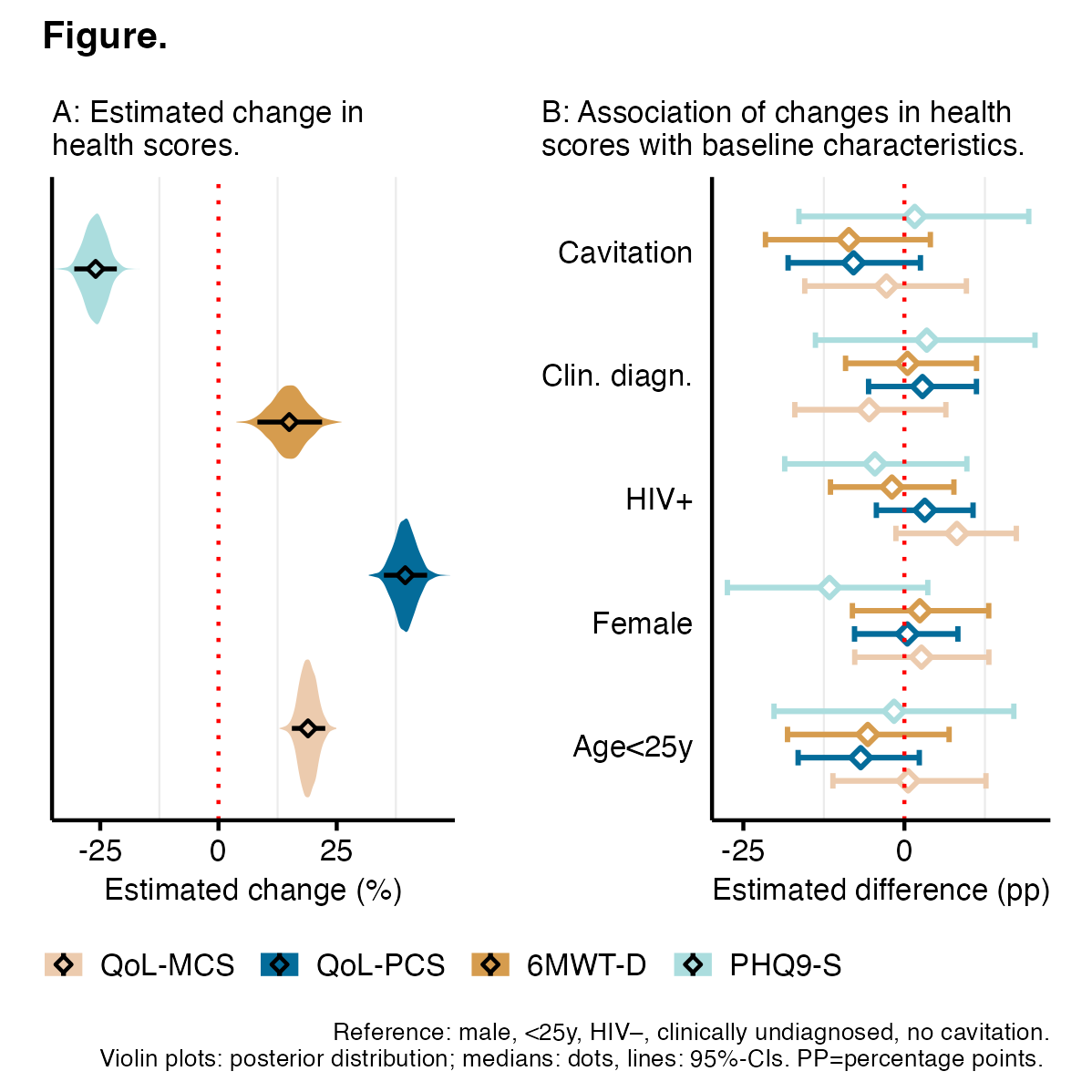
We included 200 TB patients with at least one outcome at the start and end of treatment. Overall, the median age was 36 years (Interquartile Range [IQR]: 28-43 years), 55 (27%) female, 79 (40%) living with HIV, 101 (51%) were clinically diagnosed, 34 (17%) had lung cavitations, and 3 (1%) presented with TB drug resistance. At treatment start, overall median QoL-PCS was 37 (IQR 29-43), QoL-MCS was 44 (IQR 39-50), PHQ9-CS was 6 (IQR 3-10), and 6MWT-D was 400m (IQR 332-464). QoL-PCS increased by 39% (95%-Credible Interval [CI] 35-44%), QoL-MCS by 19% (95%-CI 16-22%), 6-MWT-D by 15% (95%-CI 8-22%), and PHQ9-S decreased by 26% (95%-CI 22-31%) (Figure A). Lung cavitations tended to be negatively associated with improvements in QoL and physical fitness, and female gender was negatively associated with QoL-MCS (Figure B). Recruitment and study visits six months after completion of TB treatment are ongoing.
Conclusions:
QoL and physical fitness were reduced at the start of treatment in South African TB patients but improved by the end of treatment. More emphasis should be placed on improving clinical management with respect to QoL and mental health aspects during and after TB treatment.