Background:
Tuberculosis (TB) treatment is highly effective, but in real-world settings, >10% of TB patients experience drug toxicity or treatment failure. Current target drug levels of standard anti-TB medications (isoniazid (INH), rifampin (RIF), pyrazinamide (PZA), and ethambutol (EMB)) are based on expected levels two hours after dosing. We assessed a large Brazilian cohort of pulmonary TB patients undergoing anti-TB therapy for concomitant optimal drug levels associated with minimal toxicity and maximum effectiveness.
Methods:
Plasma drug levels from participants enrolled in Regional Prospective Observational Research in Tuberculosis (RePORT)-Brazil were used to estimate therapeutic drug range for all four anti-TB drugs. Pharmacokinetic (PK) analyses using drug concentrations and time since last anti-TB dose were performed using Extreme Gradient Boosting. The PK model was built using 10-fold cross-validation, adjusting for sex, BMI, HIV positivity, smoking and alcohol use, substance use, HbA1c, ancestry informative genetic markers, directly observed therapy assigned at baseline, and NAT2 acetylator status. Maximum drug concentrations (C[sub]max[/sub]) computed from individual PK profiles were tested for correlation with TB treatment outcomes: toxicity (Grade ≥ 3 adverse events) and treatment failure or recurrence. Safety and effectiveness bounds were defined as drug concentrations that would lead to probabilities of toxicity or treatment failure/recurrence of no more than 5%, respectively. Confidence intervals were computed after 999 bootstrap resamples. Therapeutic drug range was defined as concentrations that were both safe and effective.
Results:
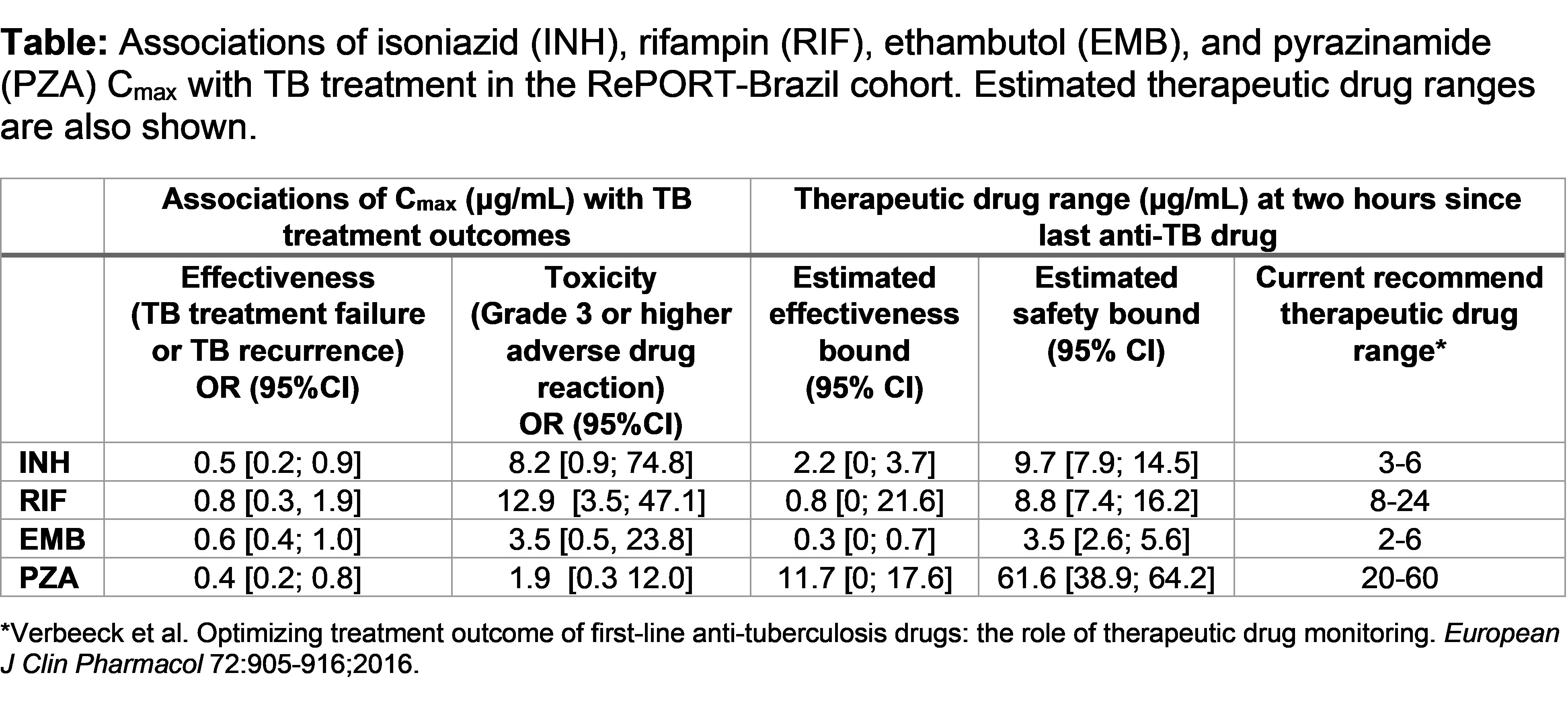
There were 966 plasma samples from 459 participants. Overall, 11 (2.4%) experienced toxicity after month 1, and 13 (2.8%) had treatment failure or TB recurrence. Log-transformed Cmax for RIF was associated with greater odds of toxicity: Odds Ratio (OR) = 12.9 [95% CI=3.5-47.1]. Log-transformed Cmax for INH, EMB, and PZA were associated with decreased odds of failure/recurrence: OR = 0.5 [0.2-0.9], OR = 0.6 [0.4-1.0], and OR = 0.4 [0.2-0.8], respectively. Therapeutic drug ranges for all four anti-TB drugs are shown in the Table.
Conclusions:
Our findings suggest target Cmax values, particularly for INH and RIF, that differ somewhat from currently recommended targets. Further studies with less variation in PK profiles are still needed to compute optimal targets for concentration ranges.