Background:
Post-acute sequelae of COVID19 or ‘Long COVID’ is a common but heterogenous condition associated with significant morbidity. Its pathogenesis remains poorly understood, with a number of different clinical phenotypes reported. We aimed to characterize host inflammatory responses by identifying inflammatory patterns and their association with demographic factors, comorbidities, and symptoms.
Methods:
In plasma from individuals with PCR-confirmed COVID-19 diagnosed with Long COVID (symptoms ≥4 weeks post-acute COVID-19), part of the All-Ireland Infectious Diseases Cohort study, we measured 57 biomarkers mapped to systemic inflammation, antiviral cytokine responses, endothelial dysfunction, tissue damage, coagulation, microbial translocation, innate immune activation, immune regulation and axonal injury using quantitative immunoassays. We used principal component analysis and unsupervised hierarchical clustering to identify distinctive biological clusters. We used Kruskal-Wallis and Chi-Square tests to explore demographic and clinical parameter differences between clusters.
Results:
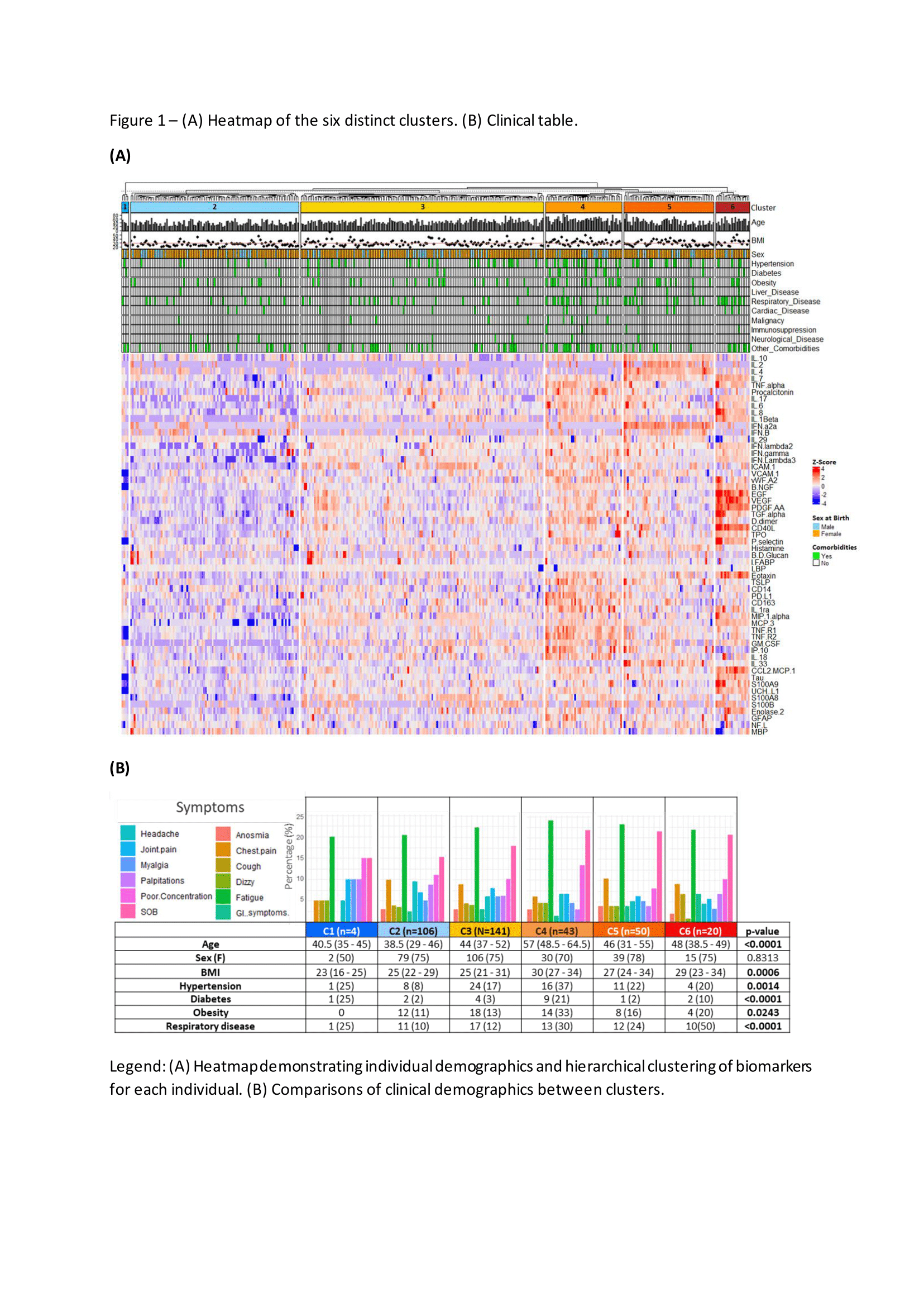
We included 364 individuals (median (IQR) age 44 (35-53) years, BMI 27 (22-32), 74% female, 85% Caucasian) in the analysis. We identified 6 distinct biological clusters (Figure 1 A). Clusters 1,2 and 3 (68,9%) exhibited low inflammatory biomarkers, lower BMI, younger age, and fewer comorbidities. In contrast, clusters 4,5 and 6 were characterized by higher inflammatory profiles. Cluster 4 characterized by higher innate immune activation markers, had the highest BMI, oldest age, and more prevalent comorbidities like hypertension and obesity, suggesting metabolic syndrome. In contrast, cluster 5 had higher anti-inflammatory (IL2, IL4, IL10) and antiviral biomarkers (IFN-α2a, IFN-B) and was relatively younger, suggesting a persistent immune response to infection. Cluster 6, mainly cardiorespiratory (60%) (Fig-1 B), and higher expression levels of tissue damage biomarkers (VEGF, EGF, PDGF, TGF-α, β-NGF), coagulation (CD40L, P-selectin, TPO, vWF), and axonal injury (S100A9, S100B, Tau, ENO2, UCH-L1) and had higher reported respiratory illness.
Conclusions:
From 6 distinct biological clusters, we identified three inflammatory clusters in individuals with long COVID with specific clinical and biological characteristics, including patterns suggesting tissue damage/coagulation and persistent antiviral immune responses. The data suggest a number of distinct underlying pathogenesis in individuals with long COVID.