Background:
Identifying Long COVID predictors is crucial. We studied associations with Long COVID in untreated adults in the ACTIV-2/A5401 trial.
Methods:
Non-hospitalized adults with COVID-19 randomized to placebo within 10 days of symptom onset were analyzed. Long COVID was defined as self-reporting overall COVID-19 symptoms as present in the 4 weeks preceding study week 24 (W24) in a long-term (LT) diary, which also assessed 27 individual symptoms. Demographics, clinical and biomarker variables at day 0 (body mass index, smoking, COVID-19 vaccination, comorbidities, symptom score summed across 13 acute symptoms each graded as absent[0]/mild[1]/moderate[2]/severe[3], anterior nasal viral RNA levels, serostatus by anti-Spike and anti-nucleocapsid antibody), and inflammatory/coagulation markers (classified as above normal or tertiles of normal values) at days 0 and 28 were evaluated as predictors of Long COVID using regression models.
Results:
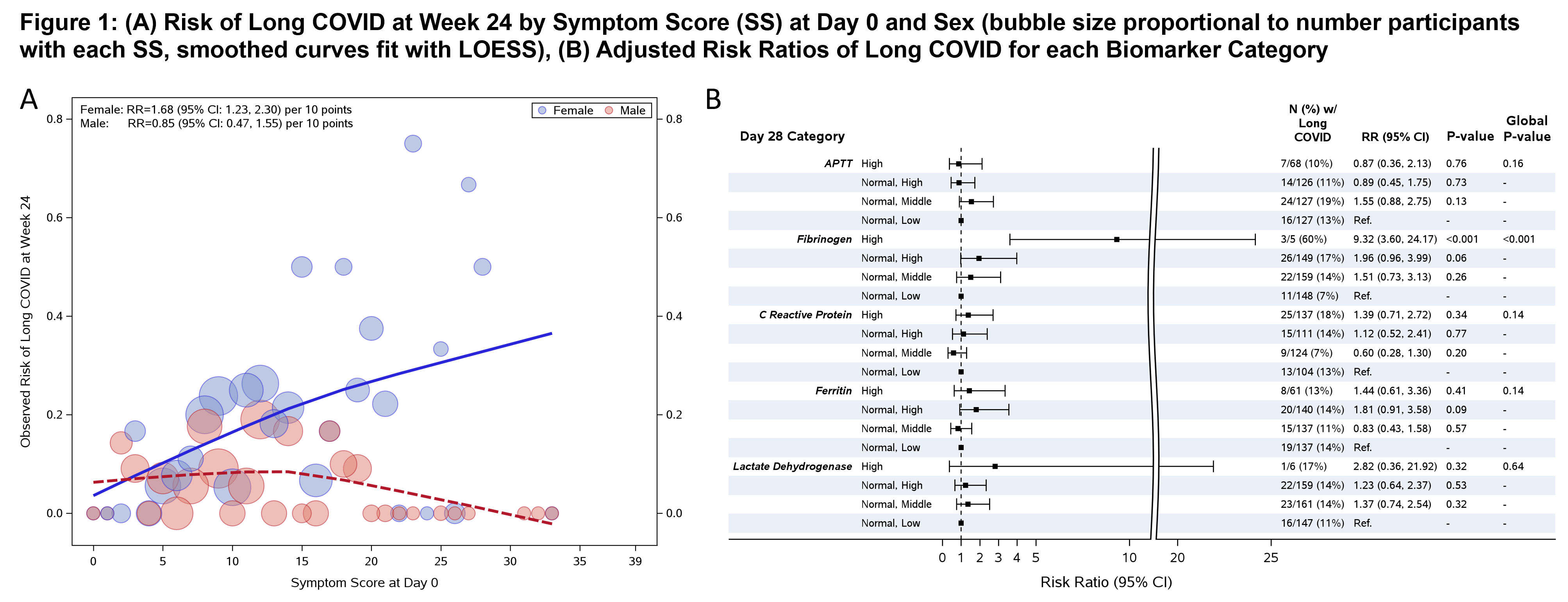
546/702 (78%) of participants who received placebo January-August 2021 completed LT diary at W24: median age 44 years, 53% female, 99% cis-gender, 13% Black, 53% Hispanic/Latino, 15% previously vaccinated, 49% seropositive. At W24, 74/546 (14%) had Long COVID, including 55/287 (19%) women and 19/259 (7%) men. Symptoms reported by ≥40% with Long COVID were fatigue (70%), musculoskeletal pain (51%), difficulty concentrating/thinking (42%), muscle weakness (42%), cough (41%), breathing difficulties (40%); most were mild. Of demographic/clinical variables, only female sex and higher symptom score at day 0 were significant predictors of Long COVID in univariable and multivariable analyses: female sex adjusted risk ratio (aRR) 2.40 (95% CI: 1.43, 4.04; p<0.001), symptom score aRR 1.45 per 10 point higher score (1.10, 1.90; p<0.009). The association of symptom score with Long COVID appeared different in women (aRR 1.68 per 10 point higher score) than men (aRR 0.85), p=0.050 (Figure 1A). Viral RNA measures and serostatus were not significant in multivariable analysis. Of other biomarkers, higher fibrinogen at day 28 was associated with increased risk of Long COVID (Figure 1B).
Conclusions:
In untreated adults with mild-to-moderate COVID-19, female sex, higher fibrinogen levels at day 28, and symptom burden at day 0 among women but not men were associated with increased risk of Long COVID. This supports sex-stratified investigations into mechanisms of Long COVID and a potential role of clotting as a risk factor.