Background:
The COVID-19 pandemic has impacted mental health among adults in the US. However, little is known about the persistence of symptoms of anxiety and depression, over the three years since the emergence of SARS-CoV-2 or the relationship between such symptoms and COVID-19 vaccination. We described the persistence of anxiety and depression among a large cohort of US adults.
Methods:
Participants from the CHASING COVID Cohort completed the Generalized Anxiety Disorder (GAD-7) and Patient Health Questionnaire (PHQ-8) at least one of 14 assessments, approximately every 3 months between July 2020 and June 2023. Persistent symptoms of anxiety or depression was defined as reported moderate/severe symptoms of anxiety (GAD-7>9) or depression (PHQ-8 >9) for >=7 assessments. Participants were classified as vaccinated (or unvaccinated) if they reported any (or never) COVID-19 vaccine between December 2020 and June 2023. We conducted multiple imputations for 18.3% missing GAD-7 or PHQ-8 scores. We used latent class growth analysis (LCGA) to identify groups of participants with shared GAD-7 or PHQ-8 trajectories over 36 months of follow-up. Chi-square tests were used to compare sociodemographic factors among those with and without persistent symptoms of anxiety/depression and by LCGA groups. At each time point, log-binomial models were used to estimate the age- and gender-adjusted prevalence of moderate/severe anxiety or depression stratified by vaccination status.
Results:
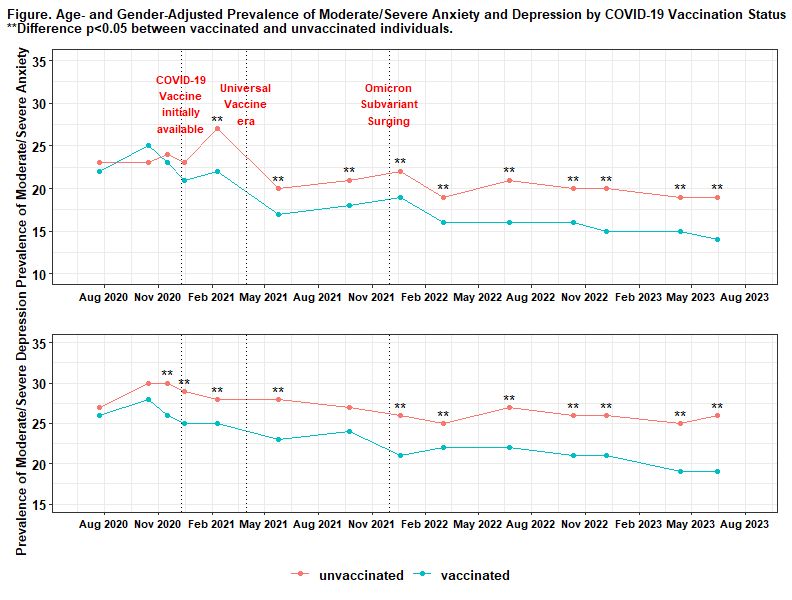
Among 5652 participants, prevalence of persistent symptoms of anxiety or depression was 19.0% (N=1074) and 22.8% (N=1288) over 36 months, respectively. Using LCGA model, 26.7% (N=1509) and 26.8% (N=1516) of participants had persistently high trajectory of GAD-7 or PHQ-8 over 36 months. Participants who were young, female, non-White, socioeconomically disadvantaged, and unvaccinated were more likely to have persistent symptoms of anxiety/depression or persistent high trajectory of GAD-7/PHQ-8. After COVID-19 vaccines became universally available, the adjusted prevalence of moderate/severe anxiety or depression symptoms decreased among vaccinated individuals compared with unvaccinated (Figure). These differences were sustained over the duration of follow-up.
Conclusions:
Further investigations are warranted to elucidate bidirectional relationships between COVID-19 vaccination and mental health symptoms, including the extent to which moderate/severe mental health symptoms may be a barrier to staying up to date on COVID-19 vaccination.