Background:
Integrase strand transfer inhibitor (INSTI)–based antiretroviral therapies are associated with greater weight gain than non-nucleoside reverse transcriptase inhibitor– or boosted protease inhibitor (PI)–based regimens, and these effects disproportionately impact Black and Hispanic individuals and women living with HIV-1. DEFINE is the first prospective, randomized trial to explore the impact of switching from an INSTI-based regimen to a PI-based regimen to mitigate or reverse INSTI-related weight gain. As previously reported, the primary Week 24 analysis found no significant difference in percent change in body weight from baseline when switching to darunavir/cobicistat/emtricitabine/tenofovir alafenamide (D/C/F/TAF) compared to continuing INSTI+tenofovir alafenamide (TAF)/emtricitabine (FTC).
Methods:
DEFINE (NCT04442737) is a randomized (1:1), prospective, 48-week, active-controlled, open-label, multicenter phase 4 study evaluating switching to D/C/F/TAF versus continuing INSTI+TAF/FTC in virologically suppressed adults with HIV-1 who had ≥10% weight gain while on the INSTI-based regimen. The primary objective was to assess percent change in body weight from baseline to Week 24. Metabolic and biomarker data through Week 24 are reported in this analysis.
Results:
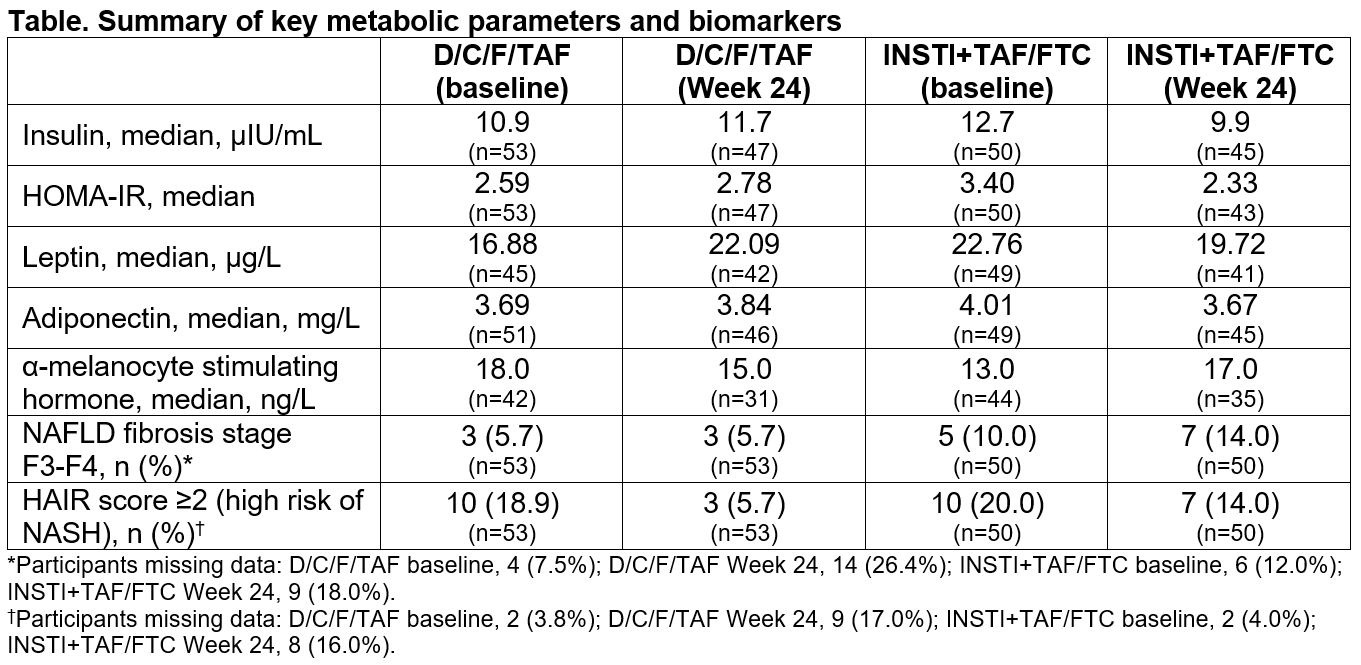
Among the 103 adults who were randomized to D/C/F/TAF (n=53) or continued INSTI+TAF/FTC (n=50), 30% were female, 61% were Black/African American, and the median BMI was 32.7 kg/m2. Consistent with the primary endpoint, at Week 24 most participants remained classified as obese (D/C/F/TAF, 53%; INSTI+TAF/FTC, 70%) and had experienced minimal BMI and waist circumference changes. Glucose and HbA1c values remained largely unchanged through Week 24; however, there were small decreases in insulin and HOMA-IR values in the INSTI+TAF/FTC arm (Table). No participants in either arm decreased medication dosages or entirely stopped lipid-lowering, anti-glycemic, or anti-hypertensive medications through Week 24. Changes in leptin, adiponectin, and α-melanocyte stimulating hormone were minimal in both arms, as were changes in NAFLD fibrosis score. The percent of participants at high risk of NASH by HAIR score decreased in both arms.
Conclusions:
Consistent with the minimal body weight changes observed through Week 24, metabolic and biomarker data remained relatively stable. Metabolic parameters in this high-BMI population did not improve following antiretroviral switch, highlighting that weight gain should be a pretreatment consideration.