Background:
Weight gain has been reported among people with HIV (PWH) after transitioning to tenofovir, lamivudine, and dolutegravir (TLD) antiretroviral therapy (ART). However, the contribution of changes in diet and physical activity to weight gain in this population remains poorly understood. We estimated relationships between diet, physical activity, and clinically significant weight gain over 48 weeks among PWH in South Africa after transitioning to TLD.
Methods:
The DISCO cohort study followed 500 PWH at four public-sector clinics in KwaZulu-Natal, South Africa. Eligible participants were >18 years of age and on efavirenz-based, first-line ART for >6 months before transitioning to TLD by clinic staff. Anthropomorphic, diet, and physical activity data were measured at enrollment, 24-week, and 48-week study visits. Our primary exposures of interest were change in four dietary and exercise behaviors over 48 weeks: (1) fruit consumption, (2) fast-food consumption, (3) sugar-sweetened beverage (SSB) consumption, and (4) physical activity (in metabolic equivalent-minutes/week). Our primary outcome was clinically significant weight gain, defined as ≥10% increase in weight from baseline to 48 weeks. We estimated differences in each exposure by presence versus absence of weight gain using multivariable logistic regression models adjusted for age, sex, education, and ART duration.
Results:
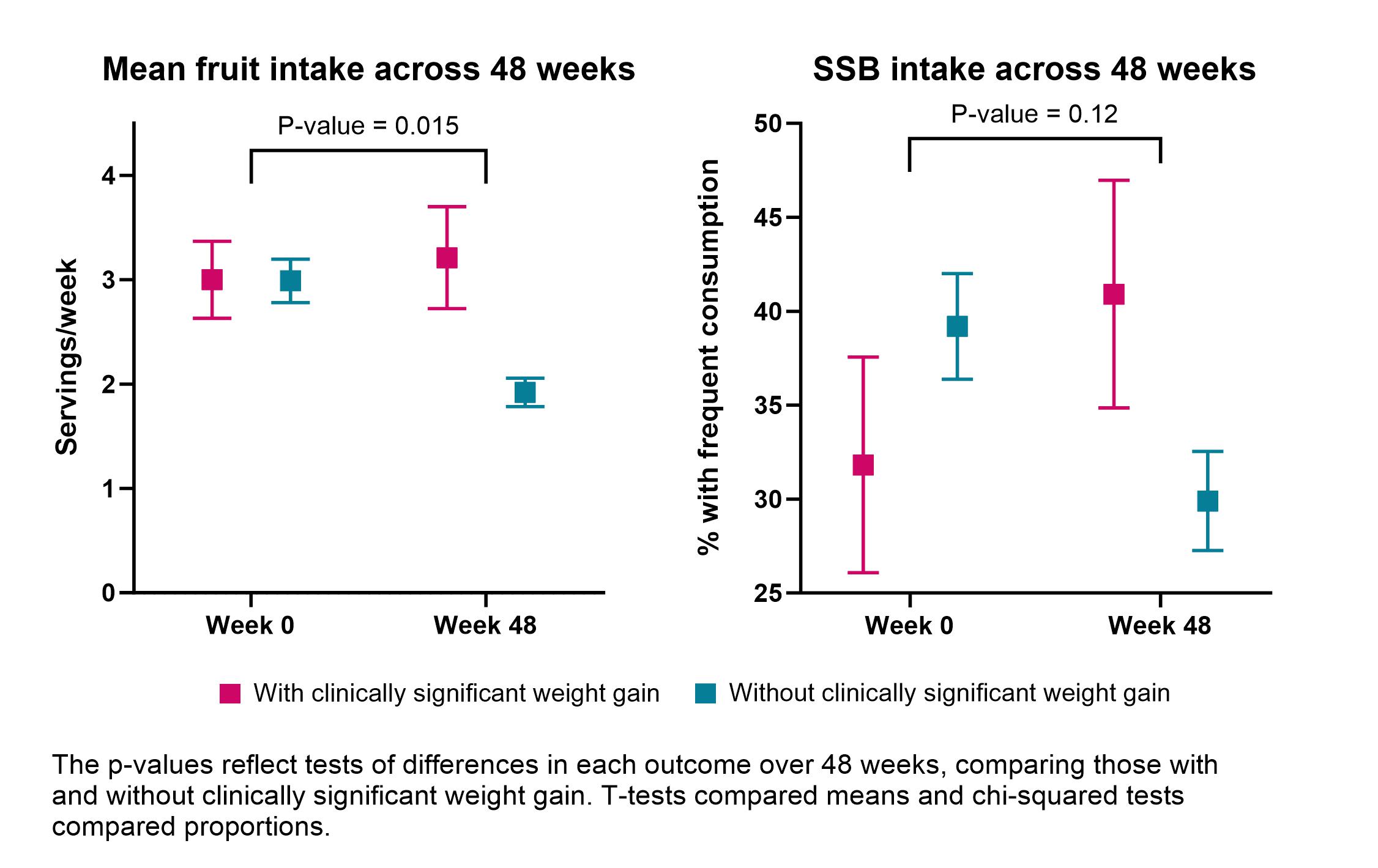
We analyzed data from 367 PWH having a mean age of 43 (standard deviation = 12) years and 78% women. People with clinically significant weight gain had an increase in fruit intake while those without clinically significant weight gain had decreased intake (0.21 servings/week [95% CI: -0.9 to 1.3] v. -1.07 servings/week [95% CI: -1.5 to -0.7], respectively) (p=0.015), but there were no significant differences in frequency of fast-food intake, frequency of SSB consumption or physical activity (Figure 1). In adjusted models, change in fruit intake remained significantly associated with clinically significant weight gain over 48 weeks ([95% CI: 1.0 to 1.1], p=0.033).
Conclusions:
Clinically significant weight gain was associated with increased fruit intake but not with other dietary or physical activity changes over 48 weeks after transitioning ART. Interventions to modify behavior in this population may have a limited role in mitigating clinical obesity. Pharmacological interventions to mitigate clinical obesity in this population may be needed.