Background:
Initiating or switching to integrase strand-transfer inhibitors (INSTIs) for HIV is associated with body weight gain, particularly in women. However, the specific mechanisms driving this effect remain unclear. Previous findings have implicated omega-6-derived poly-unsaturated fatty acids (PUFAs) as potential mediators of increased adiposity in people without HIV. This study investigated the relationship between INSTI-associated weight gain and plasma oxylipins, downstream PUFA metabolites, in women living with HIV (WLH) by utilizing a targeted lipidomics approach in a longitudinal design.
Methods:
Virologically suppressed (<200 c/mL) WLH from the Atlanta Women's Interagency HIV Study (WIHS) on antiretroviral therapy were grouped based on INSTI usage and weight change during the follow-up period (weight gain defined as ≥5% change, or weight maintenance as <5% change from baseline). We leveraged stored blood samples collected at three time points: 6-12 months before switching to or adding INSTI (baseline), 1-6 months post switch/add, and 1-2 years post switch/add, with comparable time points in the non-INSTI group. Targeted lipidomics assessed 40 oxylipins via liquid chromatography-mass spectrometry, and differences between groups assessed using linear mixed models.
Results:
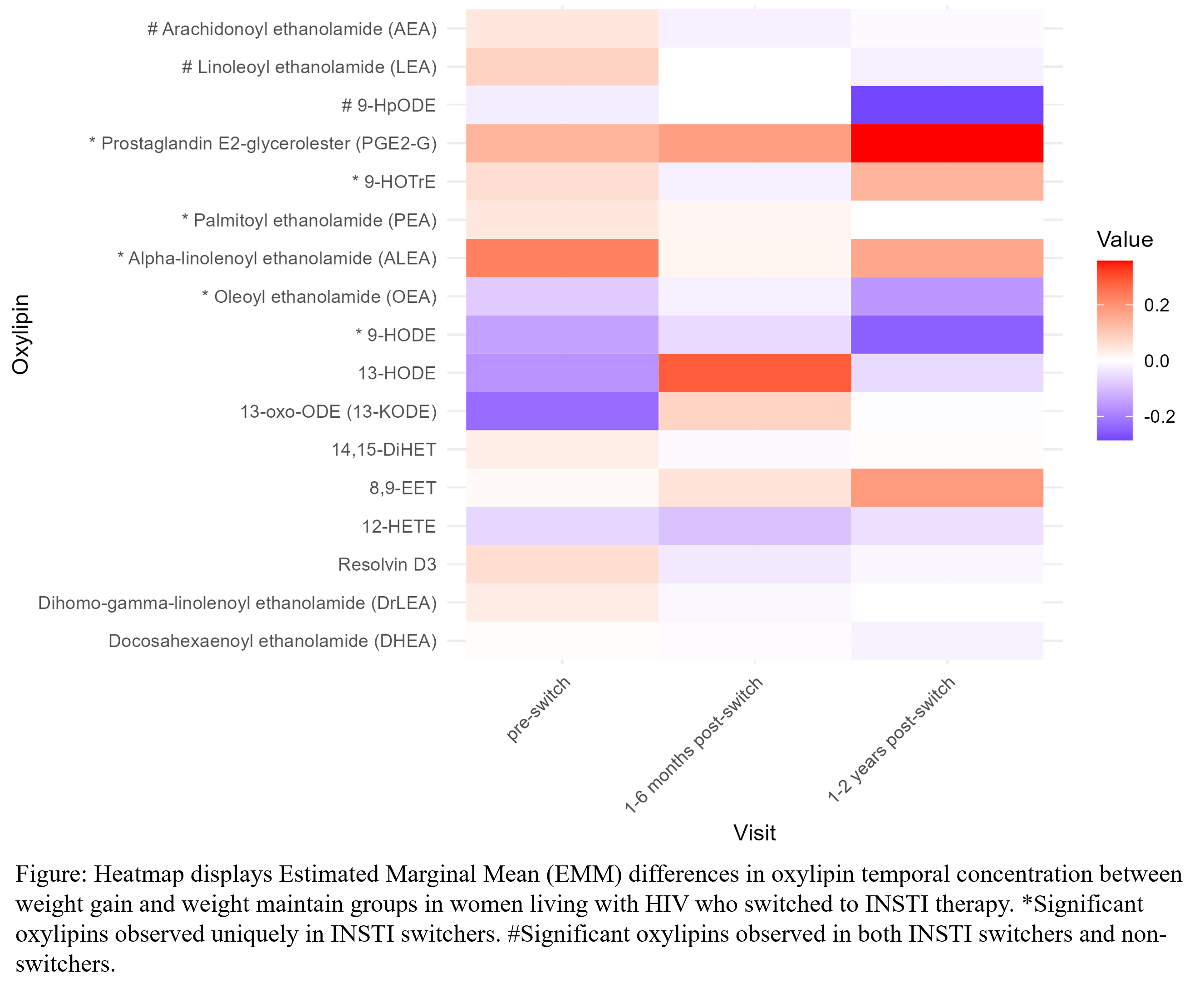
Sixty women, aged 28-62 years, were included (n=33 INSTI, n=27 non-INSTI) with n=15 weight gainers in the INSTI group and n=9 weight gainers in the non-INSTI group. Fifty-six women identified as Black, 3 as White, and 1 as Hispanic. Within the INSTI group, nine oxylipins differed between weight gainers and maintainers over time (p-value < 0.05, Figure). Three oxylipins, linoleoyl ethanolamide (LEA), arachidonoyl ethanolamide (AEA), and 9-HpODE also differed between weight gainers and maintainers among women in the non-INSTI group. Six oxylipins were unique to those who switched to INSTI, including α-linolenoyl ethanolamide (ALEA), palmitoyl ethanolamide (PEA), oleoyl ethanolamide (OEA), 9-HODE, 9-HOTrE, and prostaglandin E2 glycerol ester (PGE2-G).
Conclusions:
Employing a targeted lipidomics approach, six oxylipins were linked to INSTI-associated weight gain in WLH. Among these oxylipins, ALEA and OEA have been previously implicated in weight gain processes in healthy adults, while 9-HODE and 9-HOTrE have been linked to weight gain in mouse models. Further research is needed to identify oxylipin profiles unique to INSTI usage and to determine potential underlying biological mechanisms for INSTI-associated weight gain.