Background:
While statins for primary prevention reduce cardiovascular events, persons with HIV (PWH) have increased risk of cardiovascular disease, likely linked to persistent inflammation. Studies on immune drivers of atherosclerosis among PWH are needed to define additional therapeutic targets.
Methods:
We obtained thoracic aorta from diseased PWH (n=3) and without HIV (n=14). Autopsies were performed within 25 hours of death. The donors with HIV included 1 female (Caucasian) and 2 males (Caucasian and Hispanic) ages 52, 65 and 72. Exclusion criteria included known autoimmune disease. We used droplet digital polymerase chain reaction (ddPCR), western blot and immunohistochemistry to detect and quantify HIV. We used spatial transcriptomics (Visium) and metabolomics to define differences in aorta by HIV status (n=4 per group). Differentially expressed genes were identified using the Loupe Browser 6 software, based on their statistical significance and fold change computed using the negative binomial test. Genes with adjusted p-values, FDR < 0.05, were considered significantly different. Global metabolomic profiling of aorta was performed using ultrasensitive Hydrophilic Interaction Liquid Chromatography-Mass Spectrometry (HILIC-MS). We detected over 320 metabolites in both (+) and (-) ionization modes. Analysis was performed using MetaboAnalyst 5.0.
Results:
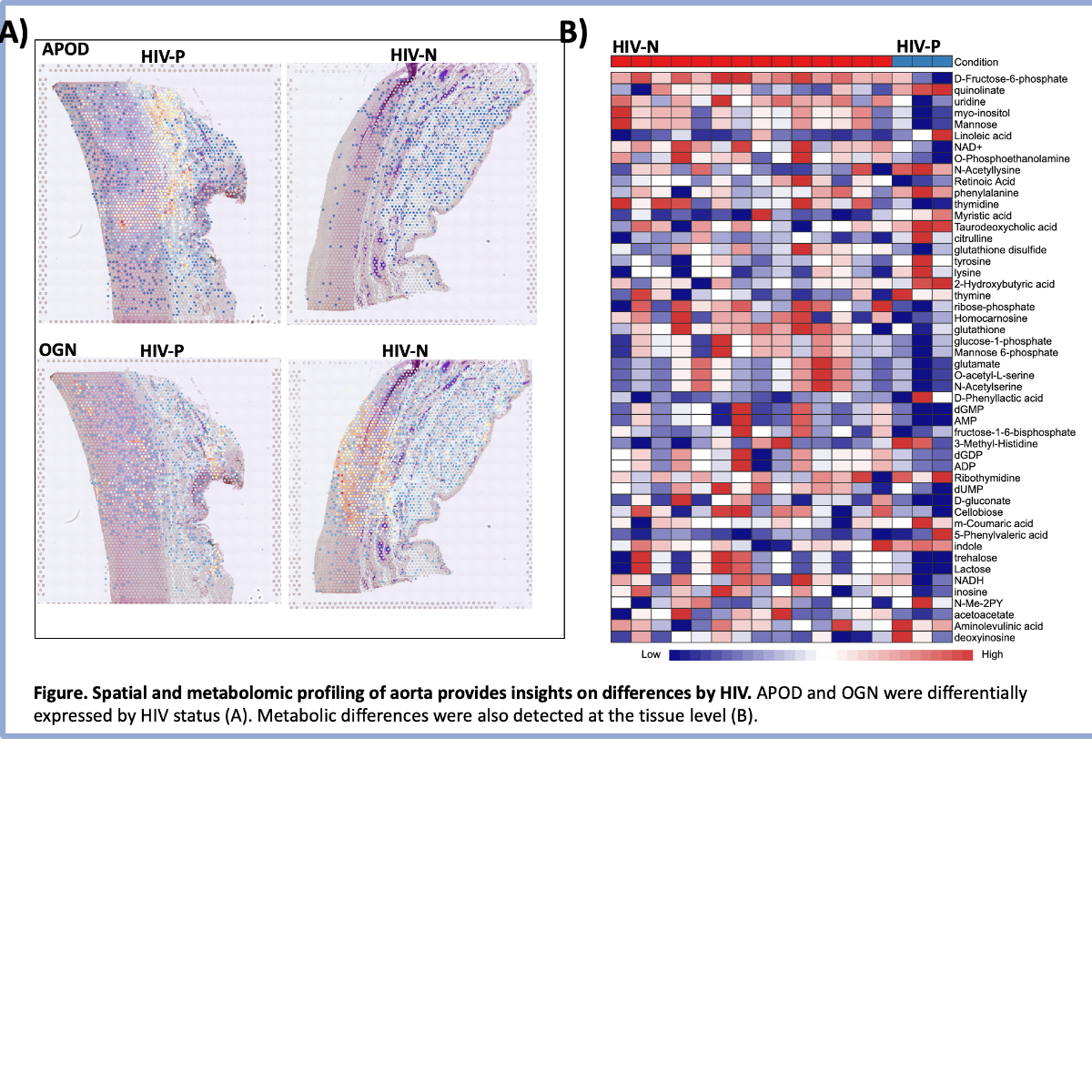
As expected, we detected HIV in aorta from all donors with HIV and not in those without HIV. Using spatial transcriptomics, several genes were differentially expressed by HIV status. Apolipoprotein D (APOD), a lipocalin associated with premature atherosclerosis and poor outcomes in persons with coronary artery disease was significantly higher in the aorta of all donors with HIV (n=4). Osteoglycin (OGN), a gene linked with vascular calcification, was higher in donors without HIV (Panel A). Both genes were expressed mainly by fibroblasts while APOD was also expressed in endothelial cell clusters. Metabolomic analysis of the aorta also showed differential expression of different metabolites (Panel B) with higher Linoleic acid in all three aorta samples from donors with HIV compared to donors without HIV.
Conclusions:
APOD has been associated with poor outcomes in coronary artery disease, and may be a therapeutic target in persons with HIV. A comprehensive multimodal approach to investigating atherosclerotic cardiovascular disease in HIV is likely to provide new therapeutic targets.