Background:
T cell immunity is important in controlling KS herpesvirus (KSHV) disease progression. We evaluated T cell responses to KSHV and associations with pre-treatment clinical characteristics and outcomes in 2 ACTG/AMC studies (A5263/AMC066; A5264/AMC067) of KS treatment in resource-limited settings.
Methods:
T cell ELISPOT responses (log10 spot-forming units [SFU]/10^6 cells) to 2 latency (LANA, K12) and 2 lytic (gB and K8.1) KSHV and to HIV Gag peptides were measured from 49 advanced KS (A5263/AMC066) and 94 mild/moderate KS (A5264/AMC067) participants with samples. In A5264/AMC067, we also measured T cell PD-1 expression by flow cytometry. Wilcoxon rank-sum and Fisher’s exact tests were used.
Results:
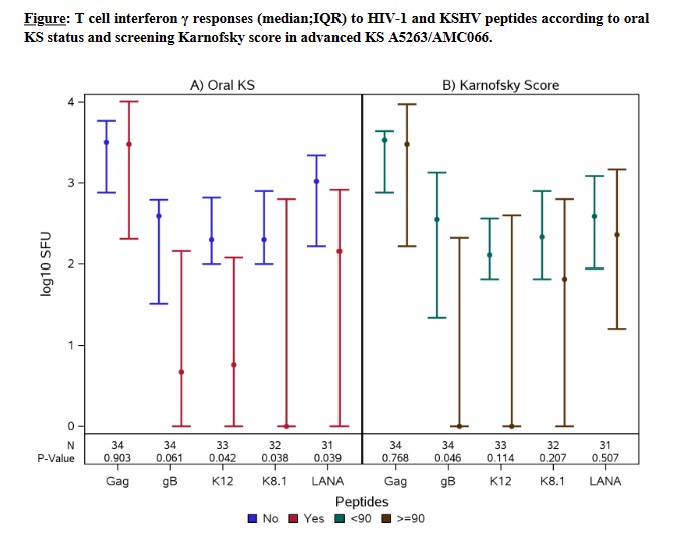
At entry, median age was 34; mostly male and black African. Median CD4 count was 250 and 190 cells/mm3, and median plasma HIV-1 RNA was 3.5 and 5.1 log10 cps/mL in advanced and mild/moderate KS, respectively. Advanced KS participants with oral KS had lower baseline responses to K12 (median: 0.76 vs 2.30 log10 SFU; p=0.042), K8.1 (0 vs 2.3 SFU; p=0.038), and LANA (2.15 vs 3.02 SFU; p=0.039) than those without. In mild/moderate KS, a higher proportion of participants without oral KS had positive response to LANA (65% vs. 19%; p=0.013). Advanced KS participants with Karnofsky scores (KPS) <90 had higher gB responses than those with KPS ≥90 (median: 2.55 vs 0 SFU; p=0.046). Similarly, in mild/moderate KS, a higher proportion of participants with KPS <90 had detectable responses to gB (63% vs. 21%; p=0.040). Despite strong responses to Gag, this response was not associated with oral KS or KPS. There was a trend for mild/moderate participants with screening T0 KS stage to respond to gB compared to those with T1 stage (54% vs 17%; p=0.056). Mild/moderate participants with oral KS had a trend for higher %PD1+CD8+ T cells (median 18.45% vs 14.40%; p=0.074) than those without. At 12 weeks, a higher proportion of mild/moderate participants without early KS disease progression had a drop in %PD-1+CD4+ (74% vs 21% with early disease progression; p=0.002) and %PD-1+CD8+ T cells (89% vs 57%; p=0.042). KSHV T cell responses were not associated with clinical outcomes in either study.
Conclusions:
In advanced and mild/moderate KS, pre-treatment KSHV-specific T cell responses were associated with several pre-treatment clinical characteristics. In mild/moderate KS, decreased T cell exhaustion was associated with less early KS disease progression. This supports T cell immunity’s importance in controlling KS.